Site Readiness (MIA/WDA) · 7 min read
What Triggers an MHRA Inspection?
A senior QP guide to MHRA inspection triggers - from risk-based cycles and new applications to recalls, CAPA failures and data integrity signals.
By Balasubramanian Ramaiah · 9 June 2026 · Updated 29 July 2026
Knowing the MHRA inspection triggers that put your site on the regulator's radar is one of the most practical pieces of intelligence a quality team can hold. An inspection is rarely random: it is the predictable output of a risk-based system that weighs your licence type, your compliance history and the signals your own data sends to the regulator. Understand those inputs and you can shape them long before an inspector confirms a date.
The risk-based logic behind MHRA inspection triggers
The MHRA does not inspect every licensed site on a fixed legal interval. Instead it operates a risk-based inspection programme, setting the frequency and depth of each visit according to the hazard a site presents and how well it has historically controlled that hazard. This approach is consistent with the quality risk management thinking set out in ICH Q9 and the lifecycle expectations of ICH Q10: regulatory effort follows risk.
In practice the agency builds a risk picture of each site from several inputs and then prioritises accordingly. The triggers below are not a ranked checklist; they interact. A single moderate signal may simply shorten your next routine interval, whereas a cluster of signals, or one serious event, can prompt an unannounced or for-cause visit. The discipline for any MIA or WDA holder is therefore to manage every input deliberately rather than to react once a trigger has already fired.
An inspection date is a lagging indicator. By the time it lands, the conditions that prompted it have usually been visible in your own quality data for months.
Routine, scheduled and licence-driven triggers
The most common reason for an inspection is simply that you are due one. Licensable activity creates a standing obligation to be inspected, and the interval is set on risk rather than on a calendar rule.
New applications and variations
A new Manufacturer's/Importer's Authorisation (MIA) or Wholesale Dealer's Authorisation (WDA) almost always attracts a pre-approval inspection to confirm the site matches the activities applied for. Significant variations such as adding a new dosage form, a sterile capability, a new site or a major change of scope frequently trigger a fresh inspection of the affected area before approval. If you are preparing such an application, our site readiness service exists to confirm the facility and quality system can withstand that first visit.
Risk-based re-inspection cycles
Established sites are re-inspected on a periodic, risk-adjusted rhythm. A strong inspection history and lower-risk operations can lengthen the interval; higher-risk products such as sterile injectables, biologicals or controlled drugs tend to shorten it. The cycle is dynamic, so a clean record is itself a tool for reducing inspection burden over time.
Compliance-history and for-cause triggers
Beyond the routine cycle, specific events can bring an inspector to your gate sooner, more deeply, or without notice. These for-cause triggers are where most sites are genuinely tested, because they are unplanned and narrow in scope but forensic in depth.
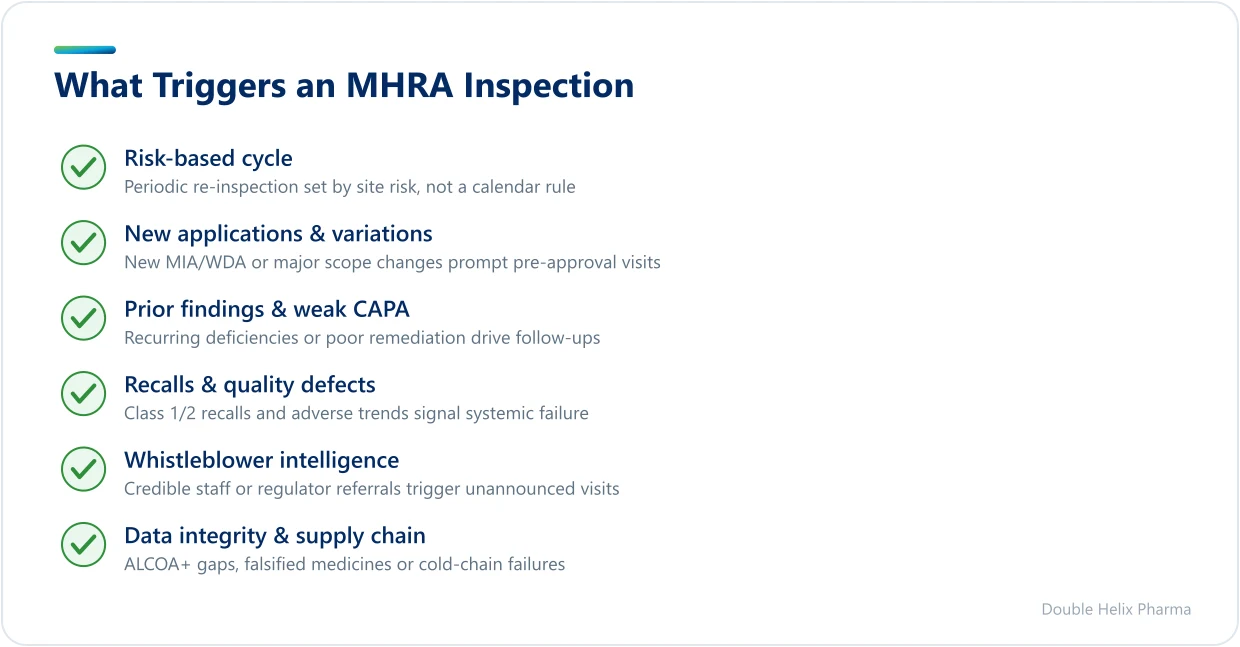
- Previous inspection outcomes: unresolved or recurring deficiencies, a weak corrective and preventive action (CAPA) response, or critical and major findings at the last visit commonly drive a follow-up inspection to confirm remediation has held.
- Product recalls and serious defects: a Class 1 or Class 2 recall, or a pattern of defective medicines reports, signals a possible systemic failure and is a classic for-cause trigger.
- Reported quality defects and adverse trends: repeated complaints, out-of-specification results, sterility concerns or stability failures that reach the regulator can prompt a focused visit.
- Whistleblower and third-party intelligence: credible allegations from current or former staff, or referrals from other regulators and customers, are taken seriously and frequently lead to unannounced inspections.
- Reporting failures: late, incomplete or absent reporting of serious GMP or GDP issues, including failure to notify the agency of significant changes, is itself a red flag.
The common thread is that your own systems generate most of these signals. A robust deviation, complaint and CAPA framework, governed under ICH Q10 and reviewed at management level, both reduces the chance of a for-cause trigger and gives you a defensible narrative if one occurs. Our case studies illustrate how disciplined CAPA closure has turned a follow-up inspection into a straightforward confirmation rather than a confrontation.
Data integrity, supply chain and intelligence triggers
Two themes have sharpened MHRA focus in recent years: data integrity and supply chain control. Both are now powerful, and sometimes silent, inspection triggers.
Data integrity signals
Weaknesses against ALCOA+ principles, attributable, legible, contemporaneous, original and accurate, plus complete, consistent, enduring and available, are treated as a serious risk to patient safety. Shared logins, disabled audit trails, unexplained data gaps, or evidence of testing into compliance can elevate a site's risk rating sharply and prompt a targeted inspection, often unannounced. Sterile manufacturers face an additional layer of scrutiny, because the Contamination Control Strategy expected under Annex 1 depends on trustworthy monitoring data.
Supply chain and distribution signals
For WDA holders and importers, intelligence about falsified medicines, unlicensed sourcing, brokering irregularities or cold-chain failures can trigger a GDP inspection. Importers bringing products in from third countries should expect particular attention to the qualification of suppliers and the importation and certification arrangements that sit behind the licence. Adverse signals from the wider distribution network, including the activities of named Responsible Persons, feed directly into the agency's risk picture.
How to manage your inspection triggers, not just react to them
Because MHRA inspection triggers are driven by data and behaviour you control, they are also manageable. The objective is not to avoid inspection, which is neither possible nor desirable, but to ensure that whenever it comes, announced or not, the site presents as low-risk and in control.
- Watch your own signals. Trend deviations, complaints, OOS results and recalls, and review them at formal management review so adverse patterns are caught internally first.
- Close CAPAs properly. Demonstrable, sustained effectiveness of corrective action is the single best defence against a follow-up trigger.
- Protect data integrity. Treat ALCOA+ as a daily operating standard across computerised and paper systems, not an audit-time exercise.
- Report transparently and on time. Proactive, timely notification of serious issues and significant changes builds regulatory trust and lowers risk perception.
- Stay inspection-ready every day. You should be able to retrieve current documentation and present your quality system on any ordinary working day, because not every trigger comes with notice.
Key takeaways
The full set of MHRA inspection triggers reduces to a simple principle: the regulator follows risk, and most of that risk is visible in signals your own organisation produces. Manage the inputs, deviations, CAPAs, data integrity, supply chain control and reporting, and the inspection becomes a confirmation of a system you already trust.
- Routine inspections are risk-scheduled; new applications and major variations trigger pre-approval visits.
- Recalls, recurring findings, weak CAPA and whistleblower intelligence are the classic for-cause triggers.
- Data integrity and supply chain failures are increasingly potent, and often silent, triggers.
- Strong internal trending, transparent reporting and genuine inspection-readiness lower your risk rating over time.
If you want an objective view of how the MHRA is likely to read your site, our team can map your current signals against the regulator's risk-based expectations and close the gaps before an inspector does. Explore our full range of compliance services or contact our QP team for a confidential site readiness discussion.
Regulatory sources
This guidance reflects current UK and EU GMP/GDP requirements. Primary references:
- MHRA — UK Medicines & Healthcare products Regulatory Agency
- EudraLex Volume 4 — EU GMP Guidelines
- MHRA Inspectorate Blog
Always confirm against the latest published version of each source.
Frequently asked questions
Does the MHRA always give notice before an inspection?+
No. Most routine GMP and GDP inspections are announced and give a site several weeks to prepare, but the MHRA can and does inspect unannounced where there is a compliance concern or a for-cause trigger such as a serious recall or a whistleblower allegation. The practical consequence is that a licensed site should be able to retrieve current documentation and present its quality system on any ordinary working day, not only when warned in advance.
Can a product recall trigger an MHRA inspection?+
Yes. A significant recall, particularly a Class 1 or Class 2, or a pattern of defective medicines reports, is a classic for-cause trigger because it signals a possible systemic failure in your quality system. The inspection that follows is usually narrow in headline scope but forensic on the triggering issue, so you should be able to walk an inspector end to end through the event and demonstrate that corrective action has been effective and has held.
How can we reduce the chance of an MHRA inspection being triggered early?+
You cannot, and should not, avoid inspection entirely, but you can lower your risk rating so the interval lengthens and unannounced visits become less likely. The most effective levers are strong internal trending of deviations and complaints, demonstrably effective CAPA closure, robust data integrity against ALCOA+ principles, and transparent, timely reporting of serious issues and significant changes. Sustaining a clean inspection history is itself one of the strongest ways to reduce future inspection burden.