Site Readiness (MIA/WDA) · 7 min read
How to Apply for a Wholesale Dealer's Authorisation (WDA)
Learn how to apply for a WDA in the UK: scope, the Responsible Person, a GDP-aligned QMS, the MHRA process and pre-approval inspection readiness.
By Balasubramanian Ramaiah · 9 June 2026 · Updated 27 July 2026
If your organisation intends to store, supply or export medicinal products to anyone other than the end patient, you must hold the correct licence before a single pallet moves. To apply for a WDA — a Wholesale Dealer's Authorisation (WDA(H)) issued by the MHRA — you need a compliant site, a named Responsible Person, and a Quality Management System that withstands inspection. This guide sets out what the authorisation covers, what the MHRA expects, and how to reach approval without avoidable rejections or delay.
What a Wholesale Dealer's Authorisation actually permits
A WDA(H) authorises the wholesale distribution of human medicines in the UK: procuring, holding, supplying and exporting finished products to other businesses, pharmacies, hospitals and qualifying organisations — never directly to patients. It is distinct from a Manufacturer's/Importer's Authorisation (MIA), which covers manufacture, assembly, primary or secondary packaging, and QP certification of batches. Many sites need both, but they are separate licences with separate obligations.
The authorisation is granted against the categories you specify, so your application must reflect reality. Key scope decisions include:
- The medicine categories handled — for example general sale, pharmacy and prescription-only medicines, and whether controlled drugs or cold-chain products are in scope.
- The activities performed: storage, distribution, import from approved countries, export, and brokering or procurement on behalf of others.
- The physical sites named on the licence, including any third-party storage providers operating under a written technical agreement.
Getting scope right at the outset matters. An authorisation that omits an activity you actually perform is a compliance gap; one that claims activities you cannot evidence invites inspection findings.
Before you apply for a WDA: the readiness foundations
The MHRA does not grant a licence to an intention — it grants one to a demonstrably compliant operation. Before you submit, the core building blocks should already exist and be functioning. Our site readiness service exists precisely to close these gaps ahead of inspection.
A named Responsible Person (RP)
Every WDA(H) requires at least one Responsible Person who is eligible, available and genuinely empowered. The RP ensures compliance with Good Distribution Practice, oversees the quality system, manages returns, complaints, recalls and falsified-medicine controls, and has the authority to halt distribution where patient safety is at risk. If you import from approved countries, an RP(i) with the appropriate remit is also required. The named individual must be assessable by the inspector, so a paper-only appointment will not survive scrutiny.
A Quality Management System built on GDP
Your QMS must align with the UK GDP guidelines (the framework derived from the EU Guidelines on Good Distribution Practice, 2013/C 343/01, as retained in UK law). Inspectors expect to see a quality system underpinned by the principles of ICH Q9 (quality risk management) and ICH Q10 (pharmaceutical quality system): documented procedures, defined responsibilities, change control, deviation and CAPA handling, self-inspection, and management review. Records must meet ALCOA+ expectations — attributable, legible, contemporaneous, original and accurate, plus complete, consistent, enduring and available.
Premises, equipment and qualified suppliers
Storage areas must be secure, clean, segregated where necessary, and maintained within validated temperature conditions, with mapping data to prove it. Supplier and customer qualification — confirming you trade only with appropriately authorised parties — is a recurring inspection focus, so the bona fides checks must be in place and evidenced from day one.
How to apply for a WDA: the MHRA process step by step
The mechanics are administrative, but each step assumes the substance behind it already exists. In outline:
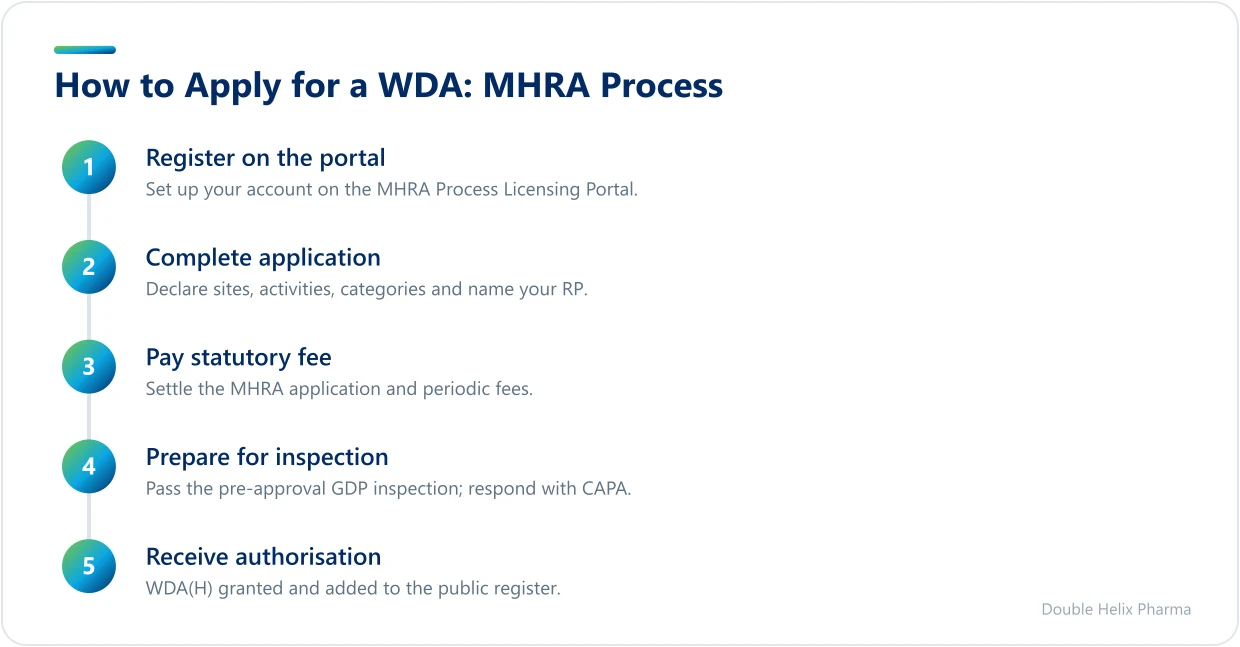
- Register for the MHRA Process Licensing Portal. All wholesale dealer applications are submitted electronically through the portal; set up your organisation account early.
- Complete the application and name your personnel. Declare the sites, activities and medicine categories, and nominate your RP (and RP(i) if importing). Supporting documentation typically includes your Site Master File or equivalent, organisation charts, and key procedures.
- Pay the statutory fee. The MHRA charges an application fee and ongoing periodic fees; confirm the current figures on the MHRA fees pages before submitting, as they are reviewed regularly.
- Prepare for the inspection. A pre-approval GDP inspection is the norm. The inspector verifies that your premises, systems, records and RP match the application and meet GDP. Findings are graded, and you will need to respond with a robust CAPA plan.
- Receive the authorisation. Once the inspector is satisfied and any findings are addressed, the WDA(H) is granted and your details are added to the public register of licence holders.
Timelines vary with the quality of the submission and inspection readiness. Incomplete applications, an unavailable RP, or weak temperature-mapping evidence are common causes of delay.
Common reasons applications stall — and how to avoid them
Most setbacks are predictable and preventable. The recurring themes we see at inspection include:
- An RP in name only. The individual is not contactable, lacks the relevant product knowledge, or has no real authority. Inspectors test this directly.
- A QMS that exists on paper but is not used. Procedures with no corresponding records, overdue self-inspections, or a deviation log that is suspiciously empty.
- Unproven cold chain. Temperature-controlled claims with no mapping study, alarm management, or excursion-handling procedure.
- Weak supplier and customer qualification. No evidence that counterparties hold the necessary authorisations, exposing the operation to falsified-medicine risk.
- Scope mismatches. The application describes activities the site cannot actually demonstrate, or omits ones it performs.
Treat the pre-approval inspection as the real deadline, not the portal submission. The systems must be live, populated and self-evidently effective — not aspirational.
An independent gap assessment before you submit consistently shortens the route to approval. Reviewing how comparable operations reached compliance can also be instructive — our case studies illustrate typical readiness journeys.
Maintaining your WDA after approval
Authorisation is the start of an ongoing obligation, not the finish line. You must keep the RP arrangements current, notify the MHRA of significant changes (new sites, activities, or RP changes) through the portal, and sustain the quality system through self-inspection, management review and continual improvement. The MHRA conducts periodic risk-based inspections, and your licence depends on remaining demonstrably compliant between them. Variations — adding a site or a new product category, for instance — should be planned and submitted in good time rather than discovered at the next inspection.
Key takeaways
To apply for a WDA successfully, build the substance before the paperwork: a credible, available Responsible Person; a living GDP-aligned Quality Management System grounded in ICH Q9 and Q10 with ALCOA+ record integrity; qualified premises with proven temperature control; and rigorous supplier and customer checks. Define your scope honestly, prepare for the pre-approval inspection as the genuine milestone, and plan for the maintenance obligations that follow.
If you are scoping a new wholesale operation or want an independent view of your inspection readiness, Double Helix Pharma UK Ltd can help with gap assessment, RP/RPi provision, QMS build and full MIA/WDA site readiness. Explore our wider consultancy services, or get in touch to discuss your application with a Qualified Person.
Regulatory sources
This guidance reflects current UK and EU GMP/GDP requirements. Primary references:
- MHRA — UK Medicines & Healthcare products Regulatory Agency
- EudraLex Volume 4 — EU GMP Guidelines
- MHRA Inspectorate Blog
Always confirm against the latest published version of each source.
Frequently asked questions
What is the difference between a WDA and an MIA?+
A Wholesale Dealer's Authorisation (WDA(H)) covers the wholesale distribution of human medicines — storing, supplying and exporting finished products to businesses rather than patients. A Manufacturer's/Importer's Authorisation (MIA) covers manufacture, packaging, importation and QP batch certification. They are separate licences with distinct obligations, and many sites need both to operate lawfully.
Do I need a Responsible Person to apply for a WDA?+
Yes. Every WDA(H) requires at least one named Responsible Person (RP) who is eligible, contactable and empowered to oversee GDP compliance, returns, complaints, recalls and falsified-medicine controls. If you import medicines from approved countries, an RP(i) is also required. The MHRA inspector will assess the RP directly, so the role cannot be a paper-only appointment.
How long does it take to get a WDA approved?+
There is no fixed timescale, as the duration depends on the quality of your submission and your readiness for the pre-approval GDP inspection. A complete application backed by a live quality system, an available RP and solid temperature-mapping evidence moves faster, while gaps such as incomplete documentation or unproven cold chain commonly cause delay. Building the operation before submitting is the most reliable way to shorten the route to approval.