Site Readiness (MIA/WDA) · 7 min read
Importing Medicines Under a WDA
A senior QP's guide to importing under WDA: what your authorisation permits, where the MIA line sits, the RP's checks and ALCOA+ traceability for GB imports.
By Balasubramanian Ramaiah · 9 June 2026 · Updated 9 August 2026
Importing under a WDA is one of the most misunderstood activities in UK pharmaceutical distribution, and getting it wrong is a fast route to an MHRA referral. A Wholesale Dealer's Authorisation (WDA(H)) lets you procure, hold and supply medicines, but the moment a product physically arrives in Great Britain from outside the UK, additional obligations bite that many quality teams underestimate. This article sets out what a WDA actually permits on importation, where the line to a Manufacturer's/Importer's Authorisation (MIA) sits, and how to keep your supply chain defensible.
What importing under a WDA actually permits
A WDA(H) authorises the wholesale distribution of medicinal products for human use. Where those products originate outside Great Britain, the holder must understand precisely what the authorisation covers, because the answer depends on the product's regulatory status and its country of origin.
Since the end of the Brexit transition period, the UK operates distinct routes for Great Britain and Northern Ireland. For Northern Ireland, EU law continues to apply, so goods moving from the EU are an intra-Union movement governed by the EU GDP guidelines (2013/C 343/01). For Great Britain, medicines arriving from a country on the MHRA's approved country for import list can, in many cases, be received under a WDA(H) with appropriate checks, rather than requiring full importation under an MIA.
The critical distinction is this: wholesale receipt of a finished, already-certified product is not the same as importation for the purpose of batch certification. If a batch still requires Qualified Person certification before release to the UK market, that activity sits firmly under an MIA(IMP) or MIA, not a WDA.
WDA versus MIA: where the line really sits
The single biggest compliance error we see during site readiness reviews is a WDA holder performing activities that legally demand an MIA. Knowing which authorisation applies is the foundation of a defensible import operation.
When a WDA is sufficient
- Receiving finished medicinal products that have already been QP-certified and released to the market, from a holder elsewhere in the supply chain.
- Procuring from an approved country for import where the MHRA permits receipt without re-certification, subject to documented assurance checks.
- Holding, storing and onward supplying those products to other authorised recipients.
When you need an MIA
- Any batch entering Great Britain that has not been certified by a QP and requires certification before market release.
- Physical importation of products from a country not covered by the approved-country route.
- Any manufacturing operation, including secondary activities such as relabelling or repackaging that go beyond routine wholesale handling.
If you are unsure which side of the line a given flow falls on, map the regulatory status of every batch before it ships, not after it lands. Retrospective correction is far more expensive than upfront design, and our MIA/WDA site readiness service exists precisely to settle these questions before an inspection does.
The Responsible Person and your importation checks
Every WDA(H) names a Responsible Person (RP). Where import activity is involved, the RP's role expands considerably, and a passive RP is a liability. The RP must ensure the conditions of the authorisation are met and that medicines are sourced from, and supplied to, appropriately authorised parties.
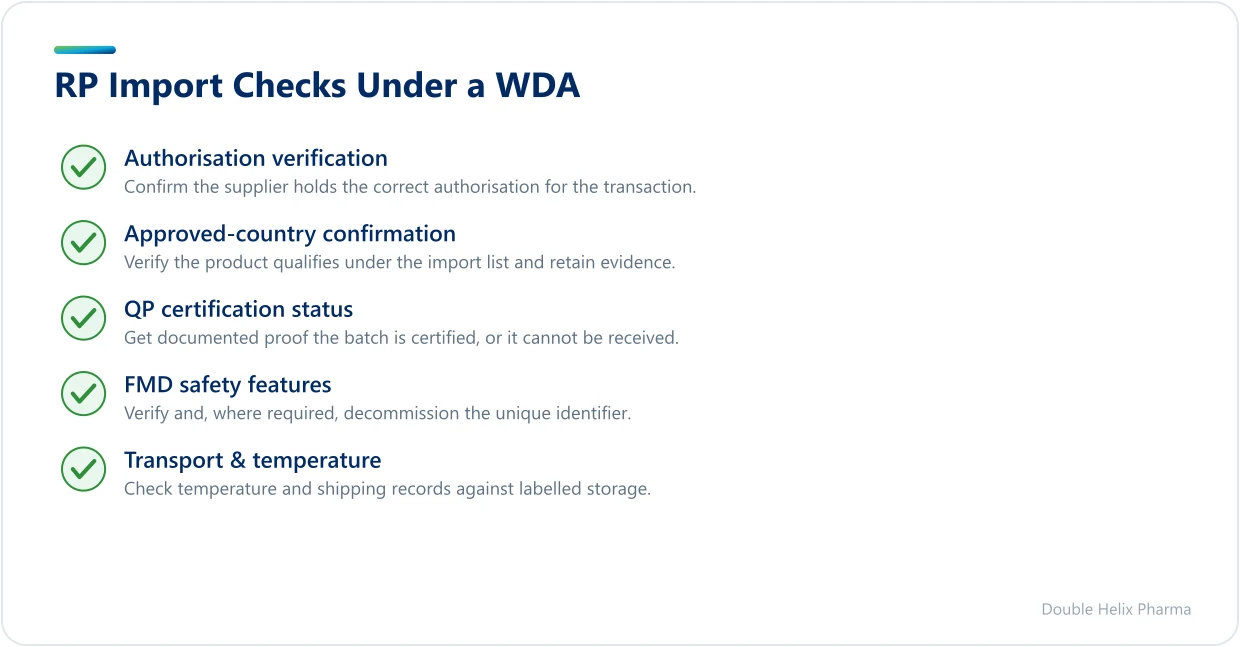
For products received from outside Great Britain, the RP should personally satisfy themselves that documented assurance exists for each consignment. In practice that means a robust set of receipt checks:
- Authorisation verification — confirm the supplying entity holds the correct authorisation and that the transaction is permitted under your WDA.
- Approved-country confirmation — where you are relying on the approved country for import list, verify the product genuinely qualifies and retain the evidence.
- QP certification status — obtain documented confirmation that the batch has been certified, or identify clearly that it has not and therefore cannot be received under the WDA.
- Falsified Medicines Directive safety features — for applicable products, verify and where required decommission the unique identifier in line with the relevant verification system.
- Transport and temperature integrity — review temperature data and shipping records against the product's labelled storage conditions.
Each of these checks must generate a record that is attributable, legible, contemporaneous, original and accurate. ALCOA+ is not optional for importation evidence; it is the difference between an assured supply chain and an unverifiable one. Our case studies show how disciplined RP oversight turns a fragile import flow into one that withstands scrutiny.
Documentation, traceability and GDP expectations
The EU and UK GDP guidelines demand full traceability of every medicinal product through the distribution chain. For imported goods this traceability must extend back to the point at which the product entered Great Britain, and the records must reconcile cleanly.
Practical documentation that inspectors expect to see includes:
- A complete audit trail from the overseas supplier through to your customer, with no gaps in the chain of ownership.
- Evidence that each supplier and customer was qualified before the first transaction and is periodically re-qualified.
- Temperature-controlled distribution records, with qualified shipping lanes and validated containers for cold-chain products.
- Deviation, complaint and recall procedures capable of acting on imported stock specifically, including rapid identification of affected batches.
An import flow is only as strong as the weakest record in its chain. If you cannot trace a batch from arrival to onward supply in minutes, you cannot defend it in an inspection or execute a recall against it.
Embedding a quality risk management approach, consistent with the principles of ICH Q9, helps you focus controls where the patient risk is greatest, whether that is cold-chain integrity, counterfeit exposure or supplier reliability. ICH Q10 then frames the wider pharmaceutical quality system that should sit around the WDA, ensuring management review and continual improvement rather than a static set of SOPs.
Common pitfalls when importing under a WDA
Across readiness assessments and mock inspections, the same avoidable failures recur. Knowing them in advance lets you design them out.
- Treating receipt as certification. Receiving an uncertified batch under a WDA and supplying it onward is a serious GMP/GDP breach, not an administrative slip.
- Assuming the approved-country route applies universally. The list and its conditions are specific; verify product eligibility for every flow rather than relying on a blanket assumption.
- An RP in name only. If the named RP cannot demonstrate active, evidenced oversight of import checks, the authorisation's foundation is unsound.
- Weak supplier qualification. Onboarding an overseas supplier without auditing or verifying their authorisations leaves the entire chain unverifiable.
- Disconnected temperature data. Shipping records that cannot be reconciled to specific batches undermine any claim of maintained product integrity.
Most of these stem from a single root cause: importation being bolted onto a wholesale operation rather than designed into it. Building the controls in from the start, and stress-testing them through a mock inspection, is far cheaper than remediating under a compliance deadline. You can see how our broader consultancy services support that work across the quality system.
Key takeaways and next steps
Importing under a WDA is entirely workable when the authorisation's limits are respected, the Responsible Person provides genuine oversight, and every consignment carries documented assurance back to its point of entry into Great Britain. The recurring failures, mistaking receipt for certification, over-relying on the approved-country route, and a passive RP, are all avoidable with deliberate design.
- Confirm whether each flow truly sits under your WDA, or whether it crosses into MIA territory requiring QP certification.
- Verify product eligibility under the approved country for import route for every consignment, and retain the evidence.
- Empower your RP with the procedures, authority and records needed to assure each import.
- Maintain ALCOA+ traceability and a quality risk management approach consistent with ICH Q9 and Q10.
If you are establishing a new import flow, scaling an existing one, or simply want assurance that your current arrangements would survive MHRA scrutiny, our QPs and RPs can review your supply chain and close the gaps before they become findings. Talk to our team to arrange a site readiness review tailored to your importation model.
Regulatory sources
This guidance reflects current UK and EU GMP/GDP requirements. Primary references:
- MHRA — UK Medicines & Healthcare products Regulatory Agency
- EudraLex Volume 4 — EU GMP Guidelines
- MHRA Inspectorate Blog
Always confirm against the latest published version of each source.
Frequently asked questions
Can I import a medicine under a WDA without a QP certifying the batch?+
Only if the batch has already been QP-certified and released, or qualifies under the MHRA's approved country for import route with documented assurance. If a batch entering Great Britain still requires QP certification before market release, that activity needs an MIA, not a WDA. Receiving and onward-supplying an uncertified batch under a WDA is a serious compliance breach.
What is the Responsible Person's role when importing under a WDA?+
The RP must ensure the WDA's conditions are met and that medicines are sourced from and supplied to appropriately authorised parties. For imports, this means actively verifying authorisations, approved-country eligibility, certification status and temperature integrity for each consignment. A passive, name-only RP leaves the authorisation's foundation unsound and is a frequent MHRA finding.
Does the approved country for import list apply to every product I receive from abroad?+
No. The list and its conditions are specific, and eligibility must be confirmed for each individual flow rather than assumed across the board. You should verify that a given product genuinely qualifies and retain the supporting evidence. Relying on a blanket assumption is one of the most common and avoidable importation errors.