Site Readiness (MIA/WDA) · 7 min read
How to Apply for a Manufacturer's Licence (MIA)
A senior QP's guide to apply for an MIA licence in the UK: scope, the Site Master File, the MHRA pre-licensing inspection, the named QP and avoiding delays.
By Balasubramanian Ramaiah · 9 June 2026 · Updated 14 August 2026
To apply for an MIA licence in the UK is to ask the MHRA to confirm that your site, your systems and your people are fit to manufacture, assemble or import medicinal products to EU GMP. It is not a form-filling exercise: the application is the moment your quality management system is judged ready for inspection, so the work that earns the licence happens long before you submit. This guide sets out what a Manufacturer's (or Manufacturer/Importer's) Authorisation covers, what the MHRA expects, and how to reach the starting line in good order.
What an MIA actually authorises
A Manufacturer's/Importer's Authorisation (MIA) is the legal permission to carry out one or more licensable activities on named products at a named site. Depending on what you do, that may include the manufacture or assembly of finished products, primary or secondary packaging, batch release, or the importation of medicinal products from outside Great Britain. Where you import third-country product, the licence is an MIA(IMP) for investigational medicinal products or carries importation activities for commercial product; in both cases a Qualified Person must certify each batch before release.
Crucially, an MIA is activity-specific and dosage-form-specific. The MHRA will list exactly which operations and product types you are authorised for, so the scope you request must mirror your real, validated capability. Over-claiming scope is one of the quickest ways to attract findings at inspection.
MIA, WDA or both?
Manufacture and import sit under an MIA; wholesale storage and distribution sit under a Wholesale Dealer's Authorisation (WDA(H)) governed by GDP. Many organisations need both, and the two licences carry different named roles — a Qualified Person for the MIA and a Responsible Person for the WDA. Decide early which activities belong on which licence, because it shapes your whole submission and your site readiness plan.
Before you apply for an MIA licence: getting inspection-ready
The MHRA grants a licence only after a satisfactory pre-licensing inspection, so your real task is to build a pharmaceutical quality system that will stand up to scrutiny. Anchor it in EU GMP Part I, the principles of ICH Q10 for the quality system and ICH Q9 for quality risk management, and ALCOA+ for data integrity. If you handle sterile products, your facility and contamination control strategy must demonstrably meet Annex 1.
Practically, that means having the following in place and operating — not merely written:
- An approved Site Master File describing your operations, facility and quality system.
- A defined organisational structure with segregated production and quality functions, and an independent quality unit.
- Validated facilities, utilities and equipment, with qualification documentation and a validation master plan.
- Core GMP systems running with real records: change control, deviations, CAPA, complaints, recall, self-inspection and supplier qualification.
- A named, eligible Qualified Person (and deputy cover) ready to be listed on the licence.
A common and costly mistake is to apply with documents that have never generated evidence. Inspectors look for systems with a track record — completed deviations, closed CAPAs, executed change controls — not pristine, unused SOPs.
The application and inspection process
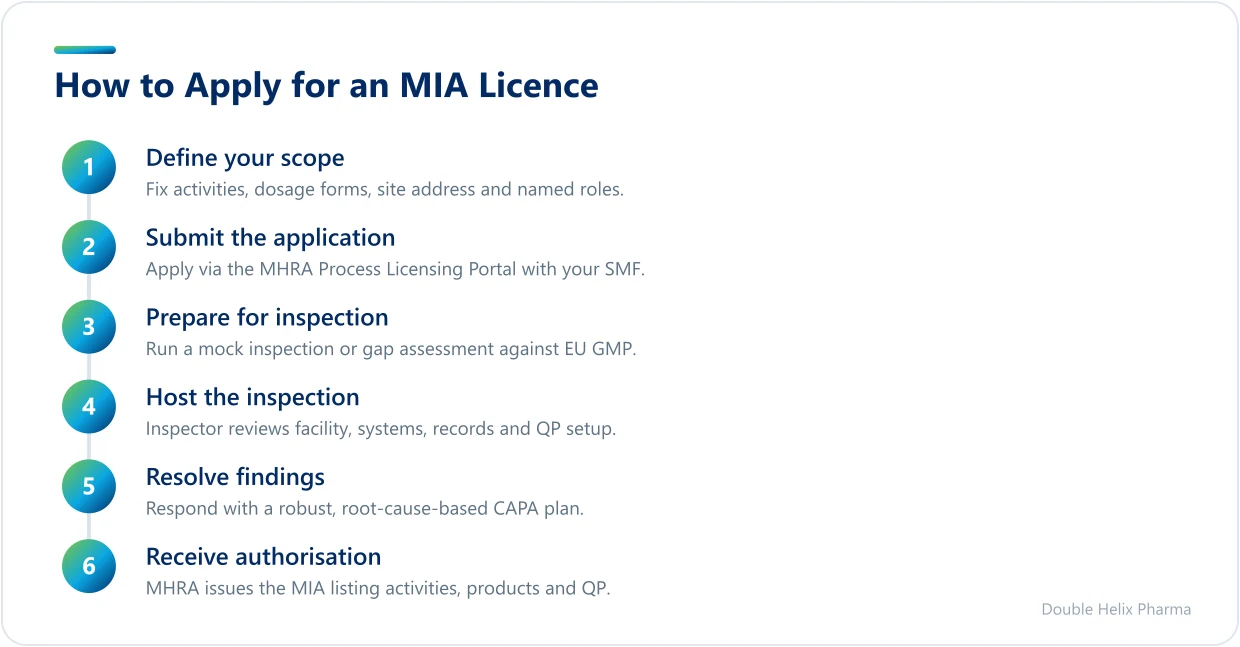
The route from intent to authorisation follows a predictable sequence, and treating it as a project with clear ownership pays dividends:
- Define your scope. Fix the precise activities, dosage forms and product categories you need, and confirm the site address and named roles.
- Submit the application. Apply to the MHRA through its Process Licensing Portal, paying the relevant fee and providing your Site Master File and supporting quality documentation.
- Prepare for inspection. Expect a pre-licensing inspection of the named site against EU GMP. A mock inspection or independent gap assessment is invaluable here for finding weaknesses before the regulator does.
- Host the inspection. The inspector evaluates your facility, systems, records and personnel, including the QP arrangements.
- Resolve findings. Respond to any deficiencies with a robust, root-cause-based CAPA plan and evidence of correction.
- Receive the authorisation. Once the MHRA is satisfied, it issues the MIA listing your authorised activities, products and named QP.
Timelines vary with the complexity of the site and the quality of the submission, but well-prepared applicants who present a mature, evidenced quality system move through far more smoothly. We have seen the difference this makes across our case studies.
The QP, the Site Master File and the documents inspectors expect
Two elements carry disproportionate weight: the named Qualified Person and the Site Master File. The QP must be eligible for your specific product types, hold documented authority and have unfettered access to the data needed to certify batches under Annex 16. The Site Master File must be accurate and current, because the inspector uses it as the map of your operation; any drift between what it claims and what they observe undermines confidence in everything else.
Beyond these, assemble a defensible documentation set: validation and qualification records, your quality manual and SOP framework, training records, batch documentation templates, technical agreements with contract givers and acceptors, and a contamination control strategy where relevant. If you outsource manufacture or testing, your supplier qualification and audit programme must show genuine oversight of those activities, not a paper relationship.
The licence is granted to a quality system, not to a building. Inspectors judge whether your organisation can consistently make and release product that is safe, effective and compliant — and they look for evidence, not intent.
Common pitfalls that delay authorisation
Most avoidable delays trace back to a handful of recurring issues. Watch for these in particular:
- Scope mismatch: requesting activities or dosage forms your facility cannot yet support to GMP.
- Immature systems: SOPs with no operating history, so quality processes cannot be shown to work.
- QP gaps: a named QP whose eligibility does not cover your product types, or no documented deputy arrangement.
- Data integrity weaknesses: systems that do not meet ALCOA+, particularly around audit trails and access control.
- Weak supplier oversight: contract arrangements without technical agreements or a working audit programme.
Each of these is straightforward to fix before submission and expensive to fix afterwards, once a finding is on the record.
Key takeaways
To apply for an MIA licence successfully, treat the submission as the visible tip of a much larger readiness effort: define your scope precisely, build a quality system grounded in EU GMP, ICH Q9 and Q10 and ALCOA+, name an eligible QP, and keep your Site Master File honest. Prepare as though the inspection is imminent — because it is — and resolve findings with genuine root-cause analysis rather than cosmetic fixes.
If you are planning a new MIA, varying an existing licence or preparing for a pre-licensing inspection, our team provides independent QP, audit and quality consultancy and end-to-end site readiness support. Contact us to discuss your application and where you are on the path to authorisation.
Regulatory sources
This guidance reflects current UK and EU GMP/GDP requirements. Primary references:
- MHRA — UK Medicines & Healthcare products Regulatory Agency
- EudraLex Volume 4 — EU GMP Guidelines
- MHRA Inspectorate Blog
Always confirm against the latest published version of each source.
Frequently asked questions
How long does it take to get an MIA from the MHRA?+
There is no fixed turnaround, because the timeline depends on the complexity of your site and, above all, the maturity of your quality system at the point of inspection. A satisfactory pre-licensing inspection is required before the licence is granted, so any deficiencies you must remediate will extend the process. Well-prepared applicants who present an evidenced, operating quality system and resolve findings promptly move through considerably faster than those who apply before they are ready.
What is the difference between an MIA and a WDA?+
An MIA (Manufacturer's/Importer's Authorisation) permits manufacture, assembly, batch release and importation of medicinal products and requires a named Qualified Person. A WDA(H) (Wholesale Dealer's Authorisation) permits the storage and distribution of medicines under GDP and requires a named Responsible Person. Many organisations hold both, and you should decide early which of your activities belong on each licence, as this shapes your whole application.
Do I need a Qualified Person to apply for an MIA?+
Yes. You cannot hold a valid MIA without at least one named, eligible Qualified Person, and the MHRA will assess the QP arrangements as part of the licensing inspection. The QP must be eligible for your specific product types, hold documented authority and have unfettered access to the data needed to certify batches under EU GMP Annex 16. You should also have documented deputy cover so that batch certification is never dependent on a single individual.