Contract QP, RP & RPi · 7 min read
What Does a Qualified Person Actually Do?
What does a qualified person do? A senior UK QP explains batch certification, legal duties, GMP oversight and when to use a contract QP for release.
By Balasubramanian Ramaiah · 9 June 2026 · Updated 22 July 2026
If you supply medicines into the UK or EU, the single signature that decides whether a batch can be sold belongs to your Qualified Person. Understanding what does a qualified person do matters because that one act of certification carries personal legal accountability and underpins patient safety across the whole supply chain. This article sets out the role in practical terms: the legal duties, the daily reality, and where a contract QP fits.
The legal foundation of the QP role
The Qualified Person is a statutory role defined in EU GMP and retained UK medicines legislation. Every holder of a Manufacturer's/Importer's Authorisation (MIA) must name at least one QP whose duty is to certify each batch of a medicinal product before it is released for sale or supply. In practice this means confirming, batch by batch, that the product has been manufactured and tested in accordance with the marketing authorisation and the principles of Good Manufacturing Practice.
Annex 16 of the EU GMP guide is the document that frames this responsibility. It describes certification, confirmation and the long list of factors the QP must be satisfied with before signing. The role is personal: certification is not something a company does collectively, it is an individual professional taking legal responsibility for a decision.
Eligibility and named status
A QP must hold recognised qualifications in a relevant scientific discipline, possess defined practical experience in manufacturing and quality control, and be named on the relevant licence. Regulators expect the named individual to be genuinely available to the site, not a name on paper. That availability is precisely why outsourced and contract arrangements have to be structured with care.
What does a Qualified Person do day to day?
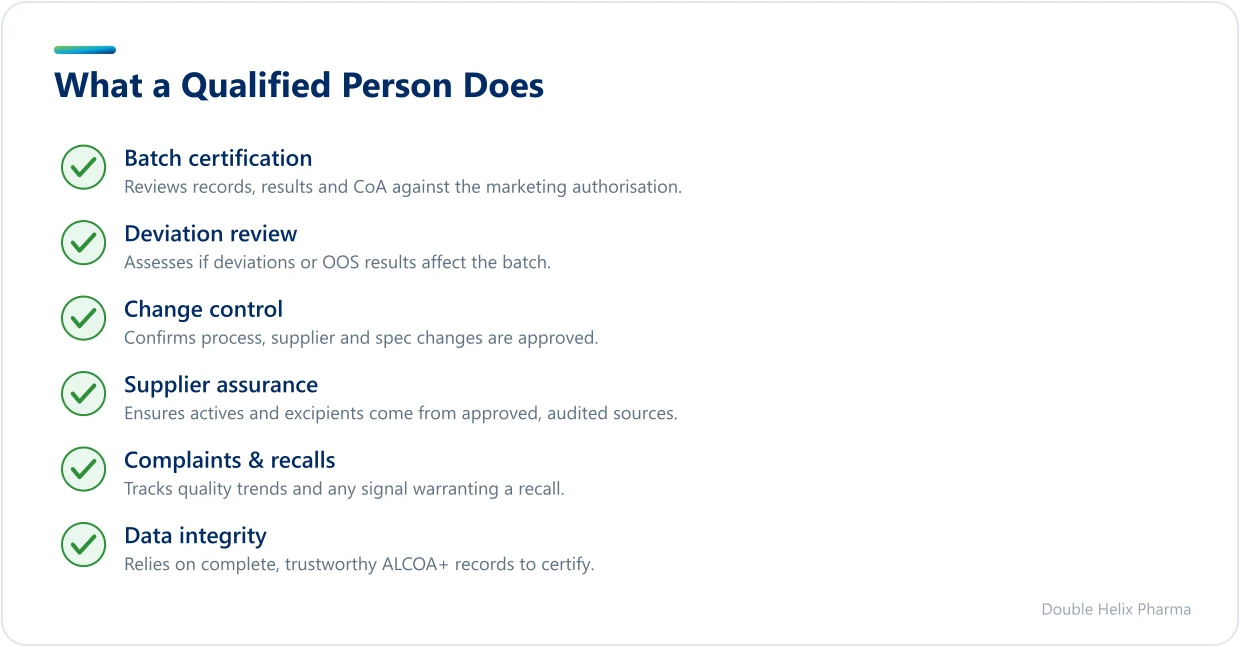
So what does a qualified person do beyond signing the register? The certification decision is the visible output, but it rests on a great deal of quality oversight. A typical remit includes:
- Batch certification and release — reviewing batch manufacturing and packaging records, analytical results and the certificate of analysis against the marketing authorisation.
- Deviation and investigation review — assessing whether any deviation, out-of-specification result or unplanned event affects the batch in question.
- Change control oversight — confirming that changes to processes, suppliers or specifications have been properly assessed and approved.
- Supplier and supply-chain assurance — being satisfied that active substances and excipients come from approved, audited sources with the correct documentation.
- Complaints, recalls and stability — staying close to product quality trends and any signal that might warrant a recall or field action.
Underpinning all of this is data integrity. The QP relies on records being complete, attributable and trustworthy, which is why ALCOA+ principles sit at the heart of every release decision. If the data cannot be trusted, the certification cannot stand.
How the QP fits into the quality system
The Qualified Person does not work in isolation. The role is embedded in the pharmaceutical quality system described by ICH Q10, and decisions are increasingly informed by formal quality risk management under ICH Q9. A QP weighs risk constantly: the significance of a deviation, the robustness of a supplier, the impact of a sterility assurance concern under Annex 1 for sterile products.
Certification is the end of a chain of assurance, not a single inspection. A QP can only certify what the quality system has been built to deliver.
This is why the QP needs visibility of the whole system: training, validation status, the calibration of equipment, environmental monitoring, and the conduct of self-inspection. Where the system is weak, the QP either drives improvement or, when necessary, declines to certify. That ability to say no is the role's ultimate safeguard.
QP, RP and RPi: related but distinct
The QP is frequently confused with the Responsible Person (RP) and the Responsible Person for import (RPi). The RP is named on a Wholesale Dealer's Authorisation and is accountable for Good Distribution Practice — storage, transport and the integrity of the distribution chain. The RPi is a UK-specific role concerned with confirming that imported products from certain territories have been independently certified. The QP, by contrast, sits on the manufacturing and importation side and certifies batches. Many organisations need a combination of these roles, and we explain how they interlock across our consultancy services.
When to use a contract QP
Not every organisation needs, or can justify, a permanent in-house QP. Virtual pharma companies, CMOs scaling up, importers entering the UK market and sites covering absence or a sudden departure all benefit from an experienced contract QP. The advantages are practical:
- Immediate, named cover so that release is never bottlenecked by a single point of failure.
- Independent judgement from someone whose only interest is a compliant, defensible decision.
- Inspection readiness, because an experienced QP knows what the MHRA expects to see and how to evidence it.
A contract QP must still be properly named, given a clear technical agreement, and granted genuine access to records and people. Done well, an outsourced arrangement is indistinguishable in rigour from an internal one. You can see how we have structured these engagements in our case studies, and read more about the contract QP, RP and RPi service itself.
Key takeaways
To summarise what does a qualified person do: they take personal legal responsibility for certifying that each batch of medicine meets its marketing authorisation and GMP before release, supported by deep oversight of deviations, change control, supplier assurance and data integrity. The role is defined by EU GMP Annex 16, embedded in the quality system through ICH Q9 and Q10, and distinct from the RP and RPi functions. Above all, it is the point at which one qualified individual stands behind the quality of a product reaching patients.
If you need named QP cover, a release-decision review, or help preparing for an MHRA inspection, talk to our team. We provide experienced, independent Qualified Persons who certify with confidence and keep your supply chain moving.
Regulatory sources
This guidance reflects current UK and EU GMP/GDP requirements. Primary references:
- EU GMP Annex 16 — Certification by a Qualified Person and Batch Release
- EMA — GMP/GDP Questions & Answers
- EudraLex Volume 4 — EU GMP Guidelines
Always confirm against the latest published version of each source.
Frequently asked questions
Is the Qualified Person personally liable for batch release?+
Yes. Certification under EU GMP Annex 16 is an individual act, so the named QP carries personal professional and legal accountability for confirming a batch meets its marketing authorisation and GMP. This responsibility cannot be delegated to a company as a whole, which is why the QP must have genuine access to records and the authority to refuse release when the evidence does not support it.
What is the difference between a QP and a Responsible Person (RP)?+
A QP is named on a Manufacturer's/Importer's Authorisation and certifies batches for release under GMP. An RP is named on a Wholesale Dealer's Authorisation and is accountable for Good Distribution Practice across storage and transport. The roles cover different parts of the supply chain, and some organisations require both alongside a Responsible Person for import (RPi).
Can a contract QP be as effective as an in-house one?+
Yes, provided the arrangement is structured correctly. The contract QP must be formally named on the licence, covered by a clear technical agreement, and given genuine access to batch records, systems and personnel. With that foundation, an experienced independent QP delivers the same rigour as an internal appointment and is often better prepared for MHRA inspection.