Contract QP, RP & RPi · 7 min read
How to Become a Qualified Person in the UK
A senior practitioner's guide to how to become a qualified person in the UK: the degree, experience and eligibility viva needed to certify and release batches.
By Balasubramanian Ramaiah · 9 June 2026 · Updated 22 July 2026
Understanding how to become a qualified person in the UK matters whether you are a pharmacist or scientist mapping your own career, or a quality team trying to secure named QP cover for a manufacturing or import licence. A Qualified Person is the legally accountable individual who certifies each batch of a medicinal product before it is released to the market, and the route to that role is defined, demanding and rightly protective of patient safety. This guide sets out the eligibility, knowledge and experience requirements as they apply in the UK today.
What a Qualified Person actually does
Under UK medicines legislation a Manufacturer's/Importer's Authorisation (an MIA, or MIA(IMP) for investigational products) must name at least one QP. That person carries personal legal responsibility for certifying that every batch has been manufactured and tested in accordance with EU GMP, the marketing authorisation and the relevant legal requirements before it is released for sale or supply.
The role is not a paper formality. The QP must be satisfied, batch by batch, that the entire supply chain, manufacturing process and quality system supports release. That judgement draws directly on the principles in ICH Q9 (Quality Risk Management) and ICH Q10 (Pharmaceutical Quality System), and on data that meets ALCOA+ integrity expectations. Where products are sterile, the QP must understand contamination control under Annex 1. It is a role that combines technical depth with the confidence to say no.
A QP does not simply confirm that tests passed; they take personal responsibility for the assurance that a batch is fit to reach a patient.
How to become a qualified person: the eligibility route
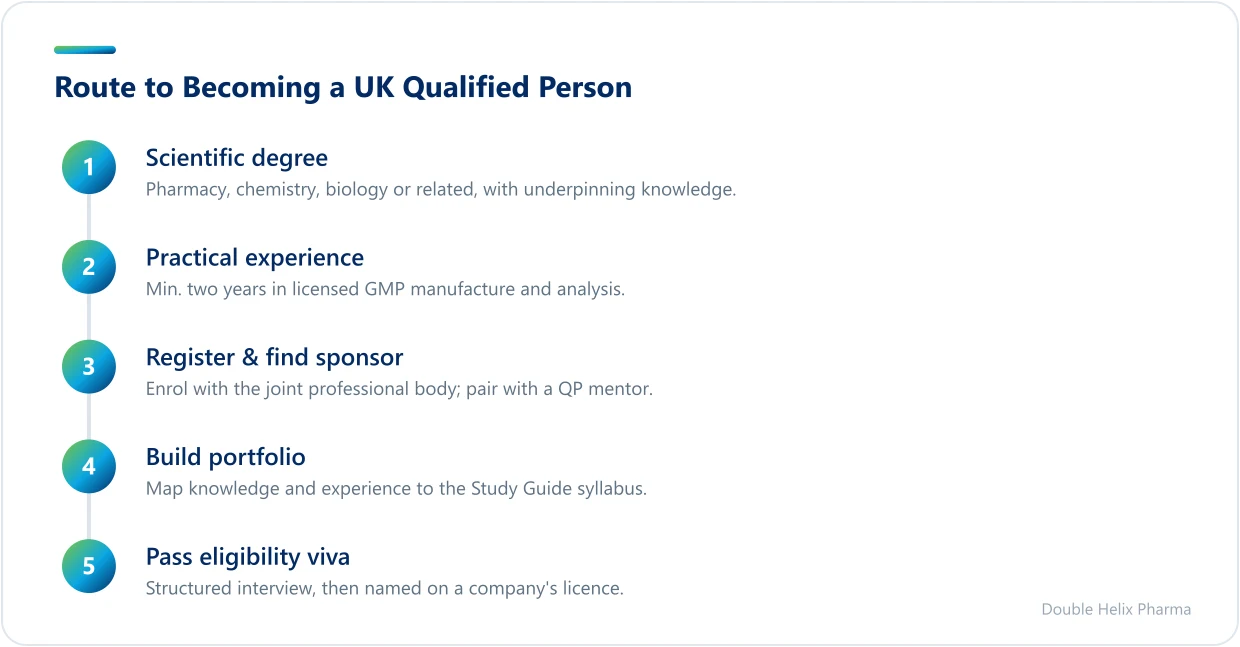
The legal foundation for QP eligibility sits in UK medicines legislation, which mirrors the long-standing requirements of EU GMP and Annex 16 on certification and batch release. In practice, becoming a QP rests on three pillars that you must satisfy together.
1. Academic qualifications
You need a university degree (or recognised equivalent) in an appropriate scientific discipline, typically pharmacy, medicine, chemistry, pharmaceutical chemistry and technology, biology or a closely related subject. The legislation also specifies a body of underpinning knowledge across defined subject areas, including pharmaceutical analysis, microbiology, pharmacology and pharmaceutical technology. If your primary degree does not cover all of these, you are expected to close the gaps before certification.
2. Practical experience
Academic study alone is not enough. You must demonstrate practical experience, normally at least two years, in a licensed manufacturing environment covering qualitative analysis, quantitative analysis of active substances, and the testing and checking necessary to assure the quality of medicinal products. The exact duration can reduce where you hold additional relevant qualifications, but hands-on exposure to real GMP operations is non-negotiable.
3. Eligibility assessment
Finally, your knowledge and experience are assessed against the QP Study Guide by one of the professional bodies. In the UK this is administered jointly by the Royal Pharmaceutical Society, the Royal Society of Biology and the Royal Society of Chemistry. Assessment usually culminates in a professional viva, after which a successful candidate can be named on a company's licence.
The eligibility assessment and viva
The professional bodies' joint scheme is the gateway most aspiring QPs pass through. Candidates register with the relevant body, are paired with a sponsor or mentor (commonly an experienced QP within their organisation), and build a documented portfolio of knowledge and experience mapped against the published Study Guide syllabus.
- Knowledge areas span EU and UK law, GMP, quality systems, manufacturing of different dosage forms, sterile and biological products, investigational medicinal products, and active substances.
- Experience must be evidenced across the syllabus, not merely asserted, with examples of real decisions and deviations the candidate has handled.
- The viva is a structured professional interview with experienced assessors who probe both technical understanding and the judgement needed to certify batches under pressure.
Preparation typically takes candidates two to four years from registration, running in parallel with a full-time quality role. The bar is deliberately high because, once named, the QP's signature carries genuine legal weight.
Building the right experience before you apply
The strongest QP candidates do not simply accumulate years; they accumulate the right exposure. Aim to work across batch certification and release, deviation and CAPA management, change control, supplier qualification and self-inspection. Time spent close to MHRA inspections, or shadowing an experienced QP through a difficult release decision, is worth more than years of routine sign-off.
Where consultancy support fits
Not every site has a resident QP to mentor candidates, and not every authorisation holder can recruit a permanent QP quickly. This is where a contract QP can bridge the gap, providing named cover on the licence while also developing internal staff. If you are an authorisation holder needing interim or ongoing cover, our contract QP, RP and RPi service places experienced QPs onto licences and supports candidate development. You can see how this works in practice in our case studies, and review the wider quality support available across our consultancy services.
QP, RP and RPi: know the difference
Candidates often confuse the QP with two related roles, and getting the distinction right matters for both careers and compliance.
- Qualified Person (QP): named on a manufacturing/import licence (MIA), responsible for certifying and releasing batches.
- Responsible Person (RP): named on a wholesale dealer's licence (WDA), responsible for compliance with GDP guidelines across storage and distribution.
- Responsible Person for Import (RPi): a UK-specific role overseeing the import of certain medicines, confirming that an equivalent QP certification has taken place before the product is placed on the market.
The QP route is the most demanding of the three, but the underlying expectation, demonstrable competence matched to clear legal accountability, runs through all of them.
Key takeaways and next steps
In summary, knowing how to become a qualified person comes down to satisfying three linked requirements: an appropriate scientific degree with the prescribed underpinning knowledge, at least two years of relevant practical experience in licensed manufacture, and a successful eligibility assessment and viva through the joint professional scheme. Anchor your development in real GMP decisions, ICH Q9 and ICH Q10 thinking, and data that withstands ALCOA+ scrutiny.
- Confirm your degree and underpinning knowledge meet the defined subject areas.
- Build genuine, evidenced experience in batch release, deviations and quality systems.
- Register with the relevant professional body, secure a sponsor and map your portfolio to the Study Guide.
- Treat the viva as a test of judgement, not just recall.
If you need named QP cover while a candidate qualifies, or experienced QPs to mentor your team and strengthen your batch release process, get in touch with our team to discuss your requirements.
Regulatory sources
This guidance reflects current UK and EU GMP/GDP requirements. Primary references:
- EU GMP Annex 16 — Certification by a Qualified Person and Batch Release
- EMA — GMP/GDP Questions & Answers
- EudraLex Volume 4 — EU GMP Guidelines
Always confirm against the latest published version of each source.
Frequently asked questions
How long does it take to become a Qualified Person in the UK?+
Most candidates take two to four years from registering with the professional body to passing the eligibility viva, running alongside a full-time quality role. This builds on the minimum two years of relevant practical experience in licensed manufacture that the legislation requires. The timeline depends heavily on the breadth of experience you can evidence and the support of an experienced QP sponsor.
What qualifications do you need to become a QP?+
You need an appropriate scientific degree, typically in pharmacy, chemistry, biology, medicine or a related discipline, that covers the prescribed underpinning knowledge in areas such as pharmaceutical analysis, microbiology and pharmacology. You must also demonstrate practical experience in qualitative and quantitative analysis and quality assurance in a licensed environment. Eligibility is then confirmed through the joint assessment scheme run by the Royal Pharmaceutical Society, the Royal Society of Biology and the Royal Society of Chemistry.
What is the difference between a QP and a Responsible Person (RP)?+
A Qualified Person is named on a manufacturing or import licence and certifies that each batch is fit for release in line with EU GMP and the marketing authorisation. A Responsible Person is named on a wholesale dealer's licence and is accountable for compliance with GDP guidelines across storage and distribution. They are distinct legal roles with different qualifications, and many sites need both depending on their licences.