Contract QP, RP & RPi · 7 min read
Importing Medicines from Third Countries: The QP's Role
QP importation third country certification explained: the QP's legal duties, importation testing, MRAs, supplier qualification and GDP for UK and EU importers.
By Balasubramanian Ramaiah · 9 June 2026 · Updated 2 July 2026
When a finished medicinal product enters Great Britain from outside the UK, someone must take personal, legal responsibility for confirming it is fit for the market. That responsibility falls to the Qualified Person, and QP importation third country certification is one of the most scrutinised duties in the entire supply chain. Get it wrong and you expose patients to risk and your company to regulatory action; get it right and importation becomes a controlled, defensible, repeatable process.
Why third-country importation needs a QP
Under EU GMP and the equivalent UK framework, no batch of a medicinal product manufactured outside the territory may be released to the market until a Qualified Person has certified it. The principle is simple but exacting: the QP must be satisfied that each batch has been manufactured and tested in accordance with the marketing authorisation and the principles of Good Manufacturing Practice, regardless of where in the world it was made.
For products imported from a third country, this is not a paperwork formality. The QP is personally attesting that a batch made under a different regulatory regime, often thousands of miles away, meets UK and EU standards. That attestation carries individual legal accountability, and it cannot be delegated away through a contract or a purchase order.
Third country, importer and the manufacturing authorisation
A "third country" is any territory outside the relevant trading bloc; for a GB importer, that includes the EU unless a specific recognition arrangement applies. Importation of a finished product requires a Manufacturer's/Importer's Authorisation (an MIA holding importation status, historically referred to as a MIA(IMP) for investigational products), and that authorisation must name the QP responsible for certification. No named QP, no lawful importation.
QP importation third country: the certification decision in practice
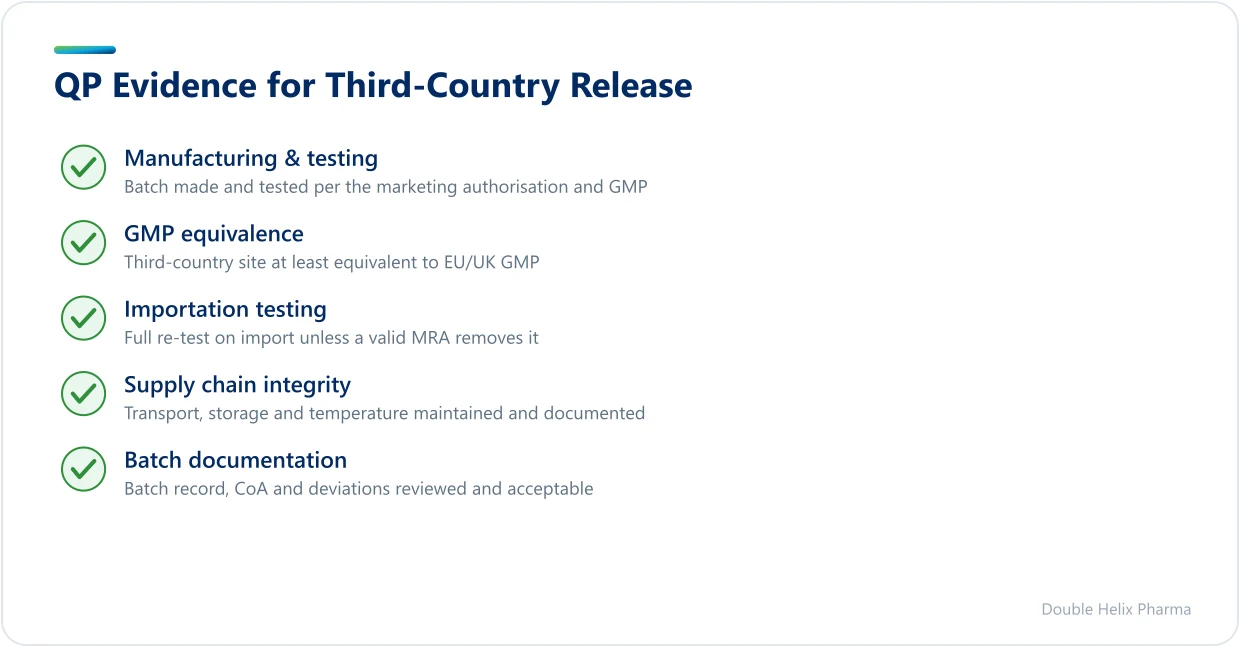
Certification is a judgement, not a checkbox. Before a QP signs, they must assemble and weigh a defined body of evidence. In practical terms that means satisfying themselves on each of the following:
- Manufacturing and testing compliance — the batch was produced and tested in line with the marketing authorisation and GMP.
- GMP equivalence at the third-country site — the manufacturing site operates to standards at least equivalent to EU/UK GMP, evidenced by inspection history, audit and the manufacturer's quality systems.
- Importation testing — where required, full analytical re-testing has been performed on import unless a Mutual Recognition Agreement (MRA) or equivalent arrangement removes that obligation.
- Supply chain integrity — transport, storage and temperature conditions have been maintained and documented from the site of manufacture to the point of release.
- Batch documentation — the batch record, certificate of analysis and any deviations have been reviewed and found acceptable.
The decision must be documented and traceable. ALCOA+ principles apply to every record the QP relies on: the data behind a certification must be attributable, legible, contemporaneous, original and accurate, and the supporting attributes must hold up under inspection years later.
Importation testing and Mutual Recognition Agreements
One of the most consequential questions is whether the batch must be re-tested on import. The default expectation for third-country products is full qualitative and quantitative analysis in the UK or EU. Where an MRA or recognised equivalence arrangement exists with the country of manufacture, the QP may rely on testing performed at origin, provided the scope of the agreement genuinely covers the product and the tests in question. Assuming an MRA applies when it does not is a common and serious error, so the scope must be confirmed for each product, not presumed.
Building the evidence: supplier qualification and risk
A QP cannot certify with confidence if the manufacturing site has never been properly assessed. Supplier and site qualification is therefore the foundation of compliant importation. This is where ICH Q9 (Quality Risk Management) and ICH Q10 (Pharmaceutical Quality System) do real work: the depth of audit, the frequency of re-qualification and the extent of importation testing should all be proportionate to documented risk.
Robust qualification typically draws on a current GMP certificate or inspection outcome, an on-site or remote audit against EU GMP, a technical/quality agreement that clearly assigns responsibilities, and ongoing performance monitoring including deviations, complaints and stability data. Where dosage forms or sterile products are involved, expectations rise accordingly — sterile importation must be assessed against Annex 1, and the QP should understand the contamination control strategy at the originating site, not merely accept a certificate at face value.
The QP's signature is only as strong as the supplier qualification beneath it. An unaudited site is an uncertified batch waiting to happen.
Our case studies illustrate how a structured, risk-based qualification programme turns an opaque overseas supply chain into one a QP can stand behind.
GDP, the supply chain and what happens after certification
Certification is not the end of the QP's interest in a batch. Good Distribution Practice governs everything that happens to the product in transit and storage, and the conditions during importation feed directly back into the certification decision. Temperature excursions during a long international shipment, gaps in the chain of custody, or an unqualified intermediate warehouse can all invalidate an otherwise sound batch.
For this reason the QP works closely with the Responsible Person (RP) who holds the wholesale dealer's authorisation. The QP attests to the quality of the batch; the RP ensures it is then stored and distributed under GDP. In many importation models the two roles are tightly coupled, and a clear interface between them — defined in quality agreements and SOPs — prevents accountability gaps. If you are mapping these responsibilities across your network, our full range of services covers both the manufacturing and distribution sides of the licence.
Common failure points the MHRA looks for
- Reliance on an MRA whose scope does not actually cover the imported product.
- Importation testing omitted or reduced without a documented, justified rationale.
- Supplier qualification that is out of date, generic or never verified on site.
- Inadequate transport qualification, so temperature integrity cannot be demonstrated.
- QP delegation that blurs personal accountability or leaves no clear decision trail.
Each of these is avoidable with the right systems, and each is exactly what an MHRA inspector will probe when reviewing imported batches.
Key takeaways
Effective QP importation third country management rests on a few durable principles: the QP carries personal, non-delegable responsibility for every imported batch; certification is a documented risk-based judgement, not a formality; importation testing is the default unless a genuinely applicable MRA removes it; and the whole decision is only as reliable as the supplier qualification and GDP controls behind it.
If your organisation is importing finished products, scaling a new supply route, or preparing for inspection, Double Helix Pharma UK can provide an experienced contract QP and a defensible certification framework. Explore our contract QP, RP and RPi service or get in touch to discuss how we can support your importation programme.
Regulatory sources
This guidance reflects current UK and EU GMP/GDP requirements. Primary references:
- EU GMP Annex 16 — Certification by a Qualified Person and Batch Release
- EMA — GMP/GDP Questions & Answers
- EudraLex Volume 4 — EU GMP Guidelines
Always confirm against the latest published version of each source.
Frequently asked questions
Does every batch imported from a third country need to be re-tested in the UK or EU?+
As a default, yes: full qualitative and quantitative testing is expected on importation of finished products from third countries. This requirement can be waived only where a Mutual Recognition Agreement or equivalent arrangement genuinely covers the specific product and tests in question. The QP must confirm the scope of any such agreement for each product rather than assuming it applies.
Can a Qualified Person delegate responsibility for certifying imported batches?+
No. Certification is a personal legal responsibility held by the named QP on the manufacturing/importation authorisation, and it cannot be transferred through a contract or purchase order. A QP may rely on the work of others, such as auditors and analysts, to build the evidence, but the certification decision and its accountability remain theirs alone. This is why a clear, documented decision trail is essential.
How do the QP and Responsible Person roles interact in importation?+
The QP certifies that each imported batch meets its marketing authorisation and GMP, while the Responsible Person ensures the product is stored and distributed under Good Distribution Practice. The two roles are closely linked because transport and storage conditions during importation directly affect the certification decision. A defined interface in quality agreements and SOPs prevents accountability gaps between manufacturing release and wholesale distribution.