Contract QP, RP & RPi · 7 min read
Interim QP Cover: Keeping Release Moving During Absence
How an interim qualified person keeps batch release and MIA compliance moving during QP absence, with practical planning, handover and data-integrity guidance.
By Balasubramanian Ramaiah · 9 June 2026 · Updated 8 July 2026
When a Qualified Person goes on extended leave, falls ill or moves on at short notice, batch release can grind to a halt within days. An interim qualified person bridges that gap, keeping certification flowing and your Manufacturer's/Importer's Authorisation (MIA) compliant while you secure a permanent appointment. The difference between a planned handover and a scramble is almost always preparation, not luck.
Why a QP gap is a supply risk, not just an HR problem
Under EU GMP and the UK Human Medicines Regulations 2012, no batch of a medicinal product may be placed on the market until a named QP has certified it against the marketing authorisation and the principles of good manufacturing practice. If your only named QP is unavailable and no alternative is in place, certification stops. Finished goods stack up in quarantine, customer orders slip, and the commercial and clinical consequences escalate quickly.
The risk is rarely the absence itself. It is the assumption that a single QP is enough, with no contingency. ICH Q9 frames this neatly: an undocumented single point of failure in your release chain is an unmanaged quality risk. Treating QP continuity as a risk to be assessed and controlled, rather than a staffing inconvenience, changes how seriously the business plans for it.
What an interim qualified person actually does
An interim QP is not a rubber stamp. They take on the full legal and professional responsibilities of the role for the duration of their appointment, which means they must be satisfied, personally, that each batch they certify meets every requirement. In practice an interim qualified person will:
- Review and sign off batch certification against the relevant marketing authorisation and EU GMP Part I/II.
- Assess deviations, out-of-specification results and open CAPAs that bear on the disposition decision.
- Confirm the validation status of processes, equipment and the supply chain feeding each batch.
- Evaluate the pharmaceutical quality system under ICH Q10 to judge whether it remains in a state of control.
- For imported products, verify that testing and the importation route meet the conditions of the MIA(IMP) or MIA.
Crucially, the interim QP must reach an independent judgement. They cannot rely solely on the word of the team around them; the data must support release, and that data must be reliable.
Named on the licence, accountable in person
A QP can only certify against a licence on which they are named. Adding an interim QP therefore involves a variation to the MIA via the MHRA, and the individual must meet the eligibility and qualification criteria set out in Annex 16 to the EU GMP guide. This is administrative reality, not optional paperwork, and it takes time, which is exactly why early action matters.
Planning cover before you need it
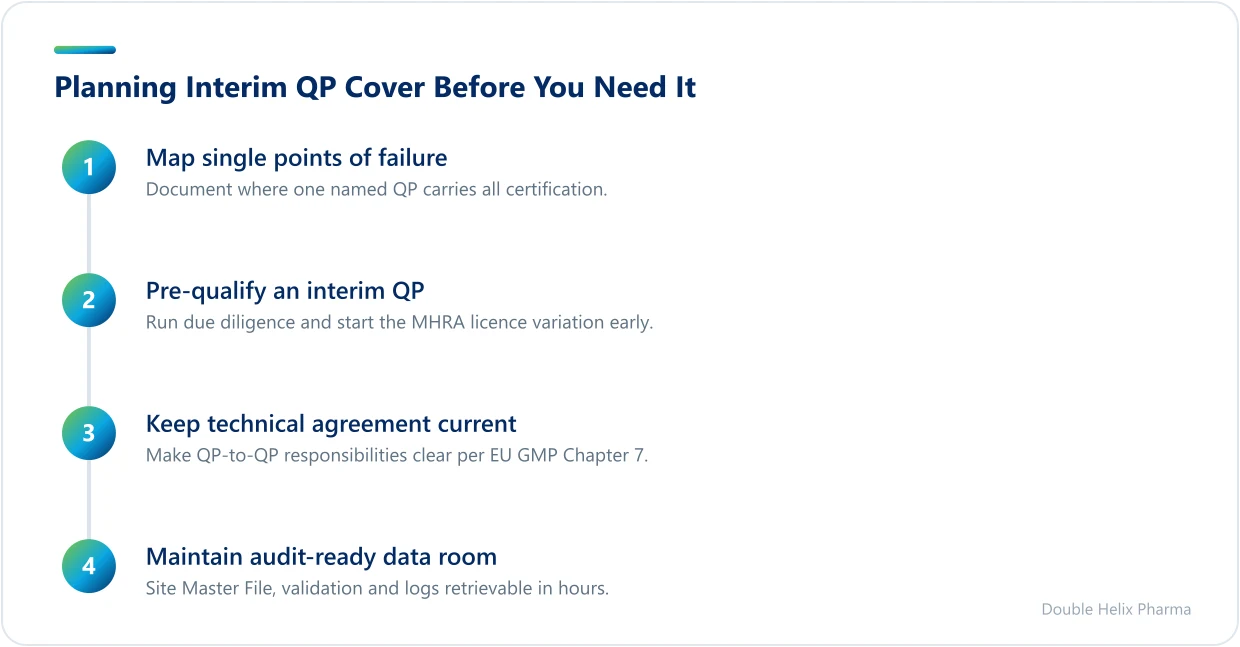
The most resilient sites plan QP absence the way they plan any other supply continuity risk. A workable approach includes:
- Map your single points of failure. If one named QP carries all certification for a product line, document that exposure and the trigger that would activate cover.
- Pre-qualify an interim QP. Identify a suitable contract QP, complete due diligence and start the licence variation early, so the name is ready to add rather than scrambled for.
- Keep the technical agreement current. For outsourced or imported product, the QP-to-QP arrangements and responsibilities must be unambiguous and reflect Chapter 7 of EU GMP.
- Maintain an audit-ready data room. Site Master File, validation summaries, deviation logs and supplier approvals should be retrievable in hours, not weeks.
Our contract QP, RP and RPi services are built around exactly this: a named, pre-briefed professional who can step in without a standing start. You can see how this works in practice across our case studies.
A clean handover protects data integrity
The point of greatest risk during any transition is the handover itself. An incoming QP inherits open deviations, partially documented decisions and certification commitments that may already be in train. ALCOA+ principles apply to every record they rely on: attributable, legible, contemporaneous, original, accurate, plus complete, consistent, enduring and available. If the underlying records are weak, the interim QP cannot certify with confidence, and they should not.
A robust handover is not a courtesy between professionals. It is the control that prevents a release decision being made on incomplete or unreliable information.
Practical handover hygiene means a documented list of open items, a clear cut-off for which batches each QP owns, and direct access to the quality system rather than filtered summaries. Where Annex 1 contamination-control commitments or aseptic process data are involved, the interim QP must be able to interrogate environmental monitoring and media-fill records directly. For sterile and high-risk products, that depth of access is non-negotiable.
Interim, contract or permanent: choosing the right model
Not every gap calls for the same answer. A short, planned absence may need only occasional certification cover. A sudden departure during a product launch needs sustained, senior presence. A site building toward its first MIA may want an experienced QP on a rolling contract while it recruits. The decision turns on three questions: how long is the gap, how complex is the product, and how mature is the quality system supporting it?
When complexity raises the bar
Imported products, biologics, sterile manufacture and investigational medicinal products all demand deeper scrutiny. For US-supplied material, an interim QP should understand how 21 CFR 210/211 expectations map onto EU GMP so that gaps in documentation are spotted before certification, not after. The more complex the product, the more the experience of the individual matters relative to their availability. A broader view of how QP cover sits alongside RP, RPi and wider quality support is set out across our consultancy services.
Key takeaways
- A QP absence stops batch release; treat it as a supply continuity and quality risk under ICH Q9, not just a staffing gap.
- An interim qualified person takes on the full legal responsibility for certification and must reach an independent, data-supported decision.
- The QP must be named on the MIA, so plan the MHRA variation and due diligence early rather than under pressure.
- Protect data integrity through a documented handover that respects ALCOA+, with direct access to deviations, validation status and monitoring data.
- Match the model, occasional, sustained or rolling, to the length of the gap and the complexity of the product.
If you are facing a planned absence, an unexpected departure, or simply want a contingency in place before you need it, we can help you keep release moving. Talk to our team about pre-qualifying an interim qualified person for your site.
Regulatory sources
This guidance reflects current UK and EU GMP/GDP requirements. Primary references:
- EU GMP Annex 16 — Certification by a Qualified Person and Batch Release
- EMA — GMP/GDP Questions & Answers
- EudraLex Volume 4 — EU GMP Guidelines
Always confirm against the latest published version of each source.
Frequently asked questions
How quickly can an interim QP start certifying batches?+
The individual can only certify once they are named on the Manufacturer's/Importer's Authorisation, which requires a variation submitted to the MHRA. The administrative timeline, rather than the QP's availability, is usually the limiting factor. This is why pre-qualifying an interim QP and starting the licence variation before a gap occurs is the single most effective way to avoid a release stoppage.
Does an interim QP carry the same legal responsibility as a permanent one?+
Yes. For the duration of their appointment the interim qualified person holds the full legal and professional responsibility for the batches they certify, exactly as a permanent QP would. They must reach an independent, data-supported decision under Annex 16 and cannot certify on the basis of assurances alone. The temporary nature of the role does not dilute the accountability attached to each certification.
What information does an incoming interim QP need at handover?+
They need direct access to the quality system, not filtered summaries: open deviations and OOS results, current validation and qualification status, supplier approvals, and a clear cut-off defining which batches each QP owns. For sterile or high-risk products they must also review environmental monitoring and media-fill data in line with Annex 1. All records relied upon must satisfy ALCOA+ so the disposition decision rests on reliable information.