GDP Transport & Supply Chain · 7 min read
Transport Validation for Medicinal Products
A practical UK guide to transport validation for medicinal products: GDP duties, ICH Q9/Q10 risk, cold-chain qualification, ALCOA+ data and supplier oversight.
By Balasubramanian Ramaiah · 9 June 2026 · Updated 7 July 2026
Transport validation is the documented evidence that your distribution lanes keep medicinal products within their licensed storage conditions, from the moment a consignment leaves a controlled environment to the point it arrives intact at the next responsible party. It is not an optional refinement of good distribution practice (GDP); it is a regulatory expectation that bridges GMP release and patient access, and increasingly a focus of MHRA inspection. Done well, it protects product quality, supports continuity of supply and gives your quality team defensible data when a deviation occurs.
Why transport validation matters under GDP
The EU Guidelines on Good Distribution Practice (2013/C 343/01) are explicit that the required storage conditions for medicinal products should be maintained during transportation within defined limits. The MHRA reinforces this in the Green Guide (Rules and Guidance for Pharmaceutical Distributors), expecting wholesale dealers and manufacturers to demonstrate, with data, that transport does not adversely affect product quality. Temperature is the obvious risk, but humidity, light, shock, vibration and excessive transit time can all degrade a product or compromise its container-closure integrity.
Crucially, the responsibility does not stop at the loading bay. Whether you ship cold chain (2–8 °C), controlled ambient (typically 15–25 °C) or frozen, the holder of the manufacturer's or wholesale dealer's authorisation must show that the chosen route, packaging and carrier reliably preserve the conditions stated on the marketing authorisation and product labelling.
From qualification to validation: getting the language right
Quality teams often blur qualification and validation, and inspectors notice. The cleanest model maps to the familiar GMP lifecycle:
- Design qualification (DQ) — define the routes, packaging systems, vehicles and acceptance criteria against the product's stability profile.
- Installation and operational qualification (IQ/OQ) — confirm that passive shippers, active containers or vehicles perform as intended, including chamber mapping of refrigerated trucks and cold rooms.
- Performance qualification (PQ) — demonstrate, across representative real-world shipments, that the end-to-end lane holds the product within limits, including summer and winter extremes.
Transport validation then becomes the overarching exercise that ties these elements to a documented rationale, supported by data and signed off by the Responsible Person (RP). It should be governed by a validation plan and protocol, with predefined acceptance criteria, rather than assembled retrospectively from whatever data happened to be collected.
Risk assessment is the foundation, not the formality
ICH Q9 (Quality Risk Management) is the right tool to scope the work proportionately. A robust assessment lets you concentrate effort where product and patient risk are highest, and justify a lighter touch elsewhere.
What a good transport risk assessment considers
- Product sensitivity — stability data, excursion tolerance, freeze sensitivity for biologics and vaccines, and any mean kinetic temperature (MKT) allowances.
- Lane characteristics — origin and destination climates, transit duration, modal changes (road, air, sea), border delays and known tarmac or warehouse hold points.
- Packaging performance — qualified passive systems versus active containers, conditioning requirements and pack-out instructions.
- Seasonal extremes — worst-case ambient profiles, not annual averages.
- Handover points — every transfer of custody where conditions or accountability could lapse.
The output should drive your monitoring strategy, your packaging selection and the number of qualification shipments you run. We discuss this proportionate, risk-led approach in more detail across our GDP and supply chain services.
Designing and executing the study
A defensible transport validation study is built around clear acceptance criteria derived from the product's approved storage statement and stability data. Define what constitutes a pass, what constitutes an excursion and how excursions will be assessed before you ship anything.
Practical essentials
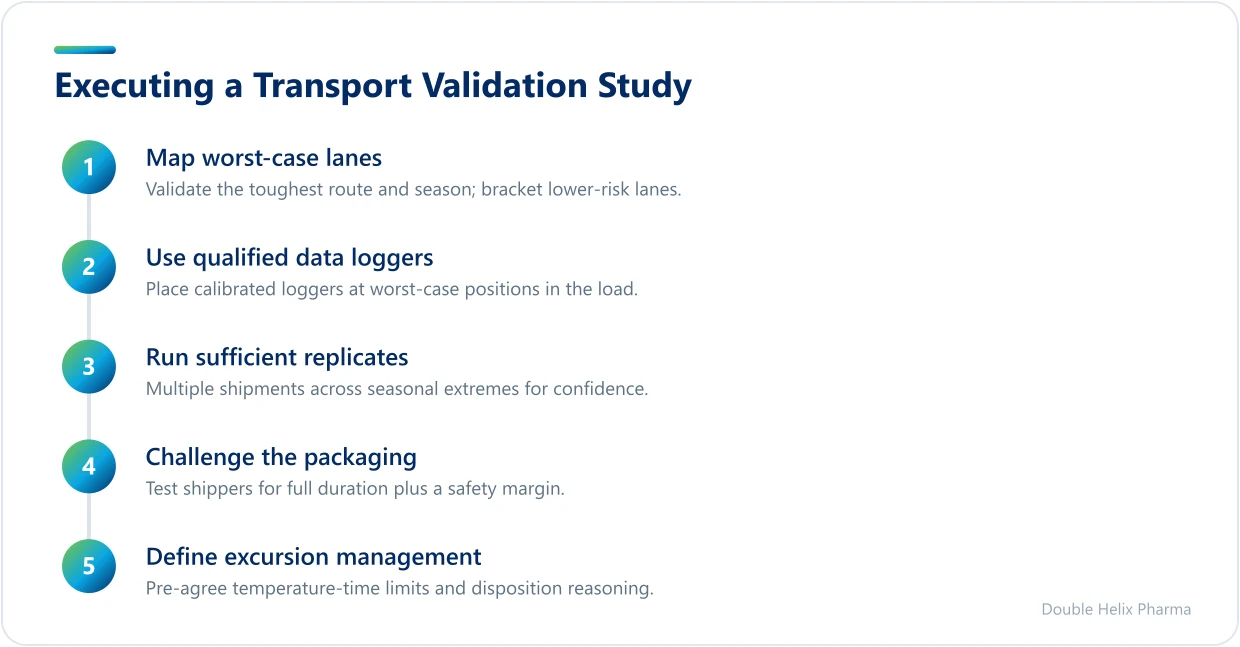
- Map worst-case lanes. Validate the most challenging route and season; lower-risk lanes can often be bracketed by a documented rationale.
- Use calibrated, qualified data loggers. Place them at representative and worst-case positions within the load, and ensure traceability to a recognised standard.
- Run sufficient replicates. Multiple shipments across seasonal extremes give statistical confidence rather than a single fortunate result.
- Challenge the packaging. Test qualified shippers against the full intended duration plus a safety margin, including conditioning errors where credible.
- Define excursion management. Pre-agree the temperature–time limits and the stability-based reasoning that supports any disposition decision.
Throughout, your records must satisfy ALCOA+: attributable, legible, contemporaneous, original, accurate, plus complete, consistent, enduring and available. Logger data, calibration certificates, protocols and reports should withstand inspection years later. For organisations distributing to or from the US, the same scientific principles align comfortably with the expectations of 21 CFR Parts 210 and 211, even though the regulatory wording differs.
Continued verification, deviations and supplier oversight
Validation is a state to be maintained, not a certificate to be filed. ICH Q10 (Pharmaceutical Quality System) frames transport as a process requiring ongoing monitoring, periodic review and change control. A lane validated two years ago may no longer hold true if a courier changes its hub, a packaging supplier reformulates a gel pack, or a new climate corridor is added.
Keeping the validated state alive
- Continued process verification — trend routine shipment data against your acceptance criteria and investigate drift early.
- Change control — assess carrier, route, packaging or volume changes before they take effect.
- Deviation and CAPA — investigate excursions through your quality system, with a stability-based disposition and meaningful corrective action.
- Supplier and 3PL qualification — hold logistics providers to formal technical or quality agreements and audit them. The marketing authorisation holder remains accountable even when transport is outsourced.
Where transport sits within a broader contracted network, clarity over roles is essential. We cover the practicalities of provider oversight in our case studies, and the full scope of the support we provide on our services page.
Key takeaways
Effective transport validation is risk-led, data-driven and continuously maintained. Anchor it to the product's stability profile and approved storage conditions, apply ICH Q9 to scope it proportionately, qualify worst-case lanes and packaging across seasonal extremes, and keep the validated state alive through ICH Q10 monitoring, change control and robust supplier oversight. Treat your records as inspection evidence from day one and ALCOA+ becomes second nature rather than a scramble.
If you are building a transport validation programme from scratch, remediating an inspection finding, or qualifying a new cold-chain lane, our Qualified Persons and Responsible Persons can help you design a defensible, proportionate approach. Get in touch to discuss your distribution network and where the real risks lie.
Regulatory sources
This guidance reflects current UK and EU GMP/GDP requirements. Primary references:
- EU GMP Annex 15 — Qualification and Validation
- EMA — GMP/GDP Questions & Answers
- MHRA Inspectorate Blog
- MHRA — UK Medicines & Healthcare products Regulatory Agency
Always confirm against the latest published version of each source.
Frequently asked questions
Is transport validation a legal requirement in the UK?+
Yes. The EU GDP guidelines (2013/C 343/01) and the MHRA Green Guide require wholesale dealers and manufacturers to maintain medicinal products within their licensed storage conditions during transport. You must hold documented, data-backed evidence that your routes, packaging and carriers preserve product quality, and the Responsible Person is expected to oversee this. It is routinely examined during GDP inspections.
What is the difference between transport qualification and transport validation?+
Qualification confirms that individual elements perform as intended, such as mapping a refrigerated vehicle or testing a passive shipper through IQ, OQ and PQ. Validation is the overarching, documented programme that ties those qualified elements to a risk-based rationale and proves the end-to-end lane holds the product within limits. In practice you qualify the components and validate the journey, governed by a plan, protocol and predefined acceptance criteria.
How many shipments are needed to validate a transport lane?+
There is no fixed number; it should be justified by an ICH Q9 risk assessment. Higher-risk products and lanes typically warrant multiple shipments spanning summer and winter extremes to give statistical confidence, while lower-risk lanes can often be bracketed by a documented rationale. The key is that your sample reflects worst-case conditions rather than a single favourable result.