GDP Transport & Supply Chain · 7 min read
The Falsified Medicines Directive Explained
A clear guide to the Falsified Medicines Directive: safety features, the unique identifier, the GB versus NI split, and what UK quality teams must do.
By Balasubramanian Ramaiah · 9 June 2026 · Updated 30 June 2026
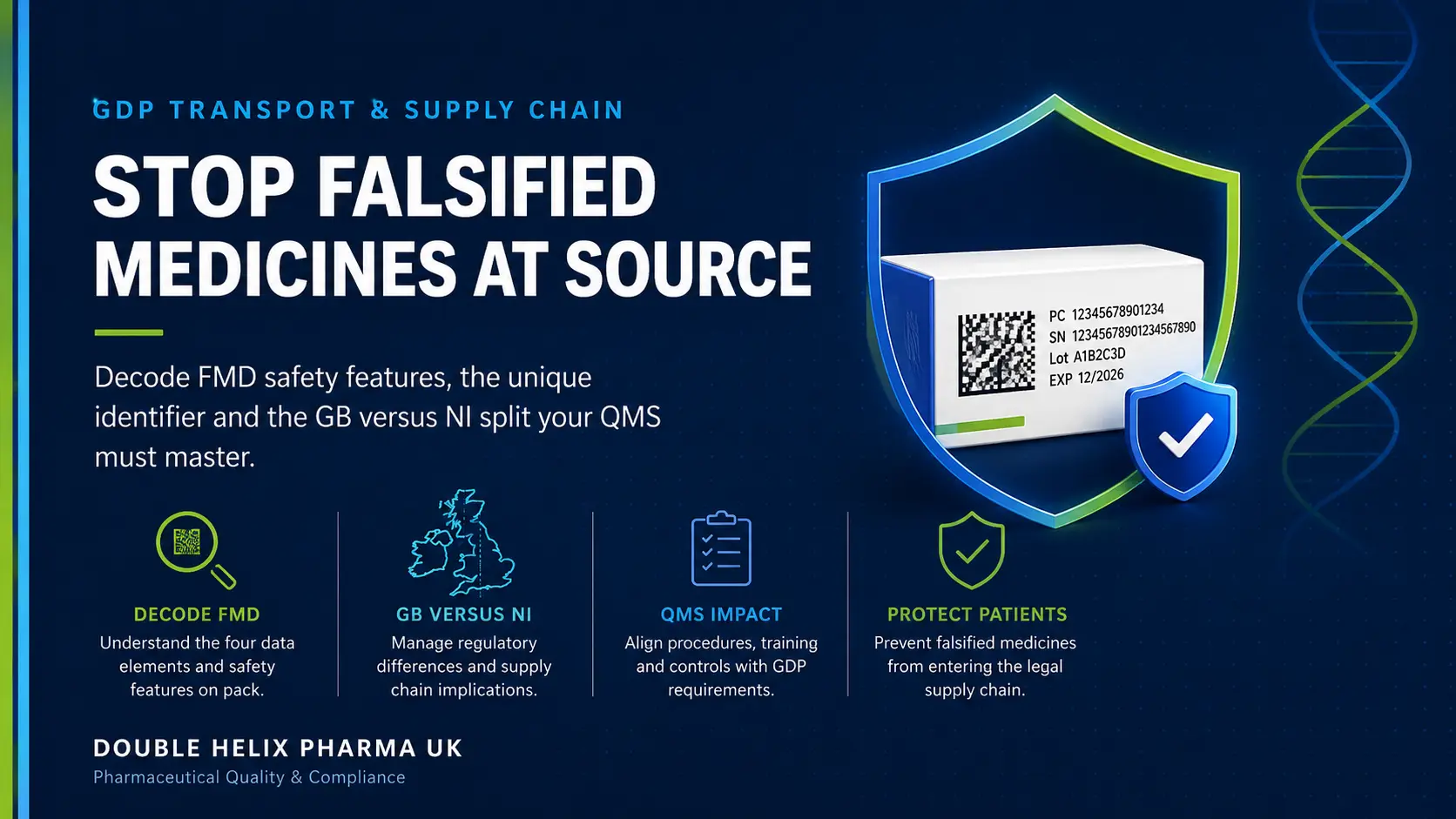
The Falsified Medicines Directive is the European legal framework designed to stop falsified medicines reaching patients through the legitimate supply chain. For UK and EU quality teams, it is far more than a labelling rule: it reshaped how products are authenticated, who may trade in them, and what your distribution and manufacturing systems must be able to prove. This article explains what the Directive requires, how Brexit split its application between Great Britain and Northern Ireland, and what your quality management system should have under control.
What the Falsified Medicines Directive is and why it exists
Directive 2011/62/EU, universally known as the Falsified Medicines Directive (FMD), amended the EU medicines code (Directive 2001/83/EC) to counter the growing infiltration of falsified products into legal distribution. A falsified medicine is one with a false representation of its identity, source or history. It is a distinct concept from a substandard or defective product: the defining feature is deliberate misrepresentation, not an accidental quality failure.
The Directive introduced obligations across the whole chain, from active substance manufacture through wholesale distribution to the point of dispensing. Its two best-known features are the safety features carried on prescription medicine packs, set out in the Delegated Regulation (EU) 2016/161, and tightened controls on supply-chain actors, including brokers and traders. Both are intended to make it materially harder for a falsified pack to be sold as genuine.
The two safety features: tamper evidence and the unique identifier
At the heart of the regime are two safety features that, for most prescription products, must appear on the outer packaging.
Anti-tampering device
The pack must carry a device that allows anyone in the chain to verify whether the packaging has been opened or altered. In practice this is a seal or equivalent feature whose integrity is checked on receipt and again before supply. A broken or suspect seal is a quarantine-and-investigate event, not a judgement call to be made on the loading bay.
Unique identifier and the repository system
Each pack also carries a unique identifier encoded in a 2D data matrix, holding a product code, serial number, batch number and expiry, plus a national reimbursement number where required. These identifiers live in a system of national and European repositories. Manufacturers upload data; wholesalers verify at defined risk points; and the person dispensing decommissions the pack, checking it against the repository and retiring its identifier so it cannot be reused. End-to-end verification of this kind is a core element of any compliant GDP and supply chain operation.
The Falsified Medicines Directive after Brexit: GB versus NI
This is where many teams stumble, so it deserves precision. Following EU exit, the safety-features and decommissioning requirements of the Falsified Medicines Directive no longer apply in Great Britain. The data-matrix may still be printed on packs, but GB wholesalers and pharmacies are not required to scan, verify or decommission against the EU repositories, and UK operators were disconnected from the European hub.
Northern Ireland is different. Under the arrangements that followed the Protocol, the FMD safety-features regime continues to apply in Northern Ireland, which remains aligned with the relevant EU rules. The practical consequence is that a single business may need two distinct procedures depending on the destination of the goods. Treating GB and NI as one regime is a common and avoidable error.
The Directive did not simply switch off at exit; it fractured along the GB and NI line, and your procedures must reflect that split rather than assume a single UK position.
Because these arrangements are administered by the MHRA and have continued to evolve, the only safe approach is to design your system against current published MHRA guidance for each leg, and to keep that mapping under change control.
What this means for manufacturers, importers and wholesalers
The Directive's obligations land differently depending on where you sit in the chain, but each role carries clear, inspectable duties.
- Manufacturers and MIA holders are responsible for applying the safety features and uploading identifier data to the repositories for packs destined for markets where the regime applies. Serialisation and aggregation processes must be validated and governed like any other GMP-critical system under EU GMP.
- Importers bringing product into a market where FMD applies must ensure safety features are present, intact and correctly represented in the repository, and that any repackaging or relabelling preserves and re-establishes them appropriately.
- Wholesale dealers must verify the authenticity of the unique identifier at defined risk points, for example when product is returned or sourced from another wholesaler, and must only deal with appropriately authorised counterparties.
- Brokers and traders are explicitly within scope; the Directive tightened registration and conduct expectations precisely because intermediaries are a known entry route for falsified stock.
Underpinning all of these is the unglamorous but decisive control of bona fides verification: confirming that every party you buy from or supply to genuinely holds the authorisation they claim. Falsified-medicines risk is, in large part, a supplier-governance problem.
Building compliance into your quality system
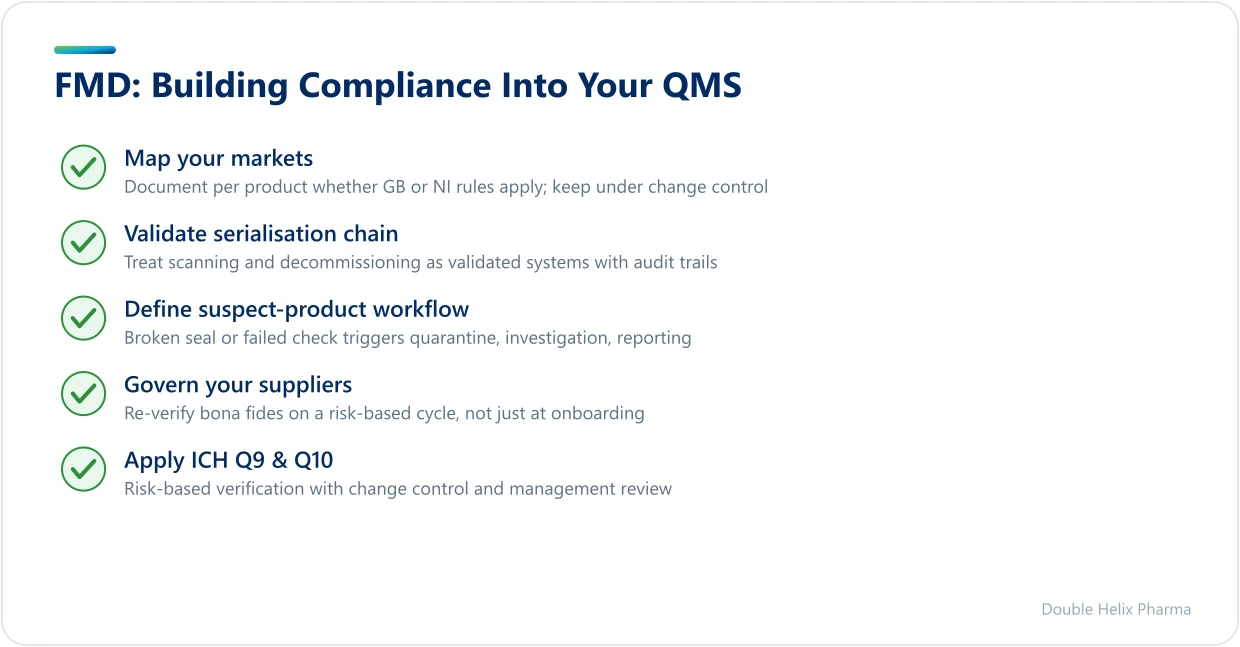
Meeting the Directive is not a one-off project; it is a set of standing controls that belong inside your quality management system. The principles of ICH Q10 apply directly, with change control, deviation handling and management review keeping the regime current as guidance shifts. Risk-based decisions, in the spirit of ICH Q9, should determine where and how often you verify, and how you triage a suspect pack.
A few priorities consistently separate robust systems from fragile ones:
- Map your markets. Document, per product and per destination, whether GB or NI rules apply and what action each requires. Keep the map under change control.
- Validate the serialisation chain. Treat repository connections, scanning and decommissioning as computerised systems requiring validation, access control and audit trails consistent with ALCOA+ data-integrity expectations.
- Define the suspect-product workflow. A broken seal, a failed verification or an alert from the repository must trigger quarantine, investigation and, where warranted, reporting, with no ambiguity about who acts.
- Govern your suppliers. Re-verify bona fides on a risk-based cycle, not just at onboarding, so that regulatory action against a counterparty is caught before stock changes hands. Our case studies show how this is closed out in practice.
Key takeaways
The Falsified Medicines Directive remains a defining influence on UK and EU supply-chain quality, even though its safety-features regime now applies in Northern Ireland but not in Great Britain. Its requirements, the anti-tampering device, the unique identifier and decommissioning, and tightened controls on wholesalers, brokers and importers, only deliver protection when they are embedded as living controls in your quality system and matched to the correct regime for each market.
If you need to confirm your serialisation, verification and bona fides processes will withstand an MHRA inspection, our Qualified Persons and Responsible Persons can help. Explore our full range of quality and compliance services, or get in touch to discuss your distribution and supply-chain programme.
Regulatory sources
This guidance reflects current UK and EU GMP/GDP requirements. Primary references:
- EMA — GMP/GDP Questions & Answers
- MHRA Inspectorate Blog
- MHRA — UK Medicines & Healthcare products Regulatory Agency
Always confirm against the latest published version of each source.
Frequently asked questions
Does the Falsified Medicines Directive still apply in the UK after Brexit?+
It is split. The safety-features and decommissioning requirements no longer apply in Great Britain, where wholesalers and pharmacies are not required to scan or decommission packs against the EU repositories. They do, however, continue to apply in Northern Ireland, which remains aligned with the relevant EU rules. A single business may therefore need two distinct procedures depending on whether goods are destined for GB or NI.
What are the two safety features required under the FMD?+
The first is an anti-tampering device on the outer packaging that lets anyone in the chain see whether the pack has been opened or altered. The second is a unique identifier, a serial number and product data encoded in a 2D data matrix and held in national and European repositories. Together they allow a pack's authenticity to be verified and its identifier decommissioned at the point of dispensing.
What is decommissioning under the Falsified Medicines Directive?+
Decommissioning is the act of checking a pack's unique identifier against the repository and then retiring that identifier so it cannot be reused, normally carried out at the point of dispensing. It confirms the pack is genuine and has not already been supplied elsewhere. In Great Britain this step is no longer required, whereas in Northern Ireland it continues to apply under the EU-aligned regime.