GDP Transport & Supply Chain · 7 min read
Brokering Medicines: Rules and Responsibilities
Medicines brokering is a regulated activity with real legal duties. Learn who must register with the MHRA, the quality-system and verification rules that apply.
By Balasubramanian Ramaiah · 9 June 2026 · Updated 23 June 2026
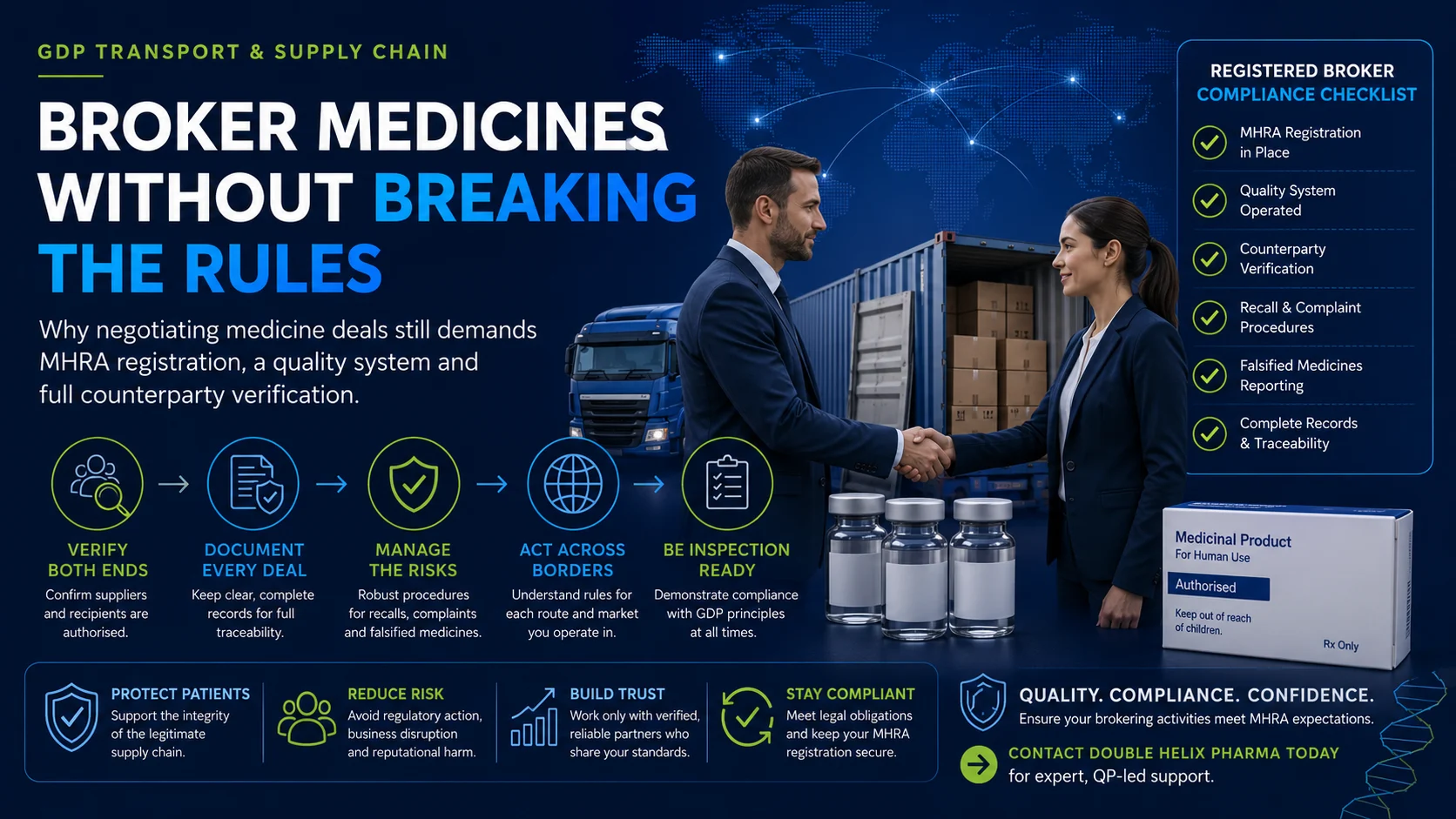
Medicines brokering occupies a peculiar position in the supply chain: brokers never physically handle, store or own the products they negotiate, yet they sit squarely within the regulated chain and carry real legal responsibilities. Too many organisations treat brokering as an informal commercial activity, only to discover during inspection that they were trading medicines without the registration, quality system or oversight the law demands. This article sets out what brokering is, who must register, and the obligations that follow.
What counts as medicines brokering?
Under the UK regulatory framework, a broker is a person involved in activities relating to the sale or purchase of medicinal products for human use, except for wholesale distribution, that do not include physical handling and that consist of negotiating independently and on behalf of another legal or natural person. The same definition flows from the EU GDP framework and Directive 2001/83/EC, on which the UK regime is closely modelled.
The distinction matters. A wholesale dealer takes possession of stock, holds it and supplies it onward under a Wholesale Dealer's Authorisation (WDA(H)). A broker does none of that. The broker introduces buyer to seller, arranges and negotiates the transaction, but the goods move directly between authorised parties and never enter the broker's custody.
Brokering versus wholesale distribution
If you take ownership of the product, store it, or ever take physical possession, you are no longer brokering: you require a WDA(H) and full compliance with the Good Distribution Practice (GDP) guidelines. Conversely, holding a WDA does not automatically permit brokering; the activity must be specifically declared. Many compliance failures originate in this grey zone, where a firm believes it is "just facilitating a deal" but in practice exercises control over the goods.
Who must register, and where
Brokers established in the UK must be registered with the Medicines and Healthcare products Regulatory Agency (MHRA) before commencing activity, and must appear on a publicly available register. Registration is not a one-off formality: it is conditional on having, and continuing to operate, an appropriate quality system and the controls described below.
Three practical points are frequently overlooked:
- Place of establishment drives jurisdiction. Where you are legally established determines which competent authority you register with, irrespective of where the buyer or seller sits.
- Brokering only applies to medicines with a marketing authorisation. The product being brokered must hold a valid authorisation in the relevant territory; brokering unauthorised products is not a route to market.
- Registration must be kept current. Material changes to your activities, premises of administration or responsible personnel must be notified, and authorities can suspend or remove a registration where requirements are no longer met.
Core responsibilities of a registered broker
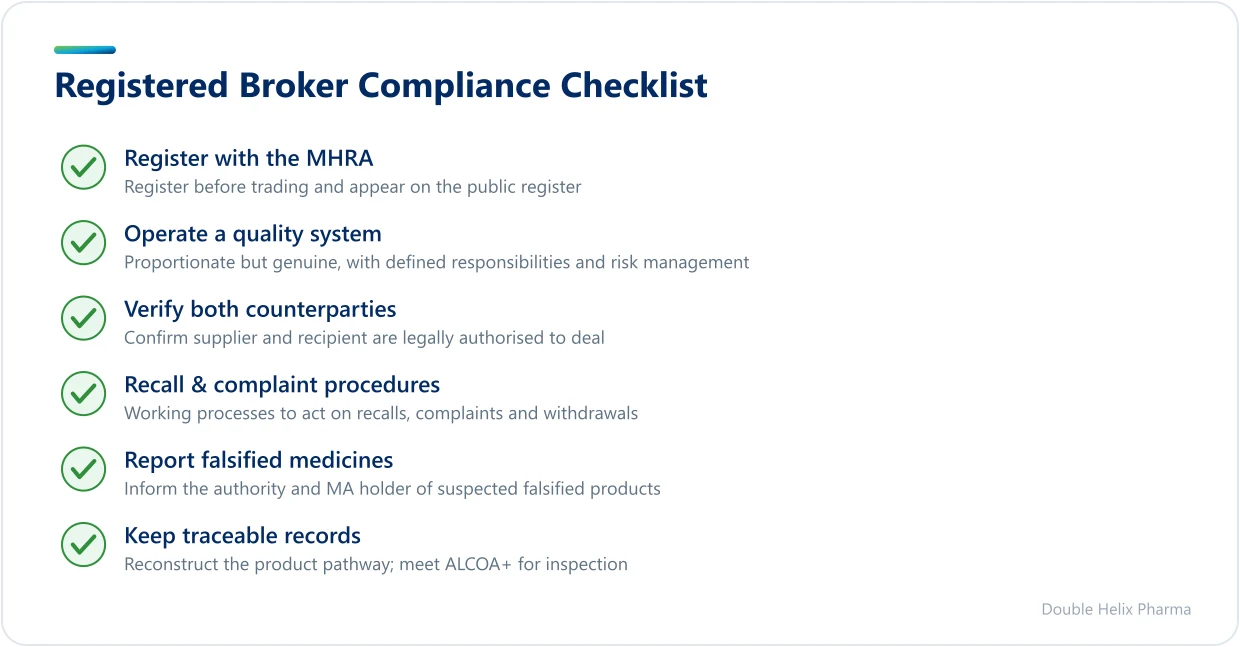
Although brokers do not hold stock, the GDP guidelines apply the relevant principles to brokering. The expectation is a proportionate but genuine quality system, supported by documented evidence that would satisfy ALCOA+ data-integrity expectations during inspection.
Quality system and emergency procedures
A broker must maintain a quality system setting out responsibilities, processes and risk management. Critically, this includes an effective system for handling and managing recalls, complaints and suspected falsified medicines, together with the ability to act on regulatory action such as a recall or withdrawal. The risk-based thinking of ICH Q9 and the lifecycle quality-system expectations of ICH Q10 are the natural reference points here, even where a broker's footprint is small.
Verifying both ends of the transaction
The broker's defining control is counterparty verification. Before facilitating any transaction, you must confirm that:
- the supplier is an authorised wholesale dealer or holds the appropriate manufacturing authorisation; and
- the recipient is permitted to receive the medicines, whether as an authorised wholesaler or another entity legally entitled to supply to the public.
This is the brokering equivalent of qualifying customers and suppliers in conventional distribution. The verification, and the rationale for accepting each party, must be documented and kept current.
Falsified medicines and the supply chain
Brokers are an explicit line of defence against falsified medicines. You must immediately inform the competent authority and, where applicable, the marketing authorisation holder of medicines you identify, or suspect, to be falsified. Because brokers often operate across borders and at the seams of the legitimate chain, this duty carries real weight: the broker may be the only party positioned to notice an irregular offer.
Records, traceability and inspection readiness
Brokers do not raise the same goods-in and goods-out records as a warehouse, but they are not exempt from documentation. Transaction records must allow the full pathway of a product to be reconstructed, supporting onward traceability and any investigation. In practice this means retaining records of orders brokered, the parties involved, and the products and quantities concerned, for the retention period required under the GDP guidelines.
A Responsible Person (RP), or a comparably named accountable individual, should own the quality system, and personnel must be competent and trained for the tasks they perform. The MHRA inspects registered brokers, and the questions are predictable: can you evidence counterparty status, can you demonstrate your falsified-medicines and recall procedures work, and can you produce the records on request? If the answer to any is "not readily", expect findings.
A broker who cannot reconstruct who bought what, from whom, and on what basis, has no defensible quality system, however small the operation.
Common pitfalls and how to manage the risk
The recurring failures we see in client engagements cluster around a few themes:
- Assuming a WDA covers brokering. The two are separate; declare and operate brokering explicitly.
- Drifting into possession. The moment goods touch your control, you are distributing, not brokering.
- Thin quality systems. "Proportionate" is not "absent": recall, complaint and falsified-medicines procedures must exist and be tested.
- Weak counterparty due diligence. Verifying authorisations once, then never revisiting, is a frequent inspection finding.
- Cross-border blind spots. Post-Brexit, GB and Northern Ireland arrangements differ; confirm the rules for each route before trading.
A pragmatic control set, scaled to the size of the operation, closes most of these gaps. Our wider consultancy services and our GDP and supply chain support are built around exactly this kind of risk-based design.
Key takeaways and next steps
Medicines brokering is a regulated activity, not a commercial convenience. If your business negotiates the sale or purchase of authorised medicines without taking possession, you almost certainly need to be registered, to operate a genuine quality system, to verify both counterparties, and to maintain records that survive inspection. The good news is that a well-designed, proportionate framework is entirely achievable, and it protects both your authorisation and the patients at the end of the chain.
If you are uncertain whether your activities amount to brokering, or you want your existing arrangements stress-tested before the MHRA does it for you, speak to our team for a confidential, practitioner-led review.
Regulatory sources
This guidance reflects current UK and EU GMP/GDP requirements. Primary references:
- EMA — GMP/GDP Questions & Answers
- MHRA Inspectorate Blog
- MHRA — UK Medicines & Healthcare products Regulatory Agency
Always confirm against the latest published version of each source.
Frequently asked questions
Do I need a Wholesale Dealer's Authorisation to broker medicines?+
No, brokering and wholesale distribution are distinct activities. A broker negotiates a transaction without ever taking ownership or physical possession of the medicines, whereas a wholesale dealer holds and supplies stock under a WDA(H). However, brokers established in the UK must instead be registered with the MHRA, and holding a WDA does not by itself authorise you to broker.
What quality system does a registered medicines broker actually need?+
Brokers must operate a proportionate but genuine quality system that defines responsibilities, applies risk management in the spirit of ICH Q9 and Q10, and includes working procedures for complaints, recalls and suspected falsified medicines. You must also verify that both the supplier and the recipient are legally entitled to deal in the products. The system has to be documented and demonstrable to an MHRA inspector on request.
What records must a broker keep if they never handle the product?+
Even without goods-in and goods-out records, brokers must keep transaction records that allow a product's pathway to be reconstructed for traceability and investigation. These should capture the orders brokered, the parties involved, and the products and quantities concerned, retained for the period required under the GDP guidelines. Records must satisfy ALCOA+ data-integrity expectations so they hold up during inspection.