GDP Transport & Supply Chain · 7 min read
Good Distribution Practice (GDP): The Essentials
A senior QP's guide to good distribution practice: WDA(H), the Responsible Person, cold chain, data integrity and the pitfalls that fail MHRA inspections.
By Balasubramanian Ramaiah · 9 June 2026 · Updated 22 June 2026
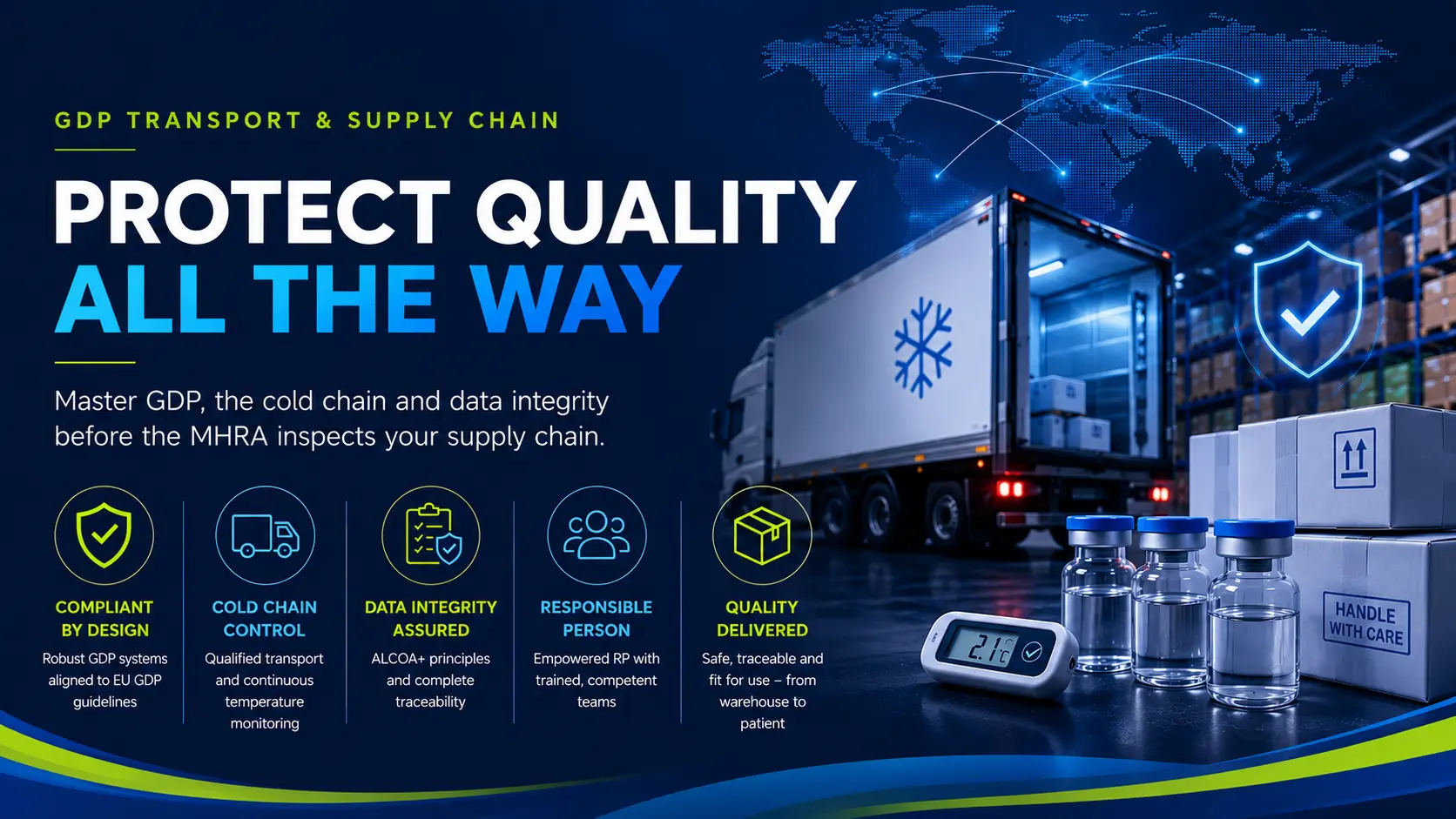
Good distribution practice is the quality system that keeps a medicinal product safe, traceable and fit for use from the moment it leaves the manufacturer until it reaches the patient. For UK and EU supply chains, it is not an optional nicety: it is a legal expectation enforced through wholesale dealer authorisations and inspected against published GDP guidelines. This article sets out the essentials every quality team should have under control.
What good distribution practice actually covers
GDP applies to the procurement, holding, storage and distribution of medicinal products for human use. It bridges the gap between licensed manufacture under EU GMP and the point of supply, ensuring that the quality assured at release is not eroded in transit or storage. In the UK, the regime is administered by the MHRA and underpinned by the European Commission's Guidelines on Good Distribution Practice of Medicinal Products for Human Use (2013/C 343/01), which the UK retained after EU exit.
Anyone who holds, supplies or exports medicinal products in the course of a business needs a Wholesale Dealer's Authorisation (WDA(H)) and must name a Responsible Person (RP). The RP is personally accountable for the GDP system, much as the Qualified Person is accountable for batch certification on the GMP side. Where falsified-medicines safeguards apply, an RP(i) oversees the import of products from third countries.
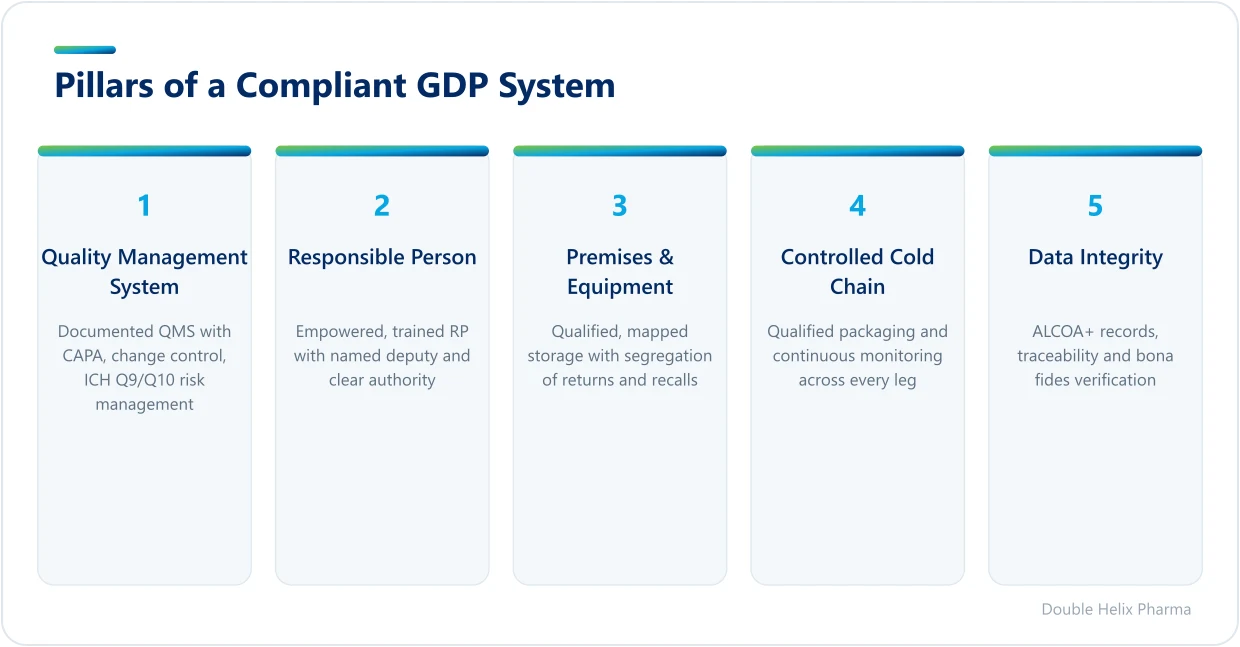
The pillars of a compliant GDP system
A robust distribution operation rests on a few well-understood foundations. None is exotic, but each is routinely cited in inspection deficiencies.
Quality management system
You need a documented quality system that defines responsibilities, processes and risk-management measures. The principles of ICH Q10 translate directly: management review, CAPA, change control and a culture in which deviations are reported rather than concealed. Quality risk management, in line with ICH Q9, should drive decisions on everything from route selection to qualification of suppliers.
Personnel and the Responsible Person
The RP must have the authority and the resources to do the job, with a deputy named for continuity. Staff handling products require role-specific training, and that training must be documented and periodically refreshed. A named, competent RP who is genuinely empowered is the single biggest predictor of a clean inspection.
Premises and equipment
Storage areas must protect products from contamination, mix-ups and adverse conditions. Temperature-controlled space should be mapped before use and monitored continuously, with calibrated equipment and documented qualification. Segregation of returns, recalls, rejected and falsified stock is essential.
Good distribution practice and the cold chain
Temperature is where good distribution practice is most often won or lost. Products labelled for storage at 2-8 degrees Celsius, or as "do not freeze", demand qualified shipping solutions and continuous monitoring across every leg of the journey, including the difficult last mile.
- Temperature mapping of warehouses, cold rooms and reefer vehicles, repeated after significant change and at defined intervals.
- Qualified packaging with documented stability data supporting the claimed duration and ambient envelope.
- Continuous monitoring using calibrated data loggers, with alarms and a defined response when limits are breached.
- Excursion management driven by a risk assessment against the product's stability profile, not a reflex decision to destroy stock.
Each shipment generates data that must withstand scrutiny. Apply ALCOA+ principles so that temperature records are attributable, legible, contemporaneous, original and accurate, and remain complete, consistent, enduring and available throughout the retention period.
Data integrity, traceability and documentation
Distribution is a documentation-heavy discipline. You must be able to reconstruct the movement of any batch, in either direction, quickly enough to support a recall. That means complete records of receipt, storage conditions, onward supply and customer details, retained for the required period and protected against loss or unauthorised change.
Two themes recur in MHRA findings. First, bona fides verification: you may only buy from and supply to appropriately authorised parties, and those checks must be evidenced. Second, electronic records: where temperature monitoring and warehouse management are computerised, systems require validation, access control and audit trails consistent with data-integrity expectations.
If it is not documented, it did not happen, and a batch you cannot trace is a batch you cannot recall.
Common pitfalls and how to close the gaps
The same weaknesses appear time and again, and most are inexpensive to fix once recognised. We see them repeatedly during readiness reviews and mock inspections; our case studies illustrate how they are resolved in practice.
- An RP in name only. A nominal RP without time, training or authority is a deficiency waiting to be written up. Define the role properly and protect the time it needs.
- Unqualified transport routes. Outsourcing logistics does not outsource accountability. Qualify carriers, define conditions in a written agreement, and audit performance.
- Weak supplier and customer governance. Bona fides checks that exist on paper but are not maintained will not survive inspection.
- Cold-chain blind spots. Gaps in monitoring during the last mile and at cross-docking points are a frequent source of unexplained excursions.
- Stale documentation. Procedures that no longer reflect reality undermine the whole quality system; keep change control live.
A focused gap assessment against the GDP guidelines, followed by a prioritised CAPA plan, usually closes the majority of these issues well before an inspector arrives. Our GDP and supply chain service is built around exactly this kind of pragmatic remediation.
Key takeaways
Good distribution practice protects product quality across the journey to the patient and is enforced through WDA(H) authorisations and MHRA inspection. The essentials are a living quality system, an empowered Responsible Person, qualified premises and transport, a controlled cold chain, and data integrity throughout. Get those right and compliance largely follows.
If you are preparing for a WDA(H) inspection, qualifying a new route, or need a contract RP, our team can help. Explore our full range of quality and compliance services, or get in touch to discuss your distribution programme with a Qualified Person.
Regulatory sources
This guidance reflects current UK and EU GMP/GDP requirements. Primary references:
- EMA — GMP/GDP Questions & Answers
- MHRA Inspectorate Blog
- MHRA — UK Medicines & Healthcare products Regulatory Agency
Always confirm against the latest published version of each source.
Frequently asked questions
What is the difference between GMP and GDP?+
GMP (Good Manufacturing Practice) governs how medicinal products are made and quality-assured up to batch release by a Qualified Person. GDP (Good Distribution Practice) takes over from there, controlling procurement, storage and distribution so that the assured quality is preserved all the way to supply. Most regulated supply chains need both, with a QP accountable on the GMP side and a Responsible Person on the GDP side.
Who needs a Wholesale Dealer's Authorisation in the UK?+
Any organisation that procures, holds, supplies or exports medicinal products for human use in the course of a business needs a Wholesale Dealer's Authorisation, WDA(H), issued by the MHRA. The holder must name a Responsible Person who is accountable for the GDP quality system. Importing certain products from third countries additionally requires a Responsible Person (import), or RP(i).
How should a temperature excursion be handled under GDP?+
Quarantine the affected stock and assess the excursion against the product's approved stability data rather than destroying it automatically. Document the duration and magnitude of the deviation, reach a risk-based disposition decision, and record the rationale. Recurring excursions should trigger a CAPA to address the root cause, such as inadequate packaging qualification or a monitoring blind spot.