GDP Transport & Supply Chain · 7 min read
Managing Temperature Excursions
A practical, risk-based guide to managing a temperature excursion under EU GDP and MHRA: detection, investigation, disposition and CAPA done right.
By Balasubramanian Ramaiah · 9 June 2026 · Updated 22 July 2026
A temperature excursion is any deviation outside the labelled storage or transport conditions of a medicinal product, and how you handle it tells regulators a great deal about the maturity of your quality system. The instinct to quarantine and panic, or conversely to wave product through, are both wrong. What you need is a disciplined, risk-based process that protects patients, preserves product and stands up to MHRA scrutiny.
What counts as a temperature excursion?
Under the EU Guidelines on Good Distribution Practice (GDP) and the corresponding MHRA expectations, products must be stored and transported within the conditions stated on the marketing authorisation and labelling. An excursion occurs the moment monitored conditions move beyond those limits, whether that is a refrigerated consignment drifting above 8°C, an ambient product exposed to a heatwave in transit, or a freezer alarm during a power outage.
Two distinctions matter. First, an alarm is not automatically an excursion that affects product; sensor placement, door openings and calibration tolerances all influence what the data really shows. Second, a documented, time-and-temperature limited excursion that falls inside an approved stability budget is very different from an open-ended deviation of unknown duration. Knowing which you are dealing with is the foundation of every decision that follows.
Stability data is your decision currency
You cannot assess an excursion without the relevant stability information. Mean kinetic temperature (MKT), accelerated and stress study data, and any manufacturer-defined permitted excursion windows are the evidence base. Where you are an importer or distributor rather than the manufacturer, secure these limits from the MAH or supplier in advance, in writing, so that decisions are not delayed when a real event occurs.
Build the response into your QMS before it happens
The worst time to design an excursion procedure is during an excursion. Your pharmaceutical quality system, in the spirit of ICH Q10, should already define roles, decision authority and timelines. A robust standard operating procedure covers detection, immediate containment, data retrieval, impact assessment and disposition, with the Responsible Person (RP) and Qualified Person (QP) clearly positioned in the decision chain.
- Detection and alerting: continuous monitoring with alarms routed to people who can act, day and night.
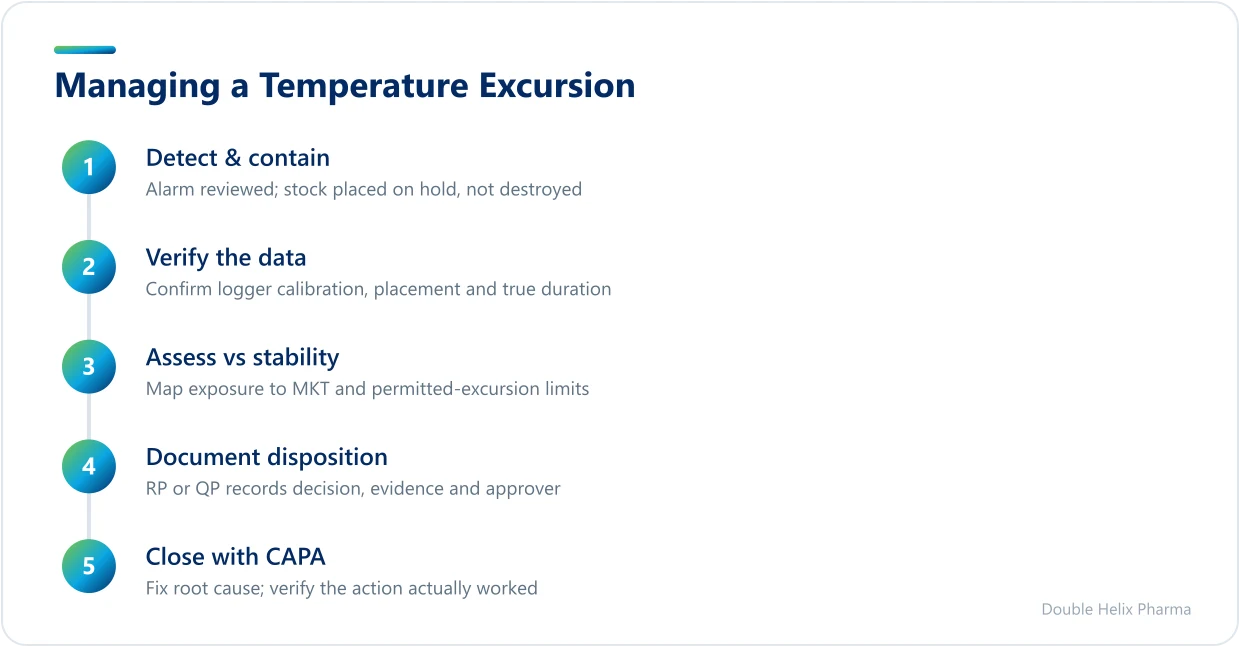
- Immediate containment: stock placed on administrative hold, not destroyed, until assessed.
- Data integrity: raw monitoring data captured in line with ALCOA+ principles, including original logger downloads and audit trails.
- Defined timelines: how quickly an assessment must begin and conclude, so cold-chain stock is not stranded.
Validated, calibrated monitoring is non-negotiable. Qualified shipping lanes, mapped warehouses and calibrated data loggers turn an excursion from a guessing game into a calculation. Our GDP and supply chain services exist precisely to put this infrastructure in place before product is at risk.
Investigating a temperature excursion: a risk-based method
When an event is confirmed, run a structured investigation rather than a reflex. The principles of ICH Q9 on quality risk management apply directly: assess the actual risk to product quality and patient safety, and make the response proportionate to that risk.
- Reconstruct the event. Establish the true duration, the magnitude of the deviation, and the cumulative exposure. A brief touch above range is not the same as twelve hours at temperature.
- Verify the data. Confirm logger calibration, placement and that the reading reflects product temperature, not a transient air-space spike or a door opening.
- Compare against stability limits. Map the exposure against approved permitted-excursion data or MKT calculations. Where data does not exist, the MAH must be consulted.
- Assess cumulative history. A single unit may experience several minor excursions across its life; the budget is finite and shared.
- Document the disposition rationale. Record the decision, the evidence and the approver. "Released on stability data" must be traceable to a specific data set, not a memory.
A disposition decision that cannot be reconstructed from the record is, for regulatory purposes, a decision that was never properly made.
Who decides, and on what authority
For distributed product, the RP holds accountability for GDP compliance and quarantine decisions; where batch certification or recall judgement is engaged, the QP is involved. The principle is that disposition rests with a named, competent, independent decision-maker who can say no. Commercial pressure to release a valuable consignment is real, and your governance must insulate the decision from it.
Disposition, escalation and CAPA
Outcomes generally fall into three categories: release where exposure sits comfortably within validated limits; reject and segregate where limits are exceeded or data is absent; or escalate to the MAH or competent authority where the picture is ambiguous or a wider batch may be affected. Each route must be documented, and rejected stock controlled so it cannot re-enter the supply chain.
An excursion is also a signal. Effective corrective and preventive action (CAPA) looks past the single shipment to the systemic cause: a poorly performing lane, an under-specified shipper, a courier dwelling on a hot loading bay, or seasonal mapping that no longer reflects reality. Trending excursions across routes and suppliers is where genuine improvement lives, and it is a recurring theme in our case studies.
- Root cause: identify the true failure mode, not the nearest symptom.
- Correction: deal with the affected stock now.
- Preventive action: re-qualify the lane, upgrade packaging, or retrain the handler so it does not recur.
- Effectiveness check: confirm the action actually worked before closing.
Strengthening the cold chain end to end
Most excursions are foreseeable and preventable. Thermal qualification of shipping configurations, seasonal lane mapping, qualified third-party logistics providers and clear technical agreements that pin down responsibility at each handover do more to protect product than any after-the-fact investigation. A supplier or 3PL who does not understand your temperature requirements is a future excursion waiting to be logged. Reviewing the full chain, from manufacture through importation to final delivery, is core to our consultancy services.
Key takeaways
Managing a temperature excursion well is a test of system maturity, not luck. Detect reliably, contain without destroying, assess against real stability data, and let an empowered RP or QP make a documented, defensible decision. Then close the loop with CAPA so the same failure does not recur. Build the monitoring, mapping and procedures before you need them, and excursions become routine quality events rather than crises.
If you need to harden your cold-chain procedures, qualify a lane, or want an independent view on a live excursion investigation, our QP and RP team can help. Contact Double Helix Pharma UK to discuss a practical, risk-based path to compliance.
Regulatory sources
This guidance reflects current UK and EU GMP/GDP requirements. Primary references:
- EMA — GMP/GDP Questions & Answers
- MHRA Inspectorate Blog
- MHRA — UK Medicines & Healthcare products Regulatory Agency
Always confirm against the latest published version of each source.
Frequently asked questions
What is the difference between a temperature alarm and a temperature excursion?+
An alarm is a monitoring trigger indicating that a sensor has read outside a set threshold, which may be caused by a door opening, sensor placement or a brief air-space fluctuation. An excursion is a confirmed deviation of the product itself outside its labelled storage conditions. Every alarm should be reviewed, but only verified deviations affecting product are treated as excursions requiring formal assessment and disposition.
Can a product be released after a temperature excursion?+
Yes, provided the cumulative exposure falls within validated stability limits or manufacturer-approved permitted-excursion data, and the decision is made by a competent Responsible Person or Qualified Person. The assessment must compare verified duration and magnitude against the approved stability budget, accounting for any prior excursions in the product's history. The rationale and supporting data must be fully documented under ALCOA+ principles so the decision is reconstructable.
Who is responsible for temperature excursion decisions under UK GDP?+
For distributed medicinal products, the Responsible Person (RP) is accountable for GDP compliance, quarantine and disposition decisions. Where batch certification or recall judgement is engaged, the Qualified Person (QP) becomes involved. The key principle is that an independent, competent and named decision-maker, insulated from commercial pressure, holds the authority to reject product where the data does not support release.