GDP Transport & Supply Chain · 7 min read
Storing and Distributing Controlled Drugs
A practical UK guide to controlled drugs distribution: safe custody, CD registers, ALCOA+ records, secure transport and an integrated, inspection-ready quality system.
By Balasubramanian Ramaiah · 9 June 2026 · Updated 24 August 2026
Few activities in the supply chain attract regulatory scrutiny quite like controlled drugs distribution. Storing and moving Schedule 2 to 5 medicines demands a discipline that goes well beyond standard Good Distribution Practice: secure storage, defensible record-keeping and a chain of accountability that holds up to inspection by both the MHRA and the Home Office. This article sets out the practical controls a UK or EU quality team needs to keep controlled drugs (CDs) compliant from goods-in to onward despatch.
The dual regulatory framework you are operating under
Controlled drugs sit at the intersection of two regimes. The Misuse of Drugs Act 1971 and the Misuse of Drugs Regulations 2001 (as amended) govern who may possess, supply and store CDs, the licences required, and the obligations placed on each Schedule. Layered on top is the MHRA's Good Distribution Practice framework, derived from the EU GDP Guidelines (2013/C 343/01), which governs how any medicinal product is procured, stored, transported and traced.
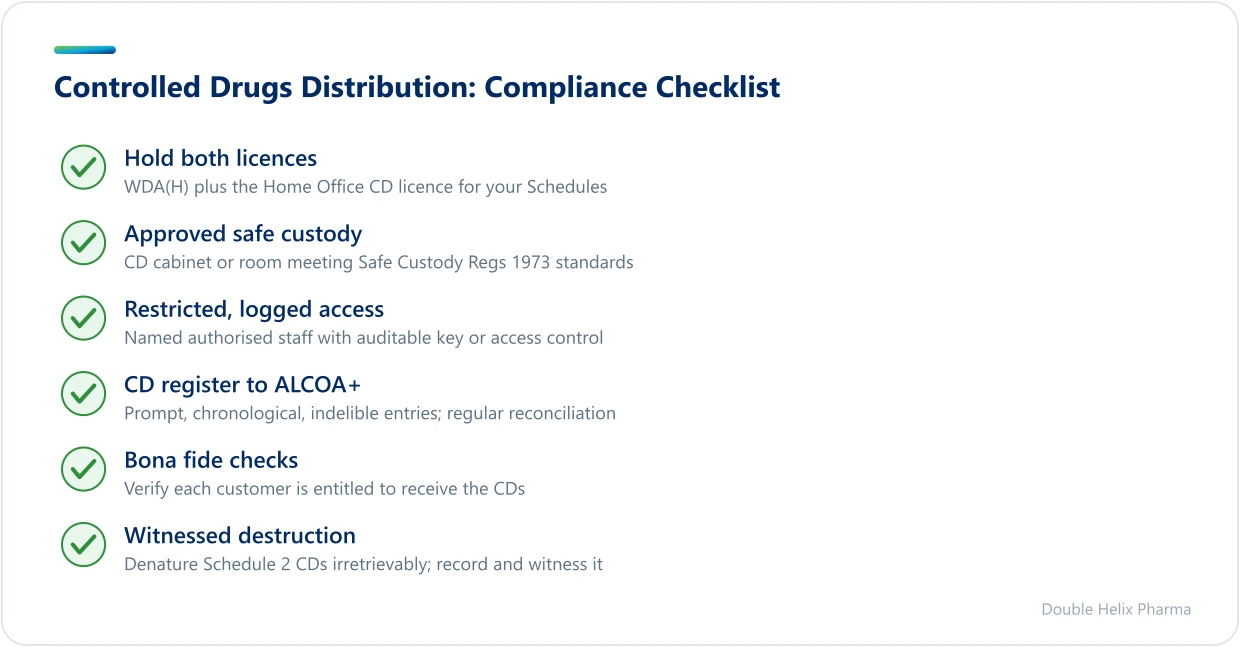
A Wholesale Dealer's Licence (WDA(H)) is the baseline for distributing human medicines, but it does not, by itself, authorise dealing in controlled drugs. You will also need the appropriate Home Office Controlled Drugs Licence for the Schedules you handle, and your Responsible Person (RP) must understand both sets of obligations. Treating GDP and the Misuse of Drugs Regulations as a single, integrated quality requirement is the only sustainable approach.
Schedules drive the controls
The intensity of control scales with the Schedule. Schedule 2 substances (such as many strong opioids) carry the fullest obligations: safe custody, register entries and destruction witnessed by an authorised person. Schedule 3, 4 and 5 substances attract progressively lighter requirements, though record-keeping and storage expectations still apply. Mapping every product you handle to its correct Schedule is the foundation on which the rest of your CD system is built.
Secure storage and safe custody
Safe custody is the control most often tested at inspection. The Misuse of Drugs (Safe Custody) Regulations 1973 set out the physical standards for storing relevant CDs, and your storage solution must be specified, qualified and maintained accordingly.
- Approved storage: CD cabinets or rooms meeting the prescribed construction standards, with controlled, auditable key or access management.
- Restricted access: a documented list of named, authorised personnel, with access logged and reviewed.
- Environmental control: temperature mapping and continuous monitoring where products are temperature-sensitive, supported by qualified equipment and alarm escalation.
- Segregation: clear separation of saleable stock from quarantined, returned, recalled or expired CDs awaiting destruction.
Apply quality risk management here, as ICH Q9 expects. A documented risk assessment of your storage and access arrangements lets you justify the controls you have chosen and demonstrate that residual risks are understood and accepted at the right level.
Records, the CD register and ALCOA+
If safe custody is the physical pillar, record-keeping is the documentary one. For Schedule 2 drugs a controlled drugs register must be maintained, with entries made promptly, in chronological order, and in a form that cannot be erased. Whether your register is bound-paper or a validated electronic system, the data must satisfy ALCOA+: attributable, legible, contemporaneous, original and accurate, plus complete, consistent, enduring and available.
Reconciliation is where many distributors come unstuck. Running balances should be verifiable against physical stock at defined intervals, and any discrepancy investigated, documented and escalated without delay. An unexplained shortfall in a CD register is not a paperwork error; it is a potential diversion signal that an inspector will expect you to have detected and acted upon.
An accurate, contemporaneous and reconcilable record is the difference between demonstrating control and merely asserting it.
Electronic registers and warehouse management systems must themselves be validated, with audit trails switched on, access controlled by individual user credentials, and change history preserved, consistent with the data integrity expectations woven through MHRA guidance and ICH Q10.
Controlled drugs distribution: transport and onward supply
Moving CDs is the point of highest vulnerability, so transport controls deserve particular attention in any controlled drugs distribution operation. GDP requires that product quality and identity are protected in transit and that consignments are delivered only to entities entitled to receive them.
- Bona fide checks: verify, before first supply and periodically thereafter, that each customer holds the licence or authorisation required to receive the CDs in question.
- Secure, tracked transport: tamper-evident packaging, vehicle and consignment security appropriate to the risk, and an unbroken delivery audit trail.
- Temperature control in transit: qualified shipping solutions and monitoring for cold-chain CDs, with deviations assessed against pre-defined stability data.
- Proof of delivery: documented receipt confirming the right product reached the right authorised recipient in the right quantity.
Diversion risk runs through every step. Order patterns that look anomalous, requests to deliver to unverified addresses, or pressure to bypass checks should all trigger your suspicious-order procedures rather than a sale. A robust, well-rehearsed process here protects patients, your licences and your reputation in equal measure.
Destruction and returns
Expired, damaged or returned Schedule 2 CDs must be denatured and destroyed so they are irretrievable, with the destruction witnessed and recorded in line with the Misuse of Drugs Regulations. Returns require their own risk-based assessment before any product is considered for return to saleable stock, with most returned CDs quarantined pending a documented disposition decision. For a sense of how we help clients build these end-to-end controls, our case studies show the approach in practice.
Building an integrated CD quality system
The strongest operations stop treating controlled drugs as a bolt-on and instead embed CD requirements into the pharmaceutical quality system as a whole. That means SOPs that explicitly cover the Misuse of Drugs obligations, trained and named accountable individuals, self-inspection programmes that test CD controls specifically, and management review that surfaces CD reconciliation trends and near-misses.
Appointing or contracting a Responsible Person with genuine CD expertise is central. The RP must have the authority and independence to halt a supply, reject a return or escalate a discrepancy, and the competence to keep the system aligned as guidance evolves. Where in-house capacity is stretched, a contract RP can provide that assurance without diluting accountability. Our GDP supply chain services and wider consultancy services are built precisely around this integrated model.
Key takeaways
- Compliant controlled drugs distribution depends on satisfying the Misuse of Drugs Regulations and GDP together, not in isolation.
- Safe custody, restricted and logged access, and qualified environmental control are the physical foundation; a contemporaneous, reconcilable CD register meeting ALCOA+ is the documentary one.
- Transport and onward supply are the highest-risk points: bona fide checks, secure tracked delivery and active diversion monitoring are non-negotiable.
- Embed CD controls into your quality system, underpinned by ICH Q9 risk management and ICH Q10 lifecycle thinking, and led by a competent Responsible Person.
If you are preparing for an inspection, extending a WDA(H) to cover controlled drugs, or simply want a candid review of your current CD controls, talk to our QP and RP team. We will help you turn fragmented requirements into a single, inspection-ready system.
Regulatory sources
This guidance reflects current UK and EU GMP/GDP requirements. Primary references:
- EMA — GMP/GDP Questions & Answers
- MHRA Inspectorate Blog
- MHRA — UK Medicines & Healthcare products Regulatory Agency
Always confirm against the latest published version of each source.
Frequently asked questions
Do I need a separate Home Office licence to distribute controlled drugs if I already hold a WDA(H)?+
Yes. A Wholesale Dealer's Licence authorises distribution of human medicines generally, but it does not by itself permit dealing in controlled drugs. You also need the appropriate Home Office Controlled Drugs Licence covering the specific Schedules you intend to handle. Both must be held and kept current before you store or supply the relevant CDs.
What are the safe custody requirements for storing Schedule 2 controlled drugs?+
Relevant controlled drugs must be held in storage that meets the construction and security standards set out in the Misuse of Drugs (Safe Custody) Regulations 1973, typically an approved CD cabinet or room. Access must be restricted to named, authorised personnel and logged, with keys or electronic access controlled and auditable. Where products are temperature-sensitive, qualified monitoring and alarm escalation should also be in place.
How often should controlled drug stock be reconciled against the register?+
Reconciliation should happen at defined, risk-based intervals so that the running balance in the CD register can be checked against physical stock regularly. Any discrepancy must be investigated, documented and escalated promptly, because an unexplained shortfall is a potential diversion signal rather than a clerical error. Inspectors expect to see that you detect, record and act on differences without delay.