GDP Transport & Supply Chain · 7 min read
Cold Chain Validation: A Practical Guide
A senior QP's practical guide to cold chain validation: risk-based strategy, temperature mapping, transport lane qualification and excursion management.
By Balasubramanian Ramaiah · 9 June 2026 · Updated 4 September 2026

For temperature-sensitive medicines, the cold chain is not a logistics detail — it is a critical quality attribute that determines whether a product reaches the patient safe and effective. Cold chain validation is the documented, science-based exercise that proves your storage and distribution conditions consistently keep product within its labelled range, from the manufacturing release point to final delivery. This guide sets out a practical, inspection-ready approach for UK and EU quality teams managing refrigerated and frozen medicinal products.
What cold chain validation actually means
It is worth being precise about terms, because the MHRA and EU inspectors are. Qualification demonstrates that a specific piece of equipment — a cold room, a fridge, a validated shipper — performs as intended. Validation is the broader documented evidence that the end-to-end process reliably maintains the required conditions. Mapping is the temperature study underpinning both. In day-to-day use the phrase "cold chain validation" usually means the whole programme: mapping, equipment qualification, transport validation and the ongoing monitoring that keeps it alive.
The regulatory anchors are the EU Guidelines on Good Distribution Practice (2013/C 343/01), which the MHRA continues to apply and reflects in its Rules and Guidance for Pharmaceutical Distributors (the "Green Guide"), together with EU GMP for product on the manufacturing side. The expectation throughout is risk-based, in the spirit of ICH Q9, and supported by data that satisfies ALCOA+ principles.
Building a risk-based validation strategy
Before any data logger is switched on, define the problem. A defensible programme starts with the product and works outward, not with the equipment you happen to own.
Define the conditions and the risk
- Labelled storage conditions — typically 2–8°C for refrigerated product, or defined frozen ranges; these set your acceptance criteria, not internal convenience.
- Product stability data — the registered stability profile and any approved excursion allowances tell you how much deviation the product can tolerate and for how long.
- Worst-case scenarios — seasonal extremes, peak loading, door openings, power loss and the longest realistic transit time.
This assessment feeds a validation plan or protocol that names the equipment and lanes in scope, the acceptance criteria, the number of studies, and the rationale for each decision. Quality risk management is what justifies where you invest effort — concentrating on the routes and units that pose the greatest threat to product, rather than spreading thin and uniform attention across everything.
Temperature mapping and equipment qualification
Static storage is where most programmes begin. Every controlled-temperature area — cold rooms, walk-in freezers, pharmacy fridges, qualified storage — must be mapped to locate hot and cold spots before it is relied upon. Sound practice includes:
- A documented mapping protocol specifying sensor placement (corners, centre, near doors, return-air and supply points), study duration and acceptance limits.
- Calibrated, traceable sensors with calibration certificates retained, ideally bracketing the range of interest.
- Studies under realistic conditions, including full and minimum loads, and a repeat in the opposing season where ambient swings are significant.
- Open-door and power-failure challenges to understand recovery behaviour and the time available before product is at risk.
The output is not just a pass or fail. Mapping tells you where to position permanent monitoring probes, where not to store product, and what alarm set-points are realistic. Equipment qualification (IQ/OQ/PQ) then formalises that the unit is installed correctly, operates across its range, and performs over time. Frozen and ultra-low-temperature units deserve particular rigour, as recovery margins are far less forgiving.
Validating transport and shipping lanes
Distribution is where cold chains most often break, and where inspectors increasingly focus. Transport validation must reflect how product actually moves, not an idealised diagram.
Active versus passive systems
Passive shippers — qualified insulated boxes with conditioned coolant — are validated for a defined payload, pack-out and duration under a temperature profile that represents summer and winter extremes. Active systems, such as refrigerated vehicles or powered containers, require qualification of the unit plus controls around loading, set-point and monitoring. Either way, the validation must define the limits of the solution: maximum and minimum ambient, time-out-of-refrigeration allowance, and the exact pack-out instruction that operators must follow without interpretation.
Lane and seasonal challenge
Validate by lane or by representative worst-case lane, with summer and winter studies where the climate justifies it. Capture real transit data, account for customs or hub delays, and confirm that the shipper still holds at the upper end of its rated duration. A solution that performs in the laboratory but not on a delayed Friday delivery has not been validated in any meaningful sense. For organisations building out distribution capability, our GDP distribution and supply chain service covers lane qualification and shipper selection end to end, and you can see comparable engagements in our case studies.
Monitoring, excursions and keeping validation alive
Validation is a snapshot; the cold chain runs every day. Continuous monitoring with calibrated data loggers, defined alarm limits and clear escalation routes turns a one-off study into a controlled process. When an excursion occurs — and it will — the response must be procedural, not improvised.
An excursion is not automatically a rejection. It is a quality decision: assess the duration and magnitude against the product's stability data and approved limits, document the rationale, and let a qualified decision-maker disposition the stock.
Robust programmes maintain a defined temperature excursion procedure, a mean kinetic temperature approach where appropriate, and full ALCOA+ traceability of every logger record. Revalidation is triggered by change — new equipment, a new lane, modified pack-out, refrigeration repairs, or a shift in product range — and reviewed periodically as part of the quality system, consistent with ICH Q10. Change control and CAPA are what stop a validated state from quietly decaying. You can read more about how we structure quality systems across our consultancy services.
Key takeaways
Effective cold chain validation is risk-based, evidence-led and continuous. Get these right and you will withstand inspection while genuinely protecting product:
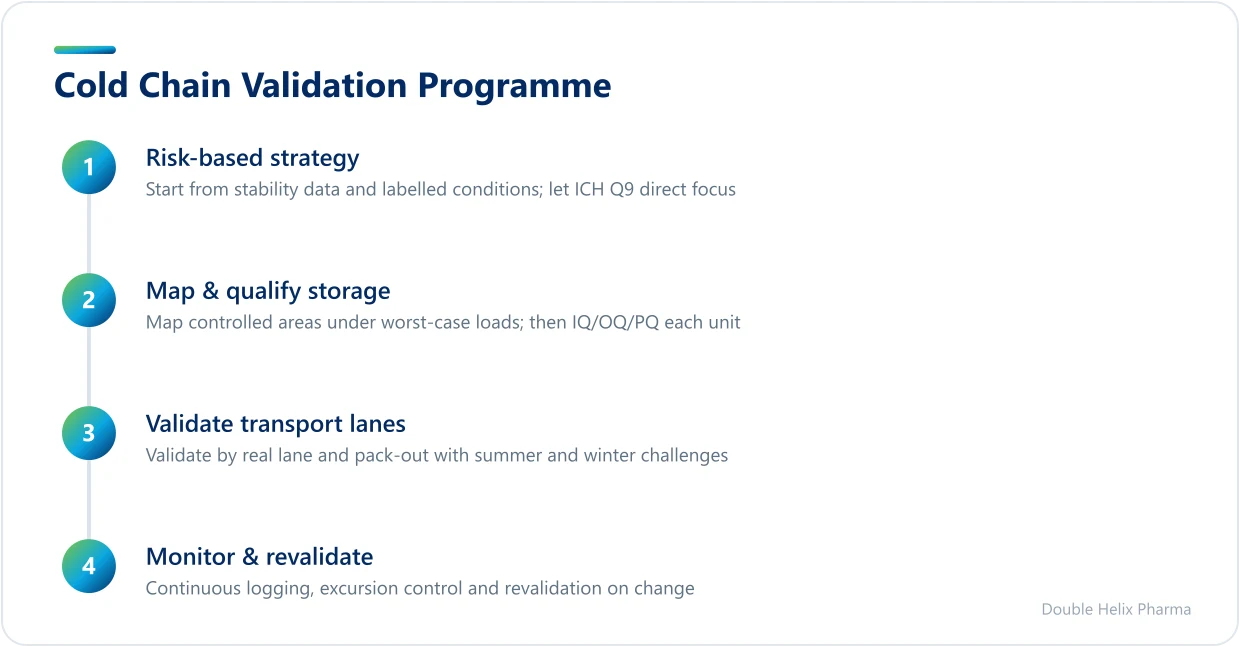
- Start from product stability and labelled conditions, then let ICH Q9 risk management direct where you focus.
- Map storage under realistic, worst-case and seasonal conditions before relying on any unit.
- Validate transport by real lane and pack-out, with summer and winter challenges, not idealised assumptions.
- Treat monitoring, excursion management and revalidation as a living process under change control.
If you are scoping a new programme, qualifying shipping lanes, or preparing for an MHRA inspection, our team can help you build a proportionate, defensible approach. Contact us to discuss your cold chain validation requirements with a senior QP.
Regulatory sources
This guidance reflects current UK and EU GMP/GDP requirements. Primary references:
- EU GMP Annex 15 — Qualification and Validation
- EMA — GMP/GDP Questions & Answers
- MHRA Inspectorate Blog
- MHRA — UK Medicines & Healthcare products Regulatory Agency
Always confirm against the latest published version of each source.
Frequently asked questions
How often should cold chain validation be repeated?+
There is no fixed calendar interval mandated; revalidation is driven by change and periodic review under your quality system. Trigger a fresh study whenever equipment, shipping lanes, pack-out configurations or the product range change, or after significant refrigeration repairs. In addition, review the validated state periodically — many organisations confirm storage mapping on a defined cycle and re-challenge transport lanes seasonally where ambient extremes are significant.
Does a temperature excursion automatically mean the product must be rejected?+
No. An excursion is a quality decision, not an automatic rejection. The duration and magnitude are assessed against the product's registered stability data and any approved excursion allowances, the rationale is documented to ALCOA+ standards, and a qualified decision-maker dispositions the stock. This is why a defined temperature excursion procedure and access to stability data are essential before a deviation ever occurs.
What is the difference between qualification, validation and mapping?+
Qualification proves a specific item of equipment — a cold room, fridge or shipper — performs as intended, typically through IQ, OQ and PQ. Mapping is the temperature study that locates hot and cold spots and underpins both qualification and monitoring placement. Validation is the wider documented evidence that the end-to-end storage and distribution process reliably maintains the required conditions; in everyday use, cold chain validation refers to the whole programme.