QMS & PQS Implementation · 7 min read
SOP Management: Keeping Procedures Current and Used
SOP management for UK and EU pharma: keep procedures current, controlled and actually used at the point of use, in line with EU GMP, ICH Q10 and ALCOA+.
By Balasubramanian Ramaiah · 9 June 2026 · Updated 8 August 2026
Most quality systems do not fail for want of procedures; they fail because the procedures are out of date, contradictory or quietly ignored on the floor. Effective SOP management is the discipline that keeps standard operating procedures current, controlled and genuinely used, rather than printed, signed and forgotten. This article sets out how UK and EU quality teams keep their SOP estate alive and inspection-ready under EU GMP and MHRA expectations.
Why SOP management decides whether your PQS works
Standard operating procedures are the connective tissue of a pharmaceutical quality system. Chapter 4 of the EU GMP guide makes documentation a foundation of GMP, and the principles of ICH Q10 treat procedural control as part of an effective pharmaceutical quality system rather than an administrative chore. A procedure that does not reflect how work is actually performed is not a minor housekeeping issue; it is a documented misstatement of your controlled process.
The MHRA and other inspectors consistently cite procedural failings: SOPs that contradict one another, documents past their review date, versions in use that differ from the controlled master, and staff who cannot locate the procedure governing the task in front of them. Each of these undermines the central claim of any GMP operation, that activities are performed against approved, current instructions.
Procedures as data, not just paper
Once a procedure is executed, the records it generates fall squarely within ALCOA+. If an SOP is ambiguous, out of date or unavailable at the point of use, the resulting records are difficult to defend as attributable, contemporaneous and accurate. Good SOP management is therefore inseparable from data integrity: the instruction and the evidence of compliance stand or fall together.
The lifecycle: drafting, approval and controlled issue
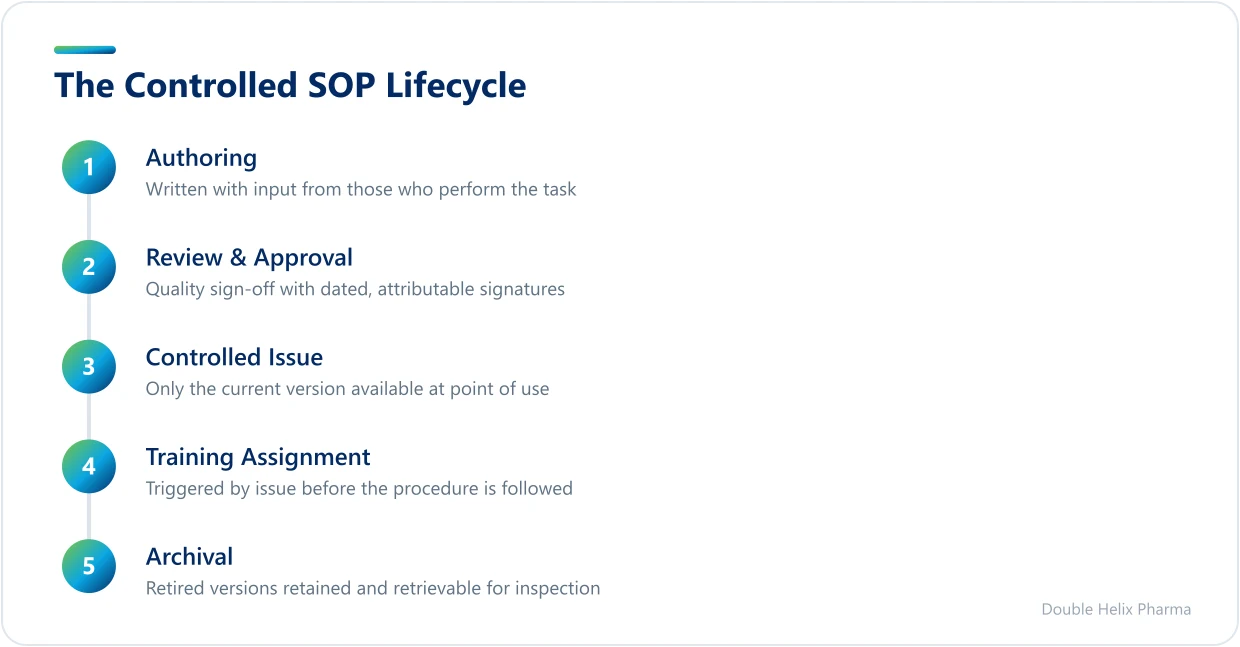
A procedure should be governed across its whole life, not merely written once. A robust lifecycle has clear, auditable stages.
- Authoring by someone who understands the process, ideally with input from the people who perform it, so the document describes reality rather than an idealised version of it.
- Review and approval by quality and the relevant function, with electronic or wet signatures that are attributable and dated.
- Controlled issue so that only the current, approved version is available at the point of use and superseded copies are withdrawn.
- Training assignment triggered by issue, so that no one is expected to follow a procedure they have not been trained on.
- Archival of retired versions, retained for the required period and retrievable for investigations or inspections.
Version control is the spine of all this. Every procedure needs a unique identifier, a version number, an effective date and a defined retention period, whether managed in a validated electronic document management system or a disciplined paper-based register. Where the system is electronic, the principles of Annex 11 and the data integrity expectations behind 21 CFR Part 11 apply to access control, audit trails and electronic signatures.
Keeping procedures current: periodic review and change control
Currency is where most SOP systems decay. Two mechanisms keep procedures honest, and they must work together.
Scheduled periodic review
Every SOP should carry a defined review cycle, commonly every two to three years, set on a risk basis rather than applied uniformly. The point of periodic review is not to re-approve an unchanged document for the sake of a fresh date; it is to ask whether the procedure still matches current practice, equipment, regulations and references. A review that simply increments the version number without genuine scrutiny is a finding waiting to happen.
Event-driven change control
Procedures must also change in response to deviations, CAPAs, new equipment, regulatory updates such as the revised Annex 1 for sterile products, or audit findings. Each change should pass through formal change control, with the impact on training, linked documents and validated state assessed before the revision takes effect. Applying ICH Q9 quality risk management here ensures effort is concentrated where patient risk is highest, rather than spread thinly across every document equally.
An SOP that has not changed in five years is not necessarily stable; more often it is simply unread.
From shelf to floor: making SOPs actually used
A perfectly controlled procedure that no one follows is worse than no procedure at all, because it creates a documented gap between what you say and what you do. Closing that gap is the hardest part of SOP management and the part inspectors probe hardest.
- Write for the user. Procedures should be clear, concise and task-focused. Dense, over-long documents that bundle policy, rationale and instruction together are routinely ignored in favour of memory or local custom.
- Train to the version. Read-and-understand sign-off is the minimum; for critical or complex tasks, assess competence rather than merely recording that a document was opened.
- Make access frictionless. If the current version is hard to find, operators will reach for an old printout. Point-of-use access to the controlled document removes that temptation.
- Verify in practice. Self-inspection, gemba walks and routine supervision should check that the documented procedure and the observed task genuinely match.
The cultural signal matters as much as the mechanism. When staff see that procedures are kept accurate, easy to use and responsive to their feedback, they trust and follow them. When SOPs are perceived as obstacles imposed from above, workarounds proliferate, and those workarounds are precisely what an experienced auditor will surface. A pragmatic QMS implementation bakes usability into the document system from the outset.
Common SOP management failures and how to avoid them
The same weaknesses recur across sites of every size. Knowing them lets you design controls that pre-empt them.
- Overdue reviews. Documents drift past their review date because no one owns the schedule. A simple, monitored review calendar with named owners prevents the backlog.
- Procedure sprawl. Too many overlapping SOPs create contradiction and confusion. Periodically rationalise and consolidate rather than only ever adding.
- Orphaned cross-references. When one SOP is revised, linked documents and forms are not updated, leaving dangling references. Change control must trace and update dependencies.
- Training lag. A new version goes effective before staff are trained, so people work to the old method. Tie the effective date to training completion for critical procedures.
- Uncontrolled local copies. Printed or desktop copies persist after revision. Controlled point-of-use access and periodic sweeps for rogue copies address this.
You can see how we have helped organisations rebuild a controlled, usable document estate in our case studies, and how SOP management fits within our wider quality and compliance services.
Key takeaways
Strong SOP management is not about generating more documents; it is about keeping a lean, accurate set of procedures current through risk-based periodic review and disciplined change control, and ensuring they are trained, accessible and genuinely followed at the point of use. Treat procedures as living controls and the records they produce will hold up under ALCOA+ scrutiny; treat them as paperwork and the gap between your documented and actual practice will eventually be found.
If your SOP estate has grown unwieldy, drifted out of date, or simply is not being used as written, talk to our team for a practitioner-led review and a practical plan to bring your procedures back under control.
Regulatory sources
This guidance reflects current UK and EU GMP/GDP requirements. Primary references:
- EU GMP Chapter 1 — Pharmaceutical Quality System
- EudraLex Volume 4 — EU GMP Guidelines
- EMA — GMP/GDP Questions & Answers
Always confirm against the latest published version of each source.
Frequently asked questions
How often should pharmaceutical SOPs be reviewed?+
There is no single regulated interval, but a periodic review cycle of every two to three years is common practice, set on a risk basis so that higher-impact procedures are reviewed more frequently. Critical, complex or frequently changing processes may warrant annual review, while stable, low-risk procedures can sit at the longer end. The key expectation under EU GMP Chapter 4 is that the cycle is defined, documented and genuinely actioned, not that a fixed number is met.
What is the difference between periodic review and change control for SOPs?+
Periodic review is a scheduled, time-based check that asks whether an existing procedure still reflects current practice, equipment and regulations, regardless of whether anything has changed. Change control is event-driven and triggered by a specific need to revise, such as a deviation, CAPA, new equipment or a regulatory update like the revised Annex 1. A mature SOP management system runs both: the calendar catches quiet drift, while change control manages active revisions and their impact on training and linked documents.
How do you make sure staff actually follow SOPs?+
Start by writing concise, task-focused procedures that describe how the work is really done, then assign training tied to each effective version, using competence assessment rather than read-and-understand alone for critical tasks. Make the current controlled version frictionless to access at the point of use so operators are never tempted to rely on old printouts or memory. Finally, verify alignment through self-inspection and routine supervision, and feed observations back into the document so the procedure stays trusted and used.