QMS & PQS Implementation · 7 min read
Building a CAPA System That Closes the Loop
How to build a CAPA system that closes the loop: risk-based triage, defensible root cause analysis and effectiveness checks for UK and EU pharma quality teams.
By Balasubramanian Ramaiah · 9 June 2026 · Updated 17 August 2026
Most quality teams can raise a deviation and write an action. Far fewer can show, months later, that the action eliminated the problem and that it has not crept back. That gap is exactly where a CAPA system either earns its keep or quietly becomes a backlog of overdue records and inspection risk. Building a system that genuinely closes the loop means designing the whole lifecycle, from problem statement to effectiveness check, around evidence rather than activity.
What "closing the loop" actually means
Under EU GMP Chapter 1 and the ICH Q10 pharmaceutical quality system model, corrective and preventive action is one of the mechanisms that keeps the quality system in a state of control. The loop is only closed when you can demonstrate, with documented evidence, that the original problem has been corrected, its root cause removed, the same vulnerability prevented elsewhere, and the change shown to be effective over time. Anything short of that is an open risk wearing a closed status.
It helps to keep three terms distinct, because inspectors will:
- Correction – the immediate fix to the specific problem, such as quarantining an affected batch or re-issuing a faulty document.
- Corrective action – the change that removes the root cause so the problem cannot recur.
- Preventive action – the change that addresses the same weakness wherever else it could occur, before it does.
Collapsing all three into a single "we re-trained the operator" entry is one of the most common reasons a CAPA fails to hold. A robust QMS implementation keeps these elements visible and separately evidenced.
Designing the CAPA lifecycle
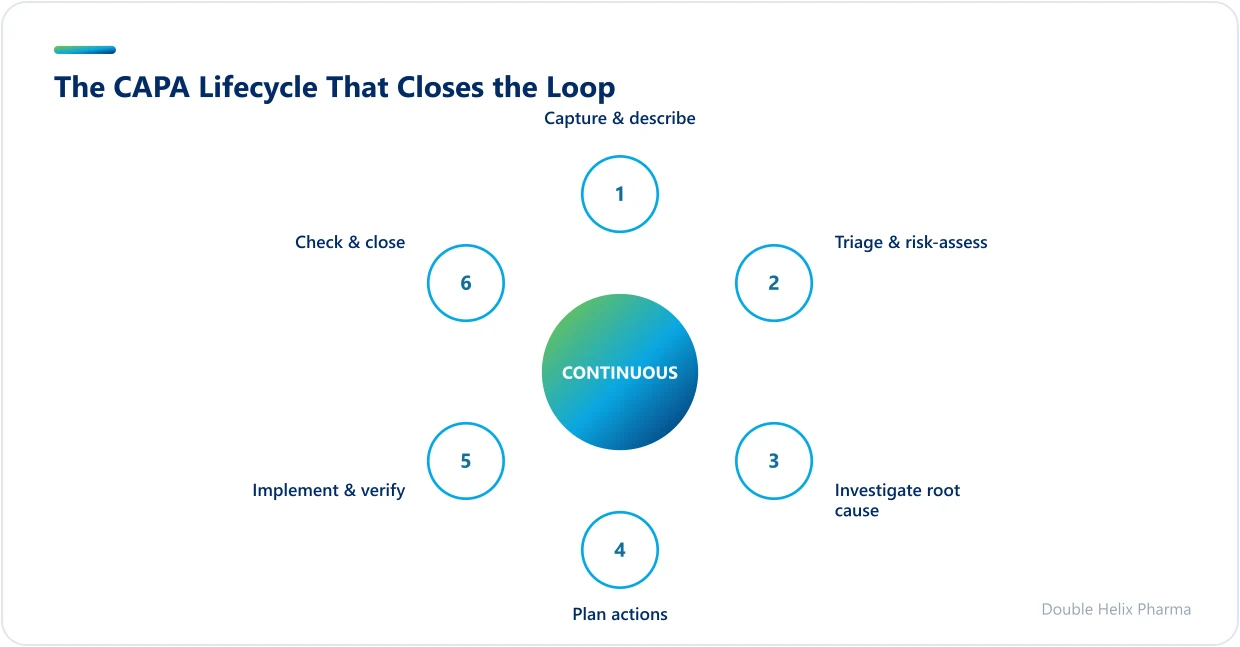
A defensible system follows a predictable, auditable flow. Each stage should have a clear owner, a defined output and a quality gate before it moves on.
- Capture and describe. Record a precise problem statement: what happened, where, when, the batches or systems affected, and how it was detected. Vague intake produces vague root cause.
- Triage and risk-assess. Decide quickly whether the issue even warrants a CAPA, and at what priority.
- Investigate root cause. Use a structured method and follow the evidence rather than the first plausible story.
- Plan actions. Define corrections, corrective and preventive actions, each with an owner and a realistic due date.
- Implement and verify. Execute the changes and confirm they were completed as written.
- Check effectiveness. Gather evidence, after a defined interval, that the problem has not recurred.
- Close. Document the rationale for closure and feed any wider lessons into management review.
Risk-based triage stops the system drowning
Not every deviation deserves a full investigation, and treating them as if they do is how backlogs form. ICH Q9 quality risk management gives you the licence to scale effort to risk. A minor, well-understood, one-off event with no product impact may need only a correction and a brief justification. A recurring data-integrity issue touching ALCOA+ principles, or a contamination signal under Annex 1, warrants a deep, formally documented investigation.
Make recurrence visible
Triage should always ask whether the issue has been seen before. A system that cannot link a new event to previous similar ones will keep raising fresh single-point CAPAs for what is really one unresolved systemic problem. Trending and categorisation at intake are what turn a pile of records into intelligence, and they are a frequent focus in MHRA inspections.
Root cause analysis that holds up
The investigation is where most CAPA systems are won or lost. The aim is to reach a root cause that, if removed, genuinely prevents recurrence, not to find a convenient human to blame. Choose a method proportionate to the problem: the five whys for simpler issues, fishbone or fault-tree analysis for complex or multi-causal events.
Two disciplines separate strong investigations from weak ones:
- Evidence over assertion. Every causal claim should be supported by records, data or direct observation. "Operator error" is almost never a root cause; it is usually a symptom of an unclear procedure, an unworkable step or inadequate training design.
- Test the conclusion. Before committing to actions, ask whether the proposed root cause actually explains all the facts, and whether removing it would have prevented the event. If the logic does not hold, the actions will not either.
If your corrective action is almost always "re-train and remind", your investigations are stopping at the symptom. Systemic fixes change the system, not just the people in it.
Effectiveness checks: the step that closes the loop
Implementing an action is not the same as proving it worked, yet missing or token effectiveness checks remain one of the most frequently cited CAPA weaknesses in EU and MHRA inspections. An effectiveness check is pre-defined evidence, gathered after a sensible interval, that the root cause is gone and the problem has not returned.
Good effectiveness checks share a few traits. They are defined when the action is planned, not invented at closure. They use objective measures, such as the absence of recurrence over a set number of batches, a trend that has shifted, or a re-audit of the affected process. And they have teeth: if the check fails, the correct response is to reopen the CAPA and revisit the root cause, not to force a closure to hit a metric. Examples of this discipline applied across real remediation programmes appear in our case studies.
Governance, metrics and ownership
A CAPA system is only as healthy as the data you watch and the management attention behind it. Under ICH Q10, CAPA performance is an explicit input to management review, so the metrics need to drive decisions rather than decorate a slide.
- Ageing and overdue rate. Overdue CAPAs are auditable and erode regulator confidence quickly; a realistic ninety-day plan that is met beats a thirty-day commitment that slips.
- Reopened and recurring CAPAs. A rising trend points to weak root cause analysis rather than bad luck.
- Effectiveness check failure rate. A useful signal of investigation quality.
- Source mix. Whether issues come from self-inspection, complaints, audits or deviations tells you how proactive the system really is.
Clear single-point ownership for each CAPA, supported by a quality unit that can escalate, prevents records from stalling between functions. The same principles apply whether you run a manufacturing site, a CMO relationship or an importer operation under our wider quality and compliance services.
Key takeaways
A CAPA system that closes the loop is built on a few stubborn principles: describe problems precisely, scale effort to risk, find root causes you can evidence, and prove effectiveness before you close. Get those right and your CAPA records become proof that the quality system works, rather than a backlog waiting to be found. Distinguishing correction from corrective and preventive action, and refusing to default to re-training, will do more for inspection readiness than any software upgrade.
If your CAPA system feels more like a queue than a control, we can help you redesign the lifecycle, strengthen root cause analysis and embed effectiveness checks that hold up under inspection. Talk to our team about building a CAPA system that genuinely closes the loop.
Regulatory sources
This guidance reflects current UK and EU GMP/GDP requirements. Primary references:
- EU GMP Chapter 1 — Pharmaceutical Quality System
- EudraLex Volume 4 — EU GMP Guidelines
- EMA — GMP/GDP Questions & Answers
Always confirm against the latest published version of each source.
Frequently asked questions
What is the difference between a correction, a corrective action and a preventive action?+
A correction is the immediate fix to the specific problem found, such as quarantining an affected batch or re-issuing a faulty document. A corrective action removes the root cause so the same problem cannot recur, while a preventive action tackles that vulnerability anywhere else it could arise before it does. Inspectors expect all three to be handled and evidenced separately rather than collapsed into a single quick fix such as re-training one operator.
How do effectiveness checks make a CAPA system more inspection-ready?+
An effectiveness check is pre-defined evidence, gathered after a sensible interval, that a corrective action actually worked and the problem has not returned. Implementing an action is not the same as proving it was effective, and missing or token effectiveness checks are among the most frequently cited CAPA weaknesses in EU and MHRA inspections. If a check fails, the correct response is to reopen the CAPA and revisit the root cause rather than force a closure to hit a metric.
How does ICH Q9 risk management help manage CAPA workload?+
ICH Q9 quality risk management lets you scale investigation effort to the actual risk, which stops a CAPA system from drowning in low-value records. A minor, well-understood, one-off event with no product impact may need only a correction and a brief justification, whereas a recurring data-integrity or contamination issue warrants a deep, formally documented investigation. This risk-based triage, combined with trending to spot recurrence, keeps attention on the issues that genuinely threaten product quality.