QMS & PQS Implementation · 8 min read
Choosing an eQMS: A Buyer's Guide
A practical eQMS selection guide for UK and EU pharma teams: map processes first, demand ALCOA+ and Annex 11 validation, then qualify the vendor.
By Balasubramanian Ramaiah · 9 June 2026 · Updated 1 July 2026
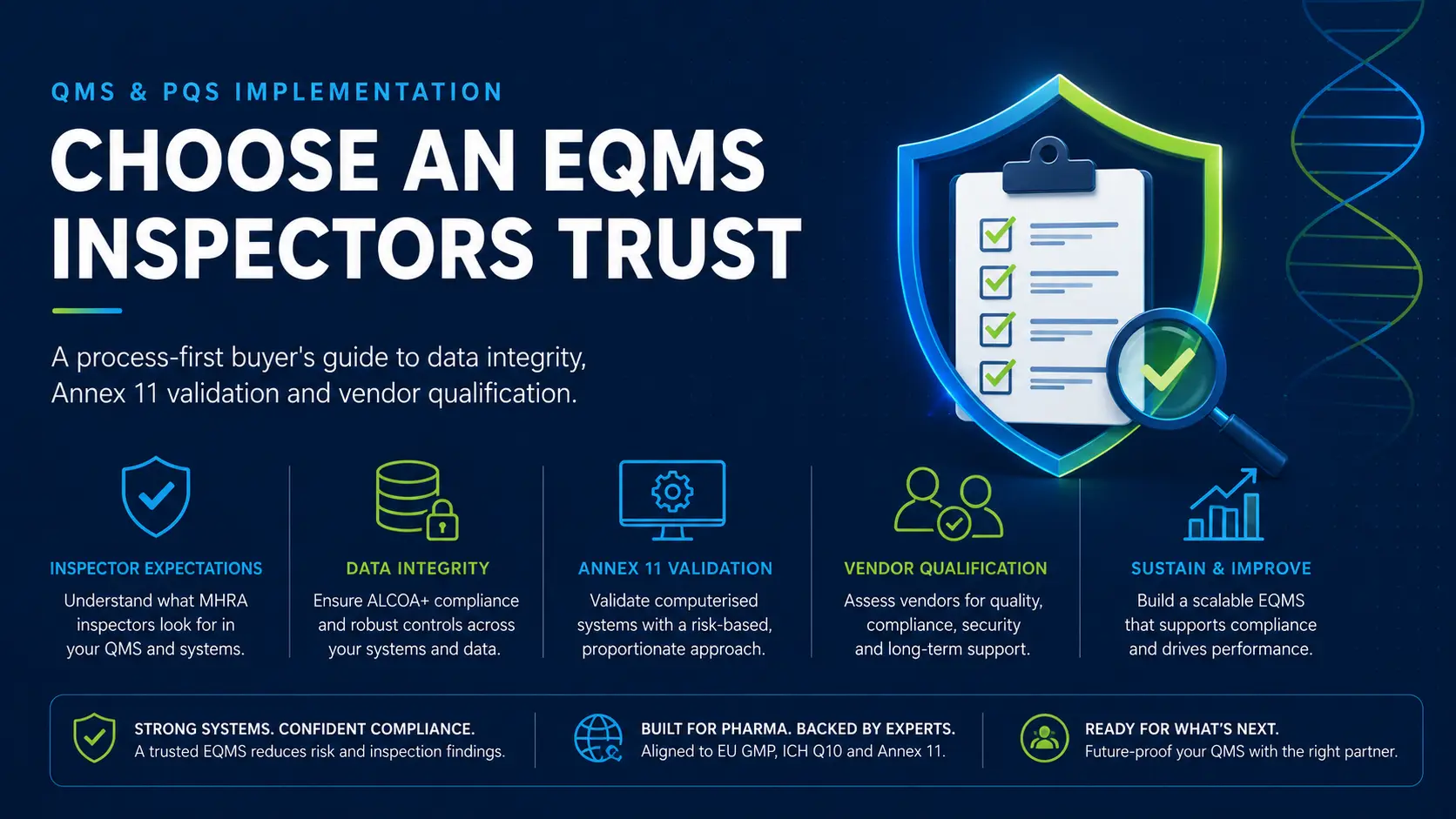
Few quality investments shape day-to-day working life as much as the software that runs your quality system, yet eQMS selection is too often driven by a glossy demo rather than a clear-eyed view of your own processes. Choose well and you get faster, more defensible quality decisions and a system that inspectors trust; choose badly and you simply digitise your existing problems at considerable cost. This buyer's guide sets out how UK and EU teams can run the decision properly.
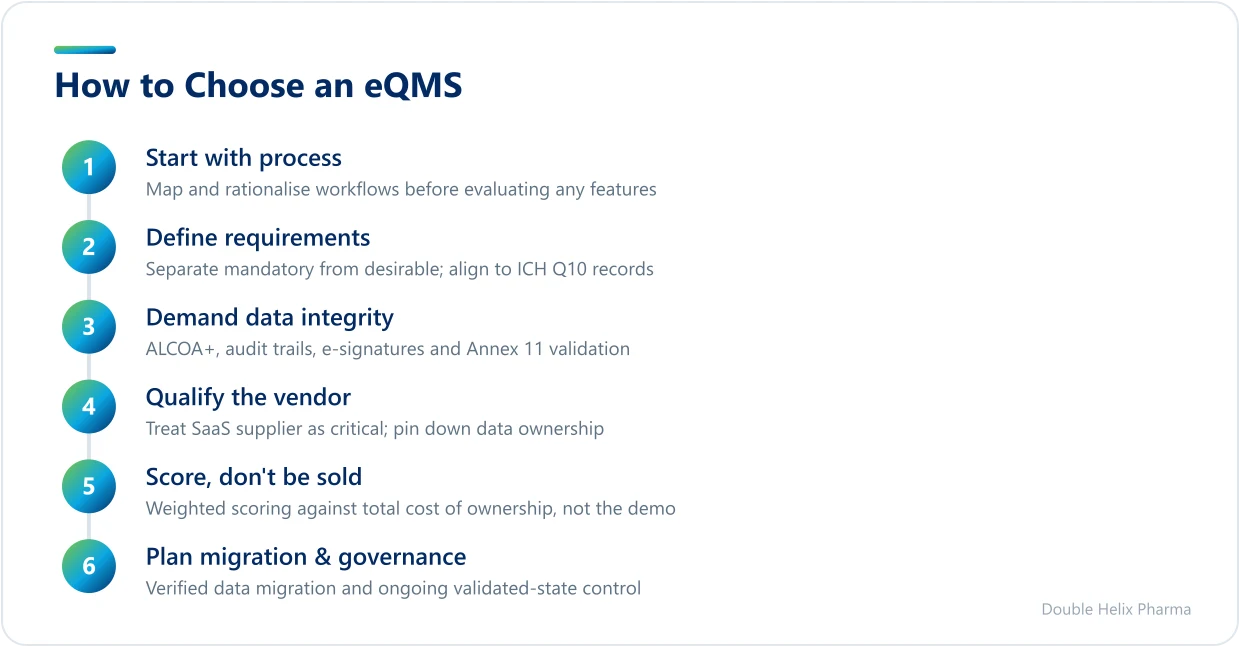
An electronic quality management system (eQMS) is the platform that manages records such as deviations, CAPA, change control, complaints, audits, training and document control. The principles here apply equally to a manufacturer, a CMO, a biotech or an importer, because the regulatory bar is the same: whatever the technology, it must keep your records compliant with EU GMP, MHRA expectations and ALCOA+ data integrity principles.
Start with process, not features
The most common eQMS selection mistake is shopping for features before understanding your own workflows. A long list of modules is meaningless if it does not map to how your quality system actually operates and to the ICH Q10 elements it must support: CAPA, change management, process performance monitoring and management review.
Before you speak to a single vendor, document your current and target processes. Where do deviations originate, who triages them, how is risk assessed under ICH Q9, and where do bottlenecks form today? An eQMS should encode a process you have already rationalised. Automating a broken workflow only makes it fail faster, and fixing it on paper is far cheaper than reconfiguring after go-live.
Configure the system to your validated process; do not quietly bend your process to fit the software's defaults without assessing the impact on compliance.
Map requirements to your real obligations
Translate your regulatory and business needs into a structured requirements specification, separating mandatory requirements from desirable ones. This document later becomes the backbone of your validation and your selection scoring, so it is worth the effort. Build it around the records you must control and the GxP scope you operate under, whether that is GMP manufacturing, GDP distribution or both.
Data integrity and validation are non-negotiable
Any eQMS is a GxP computerised system, so it must satisfy data integrity expectations from the outset rather than as an afterthought. Assess every shortlisted product against ALCOA+: are records attributable, legible, contemporaneous, original and accurate, and are they complete, consistent, enduring and available across their full retention period?
In practice that means scrutinising several technical controls before you commit.
- Audit trails — secure, time-stamped, computer-generated and tamper-evident, capturing who did what and when, with no ability to disable or edit them.
- Access control — unique user identities, role-based permissions and genuine segregation of duties, with no shared logins.
- Electronic signatures — properly bound to records and meeting the expectations of EU GMP Annex 11 and, where you supply the US market, 21 CFR Part 11.
- Record integrity — controlled retention, secure backup, archival and restoration that you can demonstrate, not merely assert.
Validation is equally fundamental. Annex 11 expects computerised systems to be validated for their intended use, supported by supplier assessment and a risk-based approach. Ask how the vendor supports validation: do they provide documented evidence of their own software development lifecycle, configuration specifications and standard test scripts you can leverage? A credible supplier shortens your validation effort; the accountability for the validated state, however, always remains with you.
Cloud, SaaS and the supplier relationship
Most modern eQMS products are delivered as cloud-based software as a service, which changes the nature of the supplier relationship rather than removing your responsibilities. Under Annex 11 the regulated company remains accountable, so the vendor becomes a critical service provider that must be qualified and governed like any other.
Treat the selection as a supplier qualification exercise. A vendor audit, or at minimum a robust postal assessment, should examine their quality system, security posture, infrastructure and change and incident management. Several questions deserve firm answers in writing.
- How are software updates and patches released, and how do you assess and re-validate the impact of vendor-driven changes on your validated configuration?
- Where is data physically hosted, and how are backup, disaster recovery and business continuity assured and tested?
- How is your data segregated, secured and, critically, returned to you in a usable format if the contract ends?
- What audit rights, service levels and notification timescales are written into the contract?
A formal quality agreement or technical agreement should capture these responsibilities so there is no ambiguity about who does what when an update, an incident or an inspection arrives.
Build a structured selection and scoring process
With requirements defined and data integrity expectations clear, run the commercial selection with the same discipline you would apply to any critical supplier. Resist the pull of an impressive sales demonstration by scoring each candidate objectively against your weighted requirements.
Demonstrate against your own scenarios
Insist that vendors configure a trial against your real workflows, not their canned showcase. Walk a genuine deviation or change control through the system end to end, and have the people who will use it daily test usability. Poor adoption is a real compliance risk: if the system is cumbersome, staff create workarounds, and workarounds are precisely what inspectors find.
Look beyond the licence cost
The headline subscription is rarely the true figure. Account for the full cost of ownership: configuration, validation, data migration, integration with existing systems, training and ongoing administration. A system that is cheap to licence but expensive to validate and maintain may be the costlier choice over its lifetime. Our case studies show how a structured, requirements-led selection avoids exactly this kind of expensive misstep.
Plan implementation, migration and ongoing governance
Selecting the product is only the start; a disciplined implementation determines whether the investment pays off. Migrating legacy records, particularly open CAPAs, deviations and controlled documents, demands a documented and verified migration plan so that data integrity is preserved in transit and nothing is silently lost or altered.
Equally, an eQMS is not a one-off purchase but a system you must keep in a validated, controlled state for its whole life. Periodic review, change control over configuration, user access reviews and audit trail review all need owners and a defined cadence. Embedding the platform within a coherent quality management system — rather than treating it as standalone software — is what makes the difference between a tool people trust and one they tolerate. It is also worth seeing where an eQMS fits among your wider compliance services and obligations.
Key takeaways
Sound eQMS selection is fundamentally a quality decision, not an IT procurement. Get the groundwork right and the software becomes the mechanism by which your quality system runs faster and more defensibly; rush it, and you simply automate today's weaknesses at scale.
- Define and rationalise your processes and requirements before you evaluate any product.
- Treat data integrity, ALCOA+, audit trails and electronic signatures as non-negotiable, in line with Annex 11.
- Qualify the vendor as a critical supplier and pin down data ownership, validation support and exit terms in writing.
- Score candidates objectively against weighted requirements and the total cost of ownership, not the demo.
- Plan migration and ongoing governance so the system stays validated and controlled for its whole life.
If you are about to begin an eQMS selection, or you suspect an existing system is being worked around rather than relied upon, an independent review will often expose the gaps faster than an internal team can. Explore our QMS implementation services or get in touch to discuss how we can help you choose, validate and embed a system that regulators trust and your teams actually use.
Regulatory sources
This guidance reflects current UK and EU GMP/GDP requirements. Primary references:
- EU GMP Chapter 1 — Pharmaceutical Quality System
- EudraLex Volume 4 — EU GMP Guidelines
- EMA — GMP/GDP Questions & Answers
Always confirm against the latest published version of each source.
Frequently asked questions
What is the difference between an eQMS and a paper or hybrid quality system?+
An eQMS manages quality records such as deviations, CAPA, change control and document control electronically within a single validated platform, rather than across paper forms, spreadsheets and email. The advantages are automated workflows, real-time trending and stronger data integrity through computer-generated audit trails. Both approaches must meet the same regulatory expectations, but a well-configured eQMS makes ALCOA+ compliance far easier to demonstrate during an inspection.
Does a cloud-based eQMS still need to be validated by the customer?+
Yes. Under EU GMP Annex 11 the regulated company remains accountable for the validated state of any computerised system, even when it is delivered as cloud-based software as a service. A reputable vendor will support you with documented development evidence, configuration specifications and test scripts that reduce your effort, but the validation and the supplier qualification remain your responsibility. You should treat the provider as a critical supplier and govern them through a quality or technical agreement.
What are the most important data integrity features to check during eQMS selection?+
Prioritise secure, tamper-evident and time-stamped audit trails that cannot be disabled or edited, alongside unique user identities with role-based access and genuine segregation of duties. Electronic signatures must be properly bound to records and meet Annex 11, plus 21 CFR Part 11 if you supply the US market. Finally, confirm controlled retention, secure backup and demonstrable archival and restoration so records stay complete and available across their full retention period.