QMS & PQS Implementation · 7 min read
Change Control: A Practical Framework
A practical change control pharma framework for UK and EU quality teams: prospective assessment, risk-based classification, and effectiveness review under ICH Q9/Q10.
By Balasubramanian Ramaiah · 9 June 2026 · Updated 12 August 2026
Few processes reveal the true health of a quality system as quickly as change control. Done well, change control pharma teams can demonstrate that nothing reaches the patient without being assessed, justified and approved; done badly, it becomes a bottleneck that people quietly route around. This framework sets out how to make the process proportionate, defensible and genuinely useful rather than a box-ticking exercise.
The principles below hold across EU GMP, MHRA expectations, the ICH Q9 and Q10 framework and, for GDP operations, the distribution guidelines. They apply equally to a manufacturer, a CMO or an importer, because the underlying question is always the same: what could this change affect, and have we controlled it?
Why change control sits at the centre of the quality system
ICH Q10 names change management as one of the four pillars of an effective pharmaceutical quality system, alongside CAPA, process performance monitoring and management review. The reason is straightforward: a validated state is only ever a snapshot. Equipment is replaced, suppliers shift, specifications tighten, premises are reconfigured and software is updated. Each of these can erode the validated condition unless it is formally assessed before it happens.
The defining feature of proper change control is that it is prospective. Assessing a change after it has been made is not change control; it is deviation management. The whole value of the process lies in deciding, in advance, whether a proposed change is acceptable and what must be done to keep the product, process and data in a state of control.
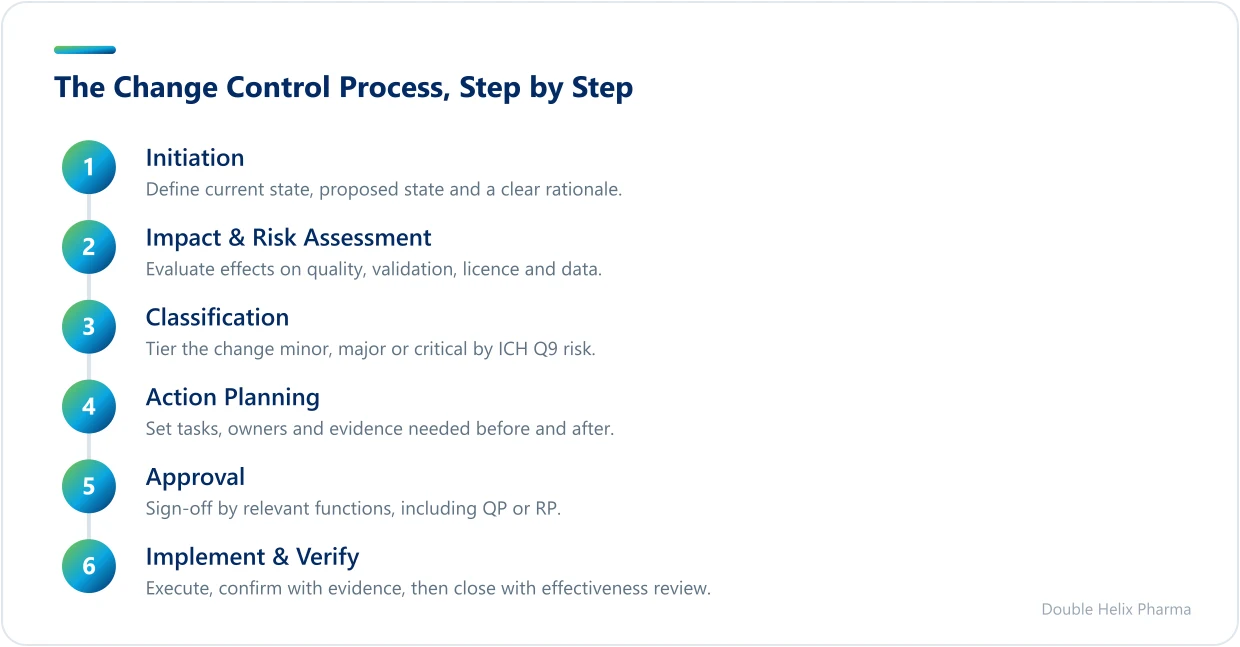
The anatomy of a robust change control process
A workable procedure does not need to be elaborate, but it does need to be complete. Every change should move through a defined sequence, with the depth of effort scaled to the risk involved.
- Initiation — a clear description of the current state, the proposed state and the rationale. Vague requests such as "update the process" cannot be assessed; specificity here saves rework later.
- Impact and risk assessment — a structured evaluation of what the change could affect: product quality, validated status, the marketing authorisation, data integrity, suppliers and any GxP systems.
- Classification — categorising the change so the level of scrutiny and approval matches the risk.
- Action planning — defining the tasks, owners and evidence required before the change can be implemented, and anything needed afterwards.
- Approval — sign-off by the relevant functions, including the QP or Responsible Person where the change touches release or distribution.
- Implementation and verification — executing the plan and confirming, with evidence, that the change landed as intended and the controlled state holds.
- Closure — a documented review that the change is complete, effective and that no loose ends remain open.
Classify by risk, not by habit
The single most useful discipline is honest classification. A like-for-like consumable swap does not warrant the same machinery as a new manufacturing site, a specification change or a move that alters a regulatory filing. Quality risk management under ICH Q9 should drive the tiering — typically minor, major and critical — with the assessment proportionate to the potential impact on the patient and the product. Treating every change as critical breeds the very workarounds you are trying to prevent; treating everything as minor invites a serious finding.
Impact assessment: asking the questions that matter
The quality of a change control record stands or falls on its impact assessment. A strong assessment is multidisciplinary and asks deliberately awkward questions before approval, not after. In practice that means probing several dimensions for every change of consequence.
- Product and process — does this affect critical quality attributes, critical process parameters or the validated state? Is requalification or revalidation triggered?
- Regulatory — does the change touch the marketing authorisation or licence, and does it require a variation or notification before implementation?
- Data integrity — for any change to a computerised system, are ALCOA+ principles preserved, and have audit trails, access controls and validation status been considered?
- Supply chain — does it alter an approved supplier, starting material or outsourced activity, and is the technical or quality agreement still accurate?
- Facilities and contamination control — for sterile operations, does the change affect the contamination control strategy expected under Annex 1?
If your impact assessment never concludes that further work is required, it is not an assessment — it is a rubber stamp. The point is to surface dependencies before they surface you.
Organisations exporting or importing into other markets should remember the wider reach of these questions. A change benign under EU GMP may still require action under 21 CFR 210/211 or another regulator's framework, and the assessment should flag that explicitly rather than assume it away.
Common failure modes and how to avoid them
Most change control findings cluster around a handful of recurring weaknesses. Recognising them is half the battle.
Retrospective changes dressed up as planned ones
When a change has already happened and a record is created afterwards to legitimise it, that is a deviation and should be handled as one. Backdating or reframing it as planned change control is a data integrity problem that inspectors find quickly and treat seriously.
Open changes that never close
A backlog of changes stuck in implementation is a visible, auditable sign of a system under strain. Each open record represents a process whose controlled state may no longer be assured. Set realistic timelines, monitor them through your quality system, and escalate slippage formally rather than letting actions drift.
Skipping effectiveness review
Implementing a change is not the same as confirming it worked. For significant changes, define upfront what evidence will demonstrate success, then review it after a meaningful interval before closure. A change that quietly reintroduces an old problem is worse than no change at all.
Linking change control to the wider quality system
Change control does not live in isolation. It feeds CAPA when a corrective action requires a permanent process change, it draws on deviation history to anticipate risk, and it should surface in management review through clear metrics: numbers open and overdue, average closure time, and the proportion classified as critical. Those trends tell leadership whether the system is genuinely in control or merely busy.
Building this into a living quality management system — rather than a standalone log — is what separates a mature operation from a compliant-on-paper one. Our case studies show how tightening change control directly reduces deviations, smooths inspections and shortens the path from proposed change to implemented improvement.
Key takeaways
Effective change control pharma practice rests on a simple idea: decide before you act, and scale the rigour to the risk. Get that right and the process stops being a brake on the business and becomes the mechanism by which the business improves safely.
- Keep change control prospective — if it is assessed after the fact, it is a deviation.
- Classify by patient and product risk using ICH Q9, not by habit or convenience.
- Make the impact assessment multidisciplinary and willing to conclude that more work is needed.
- Involve the QP or Responsible Person wherever a change touches release or distribution.
- Close changes with verified effectiveness, and watch the backlog as a system-health signal.
If your change control backlog is growing, your impact assessments feel thin, or retrospective changes are starting to creep in, an independent review often pinpoints the weakness faster than an internal team can. Explore our QMS implementation services or get in touch to discuss how we can help you build change control that regulators trust and your teams actually use.
Regulatory sources
This guidance reflects current UK and EU GMP/GDP requirements. Primary references:
- EU GMP Chapter 1 — Pharmaceutical Quality System
- EudraLex Volume 4 — EU GMP Guidelines
- EMA — GMP/GDP Questions & Answers
Always confirm against the latest published version of each source.
Frequently asked questions
What is the difference between change control and deviation management?+
Change control is prospective: it assesses and approves a proposed change before it is implemented, deciding in advance whether it is acceptable and what controls are needed. Deviation management is reactive, dealing with an unplanned departure from a procedure or specification after it has occurred. If a change has already been made and a record is created afterwards to justify it, that is a deviation, not change control, and treating it otherwise raises a data integrity concern.
How should changes be classified under a risk-based change control system?+
Classification should be driven by quality risk management principles from ICH Q9, with the level of scrutiny proportionate to the potential impact on product quality, the patient and the validated or regulatory state. A common approach uses minor, major and critical tiers, so a like-for-like consumable swap is not handled with the same machinery as a new site or a change affecting the marketing authorisation. Honest classification matters because over-grading every change breeds workarounds, while under-grading invites serious findings.
When must a Qualified Person be involved in change control?+
A QP should be involved whenever a proposed change could affect product quality, the validated state or batch release decisions, since the QP carries personal responsibility for certification. For GDP operations, the Responsible Person plays the equivalent role where a change touches storage, distribution or the integrity of the supply chain. Their sign-off should be a genuine technical review of the impact assessment, not a procedural formality added at the end.