Site Readiness (MIA/WDA) · 7 min read
The Site Master File: A Complete Guide
A practical guide to the site master file: what EU GMP Part III requires, how to structure it to PIC/S, and how to keep it inspection-ready and current.
By Balasubramanian Ramaiah · 9 June 2026 · Updated 15 September 2026

The site master file is the single document an inspector reaches for first and the one that quietly sets the tone for the entire visit. Required of every holder of a Manufacturer's/Importer's Authorisation, it is your site described on its own terms: what you do, where, how it is controlled and who is accountable. Get it right and it earns trust before the inspector has walked the floor; get it wrong and it invites scrutiny you did not need.
What a site master file is — and what it is not
A site master file (SMF) is a concise, factual description of a pharmaceutical manufacturing or importation site and its GMP-related activities. Its content and structure are defined by EU GMP Part III, which adopts the PIC/S Explanatory Notes for Industry on the Preparation of a Site Master File. The MHRA expects every MIA holder to maintain one, and it is routinely requested ahead of, or at the start of, an inspection.
It is emphatically not a quality manual, and it is not a dumping ground for procedure. The SMF describes the site; your SOPs and your quality system documents govern how the work is actually done. A common failure is the SMF that swells past its intended length because authors paste in detail that belongs in a procedure. PIC/S guidance is explicit that the document, excluding annexes, should not normally exceed around 25 to 30 pages. If yours is materially longer, it is almost certainly carrying detail it should reference rather than reproduce.
The structure: what EU GMP Part III expects
The PIC/S template gives you the chapters, and inspectors expect them in that order. Following it is not bureaucratic box-ticking; it lets an assessor find what they need without hunting, which is exactly the impression you want to create.
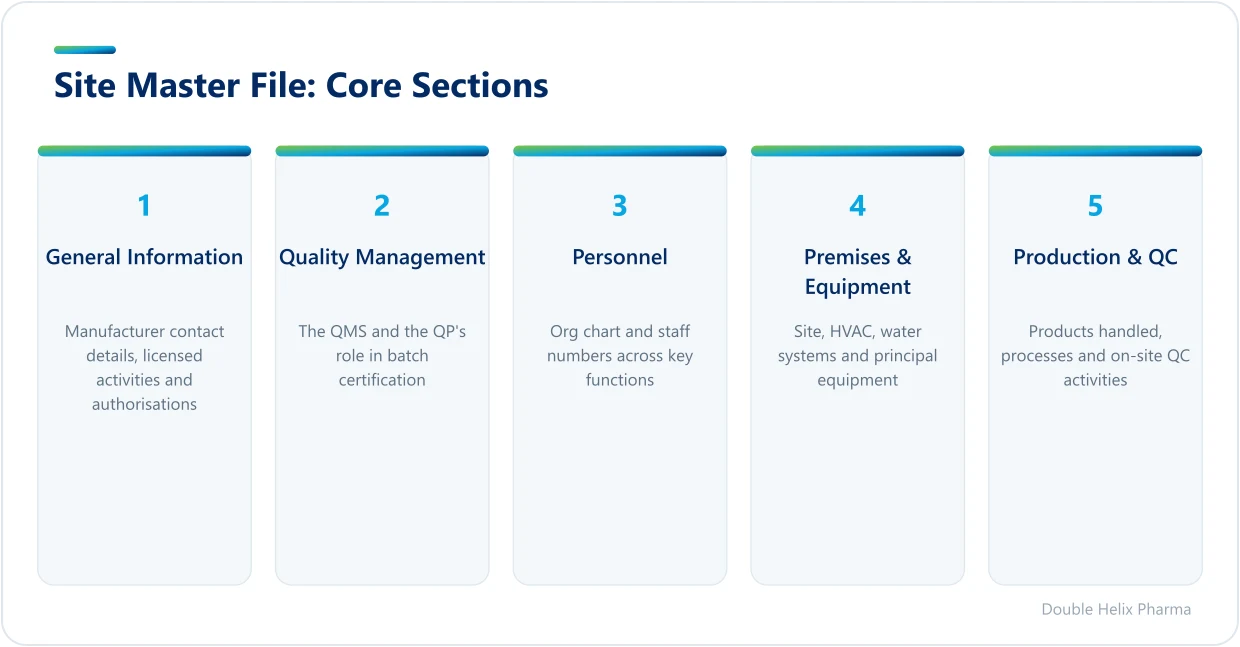
- General information on the manufacturer — contact details, the site's licensed activities, and the authorisations held, including any other manufacturing or non-pharmaceutical activities on site.
- Quality management system — a description of the QMS, the responsibilities of the management, and the role of the Qualified Person in batch certification.
- Personnel — an organisation chart and the numbers of staff engaged in quality, production, storage and distribution.
- Premises and equipment — a description of the site, the HVAC and water systems, and the principal production and laboratory equipment.
- Documentation — the documentation system and how records are controlled.
- Production — the products handled, the processes used, and arrangements for process validation and material handling.
- Quality control — the QC activities performed on site.
- Distribution, complaints, defects and recalls — the arrangements in place, which is where GDP responsibilities intersect with the SMF.
- Self-inspection — how the site's self-inspection programme operates.
The mandatory annexes do much of the heavy lifting: a copy of the valid manufacturing authorisation, a list of dosage forms, a simple site plan, schematic drawings of HVAC and water systems where relevant, and a list of contract manufacturers and laboratories with their addresses. The annexes are where detail legitimately lives, keeping the body of the document lean.
Writing a site master file that works under inspection
The best SMFs share a temperament: factual, current and confident. They state what is true without editorialising, and they never overstate capability. An inspector reads the SMF before arriving and forms a mental model of your site; every discrepancy they later find between the document and reality costs you credibility and frequently triggers deeper probing.
Keep it accurate, not aspirational
Describe the site as it is today, not as you intend it to be after the next project completes. If a cleanroom grade, a piece of equipment or an outsourced activity is described in the SMF but cannot be evidenced on the day, you have manufactured your own finding. Where flows matter — personnel, material, waste and product — a clear schematic communicates control far better than paragraphs of prose, and aligns with the contamination control thinking that Annex 1 now expects of sterile operations.
Make outsourced activities explicit
Modern supply chains mean few sites do everything in house. The SMF must name contract manufacturers, testing laboratories and other GMP-relevant outsourced activities, with addresses. For importers in particular, the document should make the importation and QP certification arrangements unambiguous, because that is precisely where assessors focus. If you are preparing a new licence or extending scope, building the SMF early is a core part of robust site readiness rather than a task left until the inspection is booked.
Keeping the site master file current and controlled
An SMF is a controlled GMP document and must be managed as one, with version control, formal approval and a defined review cycle. PIC/S guidance expects it to be kept current; in practice that means reviewing it at least annually and, more importantly, updating it through your change control process whenever something material changes — a new production line, a revised licence, a new contract laboratory, a significant organisational change or a new HVAC system.
If your change control process can alter the site without ever touching the site master file, the document will drift out of date and you will discover the gap mid-inspection.
Treat the SMF as a living index to your operation rather than a static artefact written once and refreshed only when an inspection looms. Assign clear ownership — typically the QP or the head of quality — so accountability is unambiguous. A quick discipline that pays off: before any planned inspection, walk the document against the site and confirm every annex, every number and every named third party is still correct. The examples in our case studies show how a well-maintained SMF consistently sets a calmer, more confident tone for the whole inspection.
Key takeaways and next steps
A strong site master file is concise, accurate, properly structured to EU GMP Part III, and kept genuinely current through change control. It describes your site honestly, points to the quality system rather than duplicating it, and gives an inspector an orientation they can trust. Treated well, it is one of the highest-leverage documents you maintain; neglected, it becomes the first thing that undermines you.
If your site master file has grown unwieldy, drifted from reality, or you are preparing one for a new MIA or WDA, it is worth getting a senior pair of eyes on it before a regulator does. We help UK and EU manufacturers, importers and CMOs build inspection-ready documentation that holds up under pressure — get in touch to talk through your site master file and wider site readiness.
Regulatory sources
This guidance reflects current UK and EU GMP/GDP requirements. Primary references:
- MHRA — UK Medicines & Healthcare products Regulatory Agency
- EudraLex Volume 4 — EU GMP Guidelines
- MHRA Inspectorate Blog
Always confirm against the latest published version of each source.
Frequently asked questions
What is the difference between a site master file and a quality manual?+
A site master file describes a specific manufacturing or importation site: its activities, premises, equipment, personnel and the GMP arrangements in place. A quality manual describes the pharmaceutical quality system at a higher, organisational level. The SMF is site-specific and inspector-facing, structured to EU GMP Part III, whereas the quality manual frames the overall QMS; the two are complementary rather than interchangeable.
Who is responsible for maintaining the site master file?+
Every holder of a Manufacturer's/Importer's Authorisation must maintain a site master file, and ownership normally sits with the Qualified Person or the head of quality. It must be managed as a controlled document with version control, formal approval and a defined review cycle. Updates should be driven through the change control process whenever a material change occurs on site, not left until an inspection is imminent.
How long should a site master file be?+
The PIC/S Explanatory Notes adopted in EU GMP Part III indicate that the body of the document, excluding annexes, should not normally exceed around 25 to 30 pages. Detail such as the manufacturing authorisation, site plans, system schematics and lists of contractors belongs in the annexes. If the main text runs much longer, it is usually carrying procedural detail that should be referenced rather than reproduced.