Contract QP, RP & RPi · 7 min read
RPi Explained: The Responsible Person for Import
A UK QP explains the responsible person import (RPi): what the role does, how it differs from the QP and RP, and how to resource it for MHRA compliance.
By Balasubramanian Ramaiah · 9 June 2026 · Updated 30 July 2026

Since the end of the Brexit transition period, any UK company importing certain medicines from countries on an approved list has needed a named responsible person import, or RPi, on its Wholesale Dealer's Authorisation. The role is frequently confused with the Qualified Person and the Responsible Person, yet it carries its own distinct duties around safety and quality checks at the point of import. This article explains what the RPi is, where it came from, what the role actually requires, and how to resource it correctly.
What is the Responsible Person (import)?
The RPi is a role introduced into UK medicines legislation to address a specific post-Brexit gap. Before 1 January 2021, a medicine certified by a Qualified Person anywhere in the EU or EEA could move freely into Great Britain without further intervention. Once the transition period ended, that mutual recognition no longer applied automatically to GB, and a control was needed to confirm that products imported from listed countries had still been subject to equivalent certification.
The responsible person import is the named individual on a Wholesale Dealer's Authorisation (WDA(H)) who provides that assurance. In practice, the RPi confirms that each batch of a relevant imported medicinal product has been certified by a QP in the country of export to standards at least equivalent to UK Good Manufacturing Practice, before the product is placed on the GB market. It is, in effect, a confirmation step that sits alongside the wider Good Distribution Practice obligations of the conventional Responsible Person.
Why the role exists
The MHRA created the RPi so that GB could continue to accept medicines from approved countries without requiring full re-testing and re-certification by a UK QP on import. Rather than duplicating the QP's work, the RPi verifies that appropriate certification has taken place upstream and that the supporting evidence is genuine, complete and traceable. It is a pragmatic bridge that keeps supply flowing while preserving patient safety.
RPi versus QP versus RP: drawing the lines
The three roles are easily muddled, so it helps to separate them clearly. Each attaches to a different licence and covers a different point in the supply chain.
- Qualified Person (QP) — named on a Manufacturer's/Importer's Authorisation (MIA). The QP certifies each batch against the marketing authorisation and GMP, an individual legal act framed by EU GMP Annex 16.
- Responsible Person (RP) — named on a Wholesale Dealer's Authorisation, accountable for Good Distribution Practice across procurement, storage, transport and onward supply.
- Responsible Person (import), or RPi — also linked to a WDA(H), but with the specific duty of confirming that imported medicines from listed countries have been QP-certified to equivalent standards before GB release.
The critical distinction is that the RPi does not re-certify the batch. The QP in the exporting country has already done that. The RPi's job is to be satisfied, on the basis of documented evidence, that the certification happened and that nothing in the supply chain undermines it. If you want a fuller treatment of the certification act itself, our guidance on contract QP, RP and RPi services sets out how the roles interlock on a single quality system.
What the responsible person import actually does
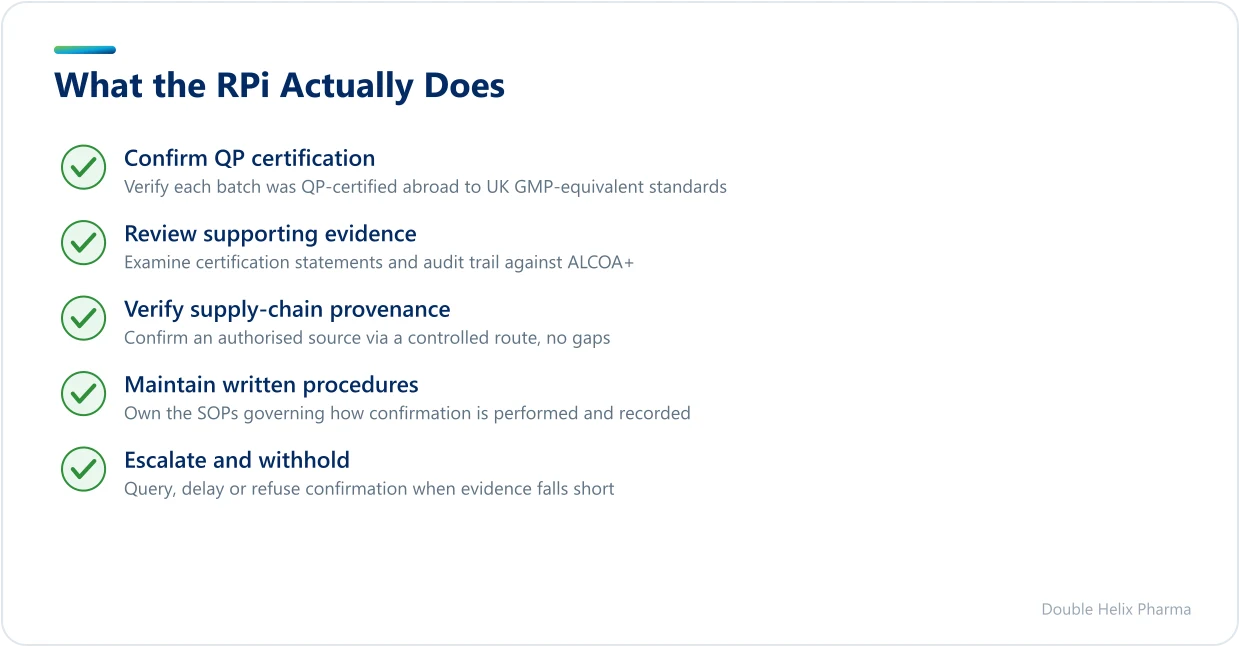
The RPi role is evidence-led. Day to day, the named individual is concerned less with hands-on inspection of stock and more with the integrity of the documentation that proves equivalent certification. A robust RPi remit typically includes the following.
- Confirming QP certification — establishing, for each relevant batch, that a QP in the country of export has certified it to standards equivalent to UK GMP.
- Reviewing supporting evidence — examining certification statements, batch documentation and the audit trail behind them, applying ALCOA+ expectations so that records are attributable, legible, contemporaneous, original and accurate.
- Verifying supply-chain provenance — checking that the product has come from the stated, authorised source through a controlled route, with no unexplained gaps.
- Maintaining written procedures — owning the SOPs that govern how confirmation is performed, recorded and escalated, so the process is repeatable rather than ad hoc.
- Escalating and withholding — having the authority to query, delay or refuse confirmation where the evidence is incomplete or inconsistent.
Underpinning all of this is the same culture of quality risk management described in ICH Q9 and the wider pharmaceutical quality system of ICH Q10. The RPi weighs the reliability of the exporting site, the strength of its certification process and the trustworthiness of its records. Where a supplier's documentation cannot be relied upon, the confirmation cannot stand, in exactly the way a QP would decline to certify on poor data.
The RPi does not repeat the QP's decision. It confirms that the decision was properly made elsewhere and that the evidence supporting it is sound.
Eligibility, naming and the practical realities
Like the conventional RP, the RPi must be named on the Wholesale Dealer's Authorisation and be assessed by the MHRA as having the knowledge, experience and standing to discharge the role. Regulators expect a genuinely available, competent individual rather than a name on a licence. The person needs a sound grasp of GMP and GDP principles, an understanding of certification under Annex 16, and the judgement to interrogate documentation rather than simply file it.
Common pitfalls
Several issues recur during MHRA inspection of importers. The first is treating the RPi confirmation as a clerical tick rather than a substantive review; the second is weak or missing SOPs that fail to define how equivalence is established. A third is inadequate evidence retention, where the company cannot later reconstruct the basis on which a batch was confirmed. Each of these is a data-integrity failure as much as a procedural one, and each is avoidable with a properly designed quality system. Our case studies show how importers have closed these gaps and strengthened their import controls.
Resourcing the RPi role
Not every importer has a suitable RPi in-house, particularly smaller distributors and newer market entrants. A contract RPi can be an effective answer, provided the arrangement is structured correctly. The named individual must be formally entered on the WDA(H), covered by a clear written agreement that defines scope and access, and given genuine sight of batch documentation, systems and people. With that foundation in place, an experienced independent practitioner brings the same rigour as an internal appointment and is often better prepared for inspection. You can see the full range of support across the quality lifecycle on our services overview.
Key takeaways
The responsible person import is a post-Brexit control unique to GB, designed to keep medicines from approved countries flowing without unnecessary re-testing, while preserving the assurance that proper QP certification has taken place. The RPi confirms rather than re-certifies, works on the strength of documented evidence, and must hold the authority to say no when that evidence falls short. Getting the role right is partly a question of competence and partly one of system design: clear procedures, reliable records and a named individual with real access.
If you are setting up a WDA(H), adding import activity, or preparing for an MHRA inspection and need a competent RPi or RP, our QP, RP and RPi specialists can help. Contact our team to discuss a named appointment or a review of your import controls.
Regulatory sources
This guidance reflects current UK and EU GMP/GDP requirements. Primary references:
- EU GMP Annex 16 — Certification by a Qualified Person and Batch Release
- EMA — GMP/GDP Questions & Answers
- EudraLex Volume 4 — EU GMP Guidelines
Always confirm against the latest published version of each source.
Frequently asked questions
When is a Responsible Person (import) actually required?+
An RPi is required on a Wholesale Dealer's Authorisation when a UK company imports certain medicines into Great Britain from countries on the MHRA's approved list. The role confirms that those products were certified by a QP in the exporting country to standards equivalent to UK GMP before GB release. If you only distribute domestically or import from a site already covered by a UK MIA and QP, an RPi may not be needed, so the activity on your licence determines the requirement.
Does the RPi re-certify imported batches like a QP?+
No. The RPi does not repeat QP certification or re-test the product. Instead, the named individual confirms, on the basis of documented evidence, that a QP in the country of export has already certified the batch to equivalent standards and that the supporting records are complete and trustworthy. It is a verification and confirmation step, not a second certification.
Can the RPi and RP be the same person?+
They can, provided that one individual holds the competence and capacity to discharge both sets of duties and is named accordingly on the Wholesale Dealer's Authorisation. Many importers do combine the roles, but the RPi function carries the specific responsibility of confirming equivalent QP certification of imported products. The key is that the MHRA is satisfied the named person is genuinely available and able to perform every duty assigned to them.