Contract QP, RP & RPi · 7 min read
Batch Certification vs Batch Release: The Difference
A QP's guide to batch certification vs release: what each act means under Annex 16, who is accountable, and why certification must always come before release.
By Balasubramanian Ramaiah · 9 June 2026 · Updated 2 September 2026
For anyone working in UK or EU supply, the phrase batch certification vs release hides a distinction that trips up quality teams, importers and CMO clients alike. The two terms are used interchangeably in conversation, yet they describe different acts, performed by different people, carrying very different legal weight. Get them confused and you risk shipping product that is technically released but never lawfully certified — a finding no QP wants to defend.
Batch certification vs release: the core distinction
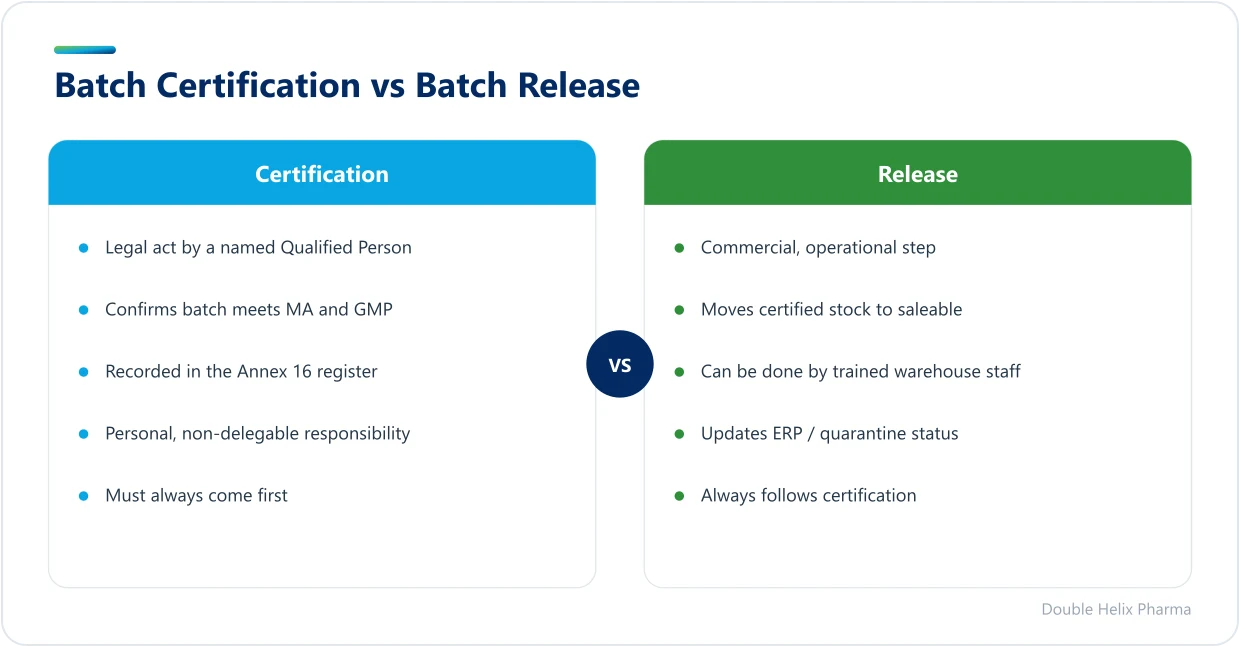
Certification and release are sequential, not synonymous. Certification is the legal act by which a Qualified Person (QP) confirms that a batch has been manufactured and tested in accordance with the marketing authorisation, the relevant Good Manufacturing Practice requirements and any other applicable provisions, and records that confirmation in the register required under EU GMP. Release is the subsequent commercial act of making that certified batch available for sale or supply — moving it from quarantine into saleable stock.
The order matters. A batch must be certified by the QP before it can be released to the market. Certification is a regulatory obligation that rests personally with a named QP on the Manufacturer's/Importer's Authorisation (MIA); release is an operational step that may be executed by trained logistics or warehouse personnel once certification is in place. One is a signature against the law; the other is a transaction against your stock system.
What QP certification actually attests
When a QP certifies a batch, they are personally attesting to a defined set of conditions set out in EU GMP and its Annex 16. In practice, the QP is confirming that:
- The batch was manufactured and tested in accordance with the relevant marketing authorisation and the principles of GMP (EudraLex Volume 4, retained in UK law).
- All in-process and finished-product testing required by the authorisation has been completed and meets specification.
- The complete batch documentation — manufacturing records, analytical results, deviations and their assessment — has been reviewed and supports release.
- For imported product, any additional importation testing or confirmation of equivalence has been satisfied.
Annex 16 is explicit that certification is a personal responsibility. The QP may rely on the pharmaceutical quality system, on data integrity controls aligned to ALCOA+, and on the work of others, but the decision and the accountability remain theirs. That is why certification cannot be delegated to a stock controller, and why a QP must be satisfied that the quality system underpinning their decision is robust under ICH Q10.
The role of the register
Certification is not complete until it is recorded. EU GMP requires that certified batches are entered in a register or equivalent document as the batches are released. This register is one of the first things an MHRA inspector will ask to see, because it is the auditable trail proving that a QP — not the warehouse — authorised each batch onto the market.
Why release is a separate, downstream act
Once a batch is certified, release is the controlled handover from quarantine to available stock. It is a logistical and systems-driven event: updating the status in the ERP or warehouse management system, physically segregating saleable from quarantined material, and confirming that no late-breaking holds — a complaint, a stability signal, a supply restriction — should stop the goods going out.
Separating the two acts is deliberate. It allows manufacturers to certify a batch but hold its release for commercial, supply or labelling reasons without compromising the regulatory position. A batch can sit certified-but-not-released for legitimate business purposes. The reverse — released-but-not-certified — is a serious GMP breach. Building that one-way dependency into your procedures, with a system control that physically blocks release until certification is recorded, is one of the simplest and most effective safeguards a quality team can put in place.
Batch certification vs release for importers and CMO clients
The distinction becomes sharpest for importers and virtual companies. If you import finished product from outside the UK, a UK QP must certify each batch before it enters the supply chain — outsourcing manufacture does not outsource the certification obligation. Where a contract manufacturer makes your product, the certifying QP may sit at the CMO, at the importer, or be engaged independently, but the certification chain across the manufacturing and testing sites must be unbroken and clearly defined in a written agreement.
Annex 16 anticipates exactly this fragmentation. Where different stages of manufacture and testing occur at different sites, each contributing party may confirm their part, but a single QP takes ultimate responsibility for the final certification. Mapping that chain — who confirms what, against which authorisation, and where the final certification sits — is precisely the work an independent contract QP, RP and RPi service exists to do. Importers also need to be clear where certification (a GMP act) ends and Good Distribution Practice begins, because the same batch then passes into GDP-controlled storage and distribution under a Responsible Person.
Where teams get caught out
Most problems we see are not exotic. They are predictable gaps in the boundary between the two acts:
- System status confusion. The ERP marks a batch "released" on goods-receipt logic before a QP has certified it, allowing dispatch of uncertified stock. The fix is a hard system block.
- Unclear certification chains. For multi-site or imported product, no single document states who certifies the final batch, so accountability is ambiguous when the MHRA asks.
- Treating release as the regulatory event. Teams document the warehouse release meticulously but cannot evidence the QP certification decision and its register entry — the act that actually matters in law.
- Pressure to certify on incomplete data. Commercial urgency pushes a QP to certify before deviations are closed or results are final. Quality risk management under ICH Q9 should govern that decision, not the dispatch schedule.
A batch that has been "released" by the warehouse but not certified by a QP has not been lawfully placed on the market. The signature on the register is the act of regulatory significance — not the status change in the stock system.
Our published case studies illustrate how a clearly mapped certification-and-release process removes this ambiguity before it becomes an inspection finding, and our wider quality and compliance services are built around getting these boundaries right from the start.
Batch certification vs release: key takeaways
The batch certification vs release distinction is not pedantry — it is the difference between a regulatory act and a commercial one. Certification is the QP's personal, legally weighted confirmation, recorded in a register under Annex 16, that a batch conforms to its marketing authorisation and GMP. Release is the downstream operational step that makes the certified batch available for supply. Certification must always come first; release without it is a breach, never a shortcut.
If you are setting up a certification chain for imported or contract-manufactured product, or you want an independent QP to review where your certification and release boundary sits before the MHRA does, talk to our team. We will help you define a clean, defensible process the first time.
Regulatory sources
This guidance reflects current UK and EU GMP/GDP requirements. Primary references:
- EU GMP Annex 16 — Certification by a Qualified Person and Batch Release
- EMA — GMP/GDP Questions & Answers
- EudraLex Volume 4 — EU GMP Guidelines
Always confirm against the latest published version of each source.
Frequently asked questions
Can the same person certify and release a batch?+
They can, but the two acts remain distinct even when performed by one individual. Certification is the QP's personal legal confirmation under Annex 16 that the batch meets its marketing authorisation and GMP, while release is the operational step of moving certified stock into saleable status. In many organisations release is handled by trained warehouse or logistics staff once the QP has certified and recorded the batch, which is perfectly acceptable provided the system prevents release before certification.
Is a batch legally on the market once it is released but not yet certified?+
No. Under EU GMP and Annex 16 a batch cannot be lawfully placed on the market until a Qualified Person has certified it and entered it in the certification register. A stock-system status of "released" carries no regulatory weight on its own. Shipping product that has been released operationally but never certified by a QP is a serious GMP breach and a predictable inspection finding.
Who certifies imported or contract-manufactured batches?+
For product imported into the UK, a UK QP named on the relevant Manufacturer's/Importer's Authorisation must certify each batch before it enters the supply chain. Where manufacture and testing span several sites, each party may confirm their stage, but a single QP takes ultimate responsibility for the final certification. The full chain should be defined in a written technical agreement so accountability is unambiguous if the MHRA asks.