Contract QP, RP & RPi · 7 min read
RP vs RPi vs QP: Who Does What?
The RP RPi QP difference explained: how Responsible Person, RPi and Qualified Person duties, authorisations and GMP/GDP accountabilities differ in UK pharma.
By Balasubramanian Ramaiah · 9 June 2026 · Updated 25 July 2026
Few questions cause more confusion in UK pharmaceutical quality teams than the RP RPi QP difference: three named, accountable roles that sound interchangeable but sit on entirely separate legal foundations. The Responsible Person (RP), the Responsible Person for import (RPi) and the Qualified Person (QP) each carry distinct statutory duties tied to different authorisations and different points in the medicine's journey. This article sets out who does what, where the roles overlap and how to resource them without gaps or duplication.
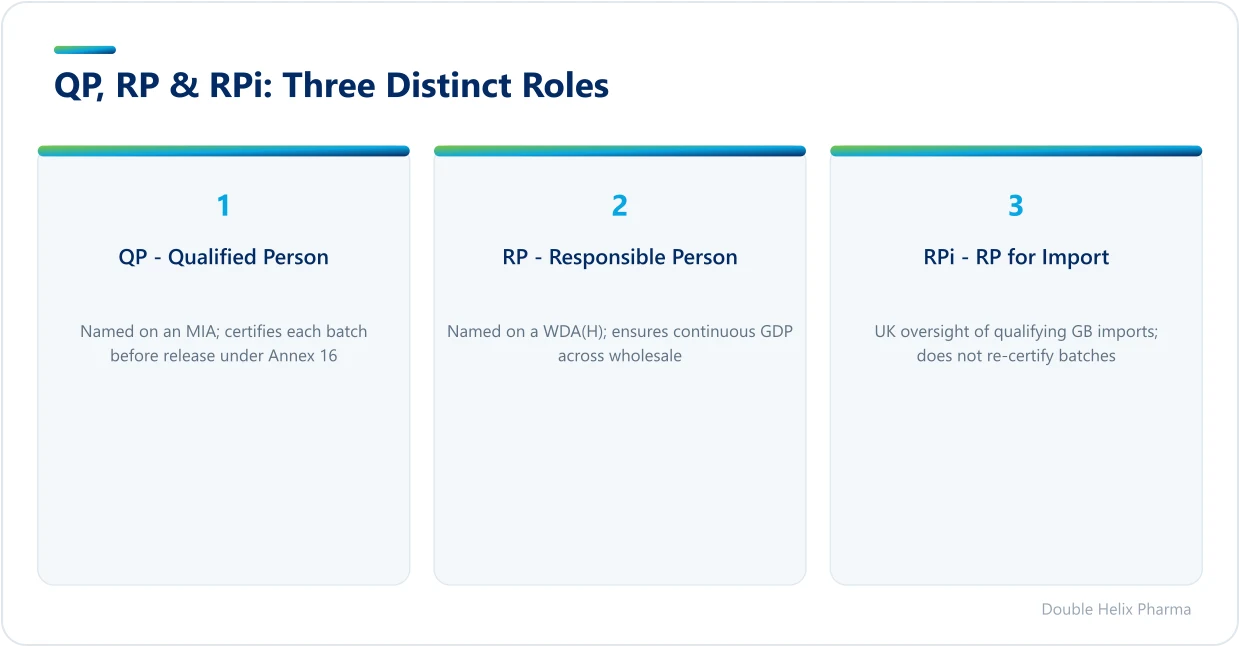
The three roles at a glance
The cleanest way to grasp the distinction is to anchor each role to its authorisation and its position in the supply chain. The QP belongs to manufacturing and importation; the RP and RPi belong to wholesale distribution. They are not a hierarchy and one person holding several does not collapse them into a single duty.
- QP (Qualified Person): named on a Manufacturer's/Importer's Authorisation (MIA). Certifies each batch before release to market under EU GMP Annex 16.
- RP (Responsible Person): named on a Wholesale Dealer's Authorisation (WDA(H)). Ensures GDP compliance across wholesale activities.
- RPi (Responsible Person for import): a UK-specific role for importing certain medicines from listed countries under a WDA(H), introduced after EU exit.
What the Qualified Person does
The QP is the role with the highest-profile personal liability. Named on an MIA, the Qualified Person carries non-delegable legal accountability for certifying that every batch placed on the market has been manufactured and checked in accordance with Good Manufacturing Practice and the terms of the marketing authorisation. That accountability is grounded in EU GMP Annex 16, retained in UK law, and it cannot be signed away even when technical assessments are performed by other staff.
In practice the QP's work spans review of batch documentation against ALCOA+ data integrity expectations, oversight of deviations and out-of-specification investigations, confidence in supplier and contract acceptor arrangements, and assurance that the pharmaceutical quality system functions as ICH Q10 intends. For sterile products, Annex 1 has sharpened the expectation that the QP is satisfied the contamination control strategy is genuinely effective. The defining act is certification: until the QP signs, the batch is not legally releasable.
Where the QP sits
The QP operates at the boundary between manufacture or import and the wholesale supply chain. Once a batch is certified, it can be released and distributed. The roles that govern that downstream distribution are the RP and, for relevant imports, the RPi. Our contract QP, RP and RPi service covers all three, which is precisely why understanding the handover points matters.
What the Responsible Person does
The Responsible Person is named on a Wholesale Dealer's Authorisation and is accountable for compliance with Good Distribution Practice across the licensed activities. Where the QP guards the quality of the batch as it leaves manufacture, the RP guards the integrity of the medicine as it moves through wholesale: receipt, storage, picking, transport and onward supply to authorised recipients only.
The RP's duties, set out in the UK GDP framework and the EU GDP guidelines, are practical and continuous rather than batch-by-batch. They include ensuring a functioning quality system is implemented and maintained, that personnel are trained, that temperature and storage conditions are controlled, that returns, suspected falsified medicines and recalls are handled correctly, and that supply is made only to those entitled to receive it. The RP must verify the bona fides of both suppliers and customers and keep distribution records that withstand inspection.
The QP certifies a batch once; the RP and RPi safeguard the medicine continuously through every wholesale transaction. The duties run in parallel, not in sequence.
What the RPi adds: the RP RPi QP difference after Brexit
The RPi is the newest of the three and the one most often misunderstood, because it exists for reasons specific to UK exit from the EU. The Responsible Person for import is required where a wholesaler imports certain medicines into Great Britain from countries on an approved list, including medicines that have been QP-certified in those countries. The role provides UK oversight of that importation without requiring the importer to hold a full MIA.
Crucially, the RPi does not re-certify batches; that is QP territory. Instead the RPi must put checks in place to confirm that the medicines were manufactured and batch-certified to standards at least equivalent to UK GMP, that appropriate evidence exists, and that the supply chain is documented and verified. The RPi role therefore bridges a specific gap created by the new GB regulatory border and should not be confused with either certification or general wholesale oversight.
Can one person hold more than one role?
Yes, and many organisations consolidate. An individual may act as both RP and RPi on the same WDA(H) where competence and capacity allow, and a single person may hold QP duties on an MIA while a colleague holds the RP on a related WDA(H). The legal duties remain separate even when the named person is the same; combining roles is a question of competence, time and conflict management, not of merging the underlying responsibilities. Documented eligibility and realistic capacity are what the MHRA expects to see.
How the roles work together in a real supply chain
Picture a product manufactured abroad, imported and distributed in the UK. The sequence of accountability runs like this:
- The batch is manufactured and, where applicable, QP-certified against GMP and the marketing authorisation.
- If imported into GB from a listed country under a WDA(H), the RPi verifies equivalence of standards and the integrity of the importation arrangements.
- The RP ensures the product is received, stored, handled and onward-supplied in line with GDP, only to entitled recipients.
Gaps appear when teams assume one role covers another, for example believing an RP can authorise importation that in fact requires an RPi, or that QP certification removes the need for GDP oversight in distribution. Mapping each authorisation to its named role, and each named role to a competent, available person, is the practical discipline that keeps a site inspection-ready. You can see how we have structured these arrangements for importers and distributors in our case studies, and the full scope is summarised across our services.
Key takeaways
The RP RPi QP difference comes down to authorisation, activity and the point in the lifecycle each role governs. Confusing them creates either compliance gaps or wasted duplication, and the MHRA expects each named role to be filled by a demonstrably competent, available individual.
- QP certifies batches under an MIA, with personal, non-delegable liability under Annex 16.
- RP ensures continuous GDP compliance across wholesale under a WDA(H).
- RPi provides UK oversight of qualifying imports from listed countries, without re-certifying batches.
If you are unsure which roles your authorisations require, or need experienced cover for any of them, our team can map your MIA and WDA(H) scope against the right named individuals and flag any gaps before an inspector does. Contact Double Helix to discuss contract QP, RP or RPi support.
Regulatory sources
This guidance reflects current UK and EU GMP/GDP requirements. Primary references:
- EU GMP Annex 16 — Certification by a Qualified Person and Batch Release
- EMA — GMP/GDP Questions & Answers
- EudraLex Volume 4 — EU GMP Guidelines
Always confirm against the latest published version of each source.
Frequently asked questions
What is the main difference between a QP, an RP and an RPi?+
The Qualified Person (QP) is named on a Manufacturer's/Importer's Authorisation and certifies each batch before market release under EU GMP Annex 16. The Responsible Person (RP) is named on a Wholesale Dealer's Authorisation and ensures continuous Good Distribution Practice compliance across wholesale activities. The Responsible Person for import (RPi) is a UK-specific role providing oversight of qualifying medicines imported into Great Britain from listed countries, without re-certifying batches. They sit on different authorisations and govern different points in the supply chain.
Can the same person be the QP, RP and RPi?+
One individual can hold more than one of these roles where competence and capacity genuinely allow, and combining RP and RPi duties on a single WDA(H) is common. However, the underlying legal duties remain separate even when the named person is the same. The MHRA expects documented eligibility, realistic availability and management of any conflicts, so consolidation should be a deliberate decision rather than a default.
Does an RPi need to re-certify imported batches like a QP?+
No. The RPi does not re-certify batches, as certification is exclusively a QP responsibility. Instead, the RPi must put checks in place to confirm that imported medicines were manufactured and batch-certified to standards at least equivalent to UK GMP, that supporting evidence exists, and that the supply chain is documented and verified. It is an oversight and assurance role created by the GB regulatory border, not a certification role.