GDP Transport & Supply Chain · 7 min read
The Responsible Person Under GDP
A senior QP's guide to the responsible person GDP role: legal duties, personal accountability, RP vs RP(i) vs QP, and the failures that fail MHRA inspections.
By Balasubramanian Ramaiah · 9 June 2026 · Updated 3 July 2026
The responsible person under GDP is the named, legally accountable individual who makes a wholesale dealer's authorisation function in practice rather than on paper. For any UK or EU business that procures, holds, supplies or exports medicinal products, the Responsible Person (RP) is the person the regulator holds to account when the distribution quality system fails. This article sets out what the role demands, where it most often goes wrong, and how to make it genuinely effective.
What the responsible person GDP role actually is
The Responsible Person is a statutory appointment named on a Wholesale Dealer's Authorisation, WDA(H), and accepted by name by the MHRA. The legal basis sits in the Human Medicines Regulations 2012, with the operational expectations set out in the European Commission's Guidelines on Good Distribution Practice of Medicinal Products for Human Use (2013/C 343/01), which the UK retained after EU exit. The RP is to the distribution chain roughly what the Qualified Person is to manufacture: a single, personally accountable individual who safeguards product quality and patient safety.
Crucially, the role is not a job title you can delegate away. The licence holder appoints the RP, but the regulator deals with that named person directly. An RP who is named on paper yet absent from the daily reality of the operation is one of the most common and most serious findings an inspector can raise.
Core duties of the responsible person GDP appointment
The GDP guidelines set out the RP's responsibilities explicitly. In practice they cluster into a handful of areas that an inspector will probe in turn.
- Quality system ownership. Ensuring a quality management system is implemented and maintained, in line with the principles of ICH Q10 and the risk-based thinking of ICH Q9.
- Authorised activities. Ensuring the company only procures from and supplies to bona fide, appropriately authorised parties, and only handles products covered by the licence.
- Training and competence. Ensuring personnel are trained for their roles and that records are kept current.
- Record integrity. Ensuring transaction and quality records support full traceability and meet ALCOA+ expectations.
- Deviations, complaints, returns and recalls. Owning these processes, including timely decisions on the disposition of returned or suspect stock.
- Falsified medicines. Ensuring safeguards against falsified products entering the legitimate chain are operating.
The thread running through all of these is decision-making authority. The RP must be empowered to stop a shipment, quarantine stock, or refuse a supplier, and that authority must be real, not nominal.
RP, RP(i) and the QP: not the same role
It is worth being precise about terminology, because the roles are routinely conflated. The RP is accountable for GDP under a WDA(H). The Responsible Person (import), or RP(i), is a distinct role concerned with confirming that products imported from certain third countries have been subject to appropriate quality oversight. The Qualified Person certifies batches for release under a manufacturing authorisation governed by EU GMP. One person may hold more than one role, but the responsibilities and the legal hooks are separate, and treating them as interchangeable causes real compliance gaps.
Personal accountability and the empowerment question
The single most important attribute of an effective RP is not technical knowledge, valuable though that is. It is genuine authority within the organisation. The MHRA expects the RP to have direct access to senior management and the standing to escalate without fear of commercial override.
An RP who cannot halt a profitable shipment is not an RP in any meaningful sense; they are a signature on a licence.
This is why the reporting line matters so much. An RP who reports into commercial operations, with no route to the board, is structurally compromised. Inspectors will ask how concerns are raised, what happens when the RP disagrees with a sales decision, and whether the RP has ever exercised a veto. The honest answer to that last question is revealing. Where the role is taken seriously, our client case studies consistently show fewer critical findings at inspection.
Continuity and contingency
The RP cannot be available every hour of every day, so the guidelines expect a documented arrangement for absence. A named, trained deputy with equivalent authority is the usual solution. Where in-house cover is thin, a contract RP service can provide qualified, named cover that satisfies the regulator while permanent recruitment is resolved. What is not acceptable is a gap in which no competent person is accountable.
Where responsible persons most often come unstuck
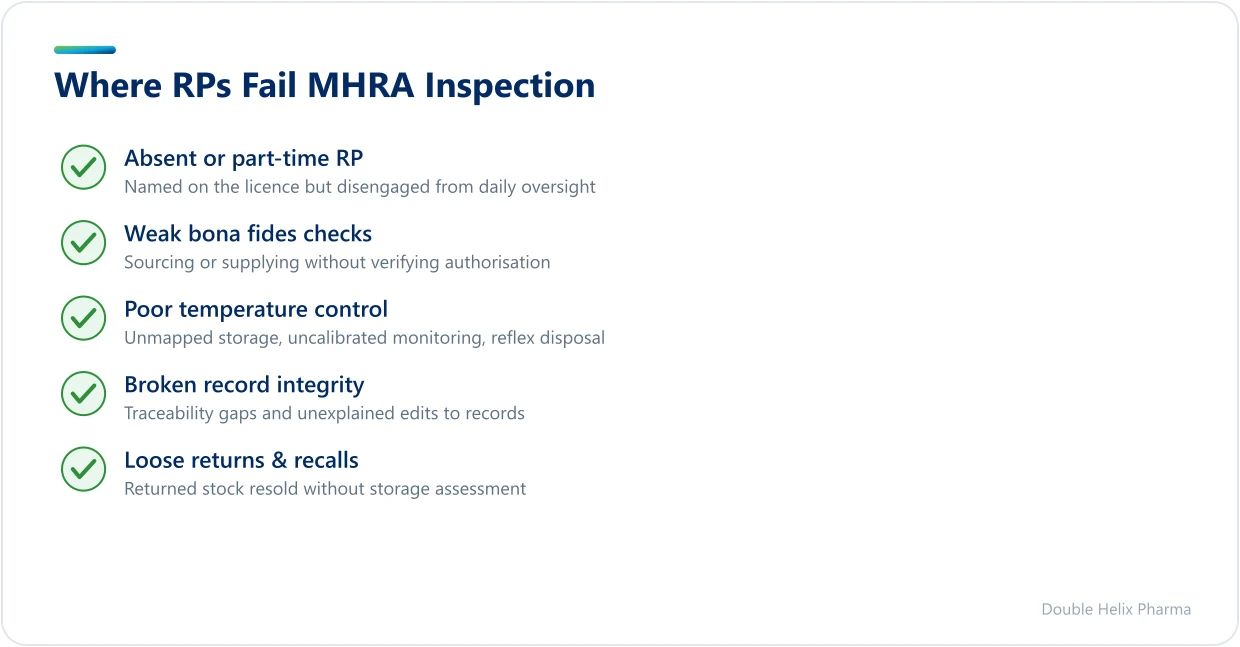
Across MHRA inspections of wholesale dealers, a recognisable pattern of deficiencies recurs. None is exotic; all are avoidable.
- The absent or part-time RP. Named on the licence but disengaged from daily operations, with no evidence of active oversight.
- Inadequate bona fides checks. Supplying or sourcing without verifying that the counterparty holds the right authorisation, undermining the integrity of the chain.
- Weak temperature control. Unmapped storage, uncalibrated monitoring, and excursions handled by reflex disposal rather than a documented, stability-based assessment.
- Poor record integrity. Gaps in traceability, unexplained edits, or records that cannot demonstrate where a product has been.
- Returns and recalls processed loosely. Returned stock placed back into saleable inventory without a proper assessment of storage conditions during the customer's possession.
A capable RP treats each of these as a standing control, not an occasional project. Self-inspection, a live quality risk register and a functioning CAPA system are the mechanisms that keep them under control between inspections.
Building a role that survives inspection
Strengthening the RP function is rarely about heroics; it is about structure. Define the role in a clear, current job description that mirrors the GDP guidelines. Secure a direct reporting line to senior management. Resource the role with time, not just a title, and document that the RP is actually performing oversight through reviews, approvals and signed decisions. Make sure deputy arrangements are real and tested. Above all, ensure the RP has, and is seen to have, the authority to say no.
Our GDP and supply chain consultancy helps wholesale dealers and importers appoint, support and, where needed, supply Responsible Persons who can withstand scrutiny. If you are preparing a WDA(H) application, covering an RP vacancy, or want an honest read on whether your current arrangement is robust, contact our team for a confidential discussion. The cost of getting the responsible person GDP role right is modest; the cost of getting it wrong is your licence.
Key takeaways
- The Responsible Person is a named, personally accountable appointment on a WDA(H), not a delegable job title.
- Genuine authority and a direct line to senior management matter more than any qualification.
- RP, RP(i) and QP are distinct roles with separate legal bases; do not conflate them.
- Most inspection findings trace back to an absent RP, weak bona fides checks, poor temperature control, or broken record integrity.
- Documented deputy cover and evidence of active oversight are what carry the role through inspection.
Regulatory sources
This guidance reflects current UK and EU GMP/GDP requirements. Primary references:
- EMA — GMP/GDP Questions & Answers
- MHRA Inspectorate Blog
- MHRA — UK Medicines & Healthcare products Regulatory Agency
Always confirm against the latest published version of each source.
Frequently asked questions
Who can act as a Responsible Person under a WDA(H)?+
The Responsible Person must be a named individual with appropriate knowledge of and experience in GDP, accepted by name by the MHRA on the Wholesale Dealer's Authorisation. They need sufficient authority within the organisation to take quality decisions independently, including halting or refusing supply. There is no single mandated qualification, but the person must demonstrably understand the GDP guidelines and have the standing to enforce them.
What is the difference between an RP and an RP(i)?+
The Responsible Person (RP) is accountable for the overall GDP quality system under a Wholesale Dealer's Authorisation. The Responsible Person (import), or RP(i), is a separate role focused on confirming that products imported from certain third countries have had appropriate quality oversight before entering the UK supply chain. One person may hold both roles, but the legal responsibilities are distinct and should not be treated as interchangeable.
What happens if a Responsible Person leaves at short notice?+
You must not operate without a competent, accountable person in place, so a documented deputy or contingency arrangement is essential. A named, trained deputy with equivalent authority is the usual solution, and a contract RP can provide qualified, named cover while you recruit a permanent replacement. The MHRA should be kept informed of changes to named persons on the licence, and any gap in oversight is a serious inspection risk.