Site Readiness (MIA/WDA) · 7 min read
Responding to MHRA Inspection Findings
A practical QP guide to building an MHRA inspection response: grading findings, CAPA, root cause, ALCOA+ evidence and realistic, defensible timelines.
By Balasubramanian Ramaiah · 9 June 2026 · Updated 8 September 2026
An MHRA inspection response is judged as carefully as the inspection itself: it tells the regulator whether your quality system can be trusted to find, understand and correct its own problems. A weak, defensive or vague reply can turn a routine set of observations into a regulatory action, whereas a structured, evidence-led response builds confidence in your site's state of control. This article sets out how UK and EU pharmaceutical, biotech, CMO and importer quality teams should handle inspection findings from the closing meeting through to closure.
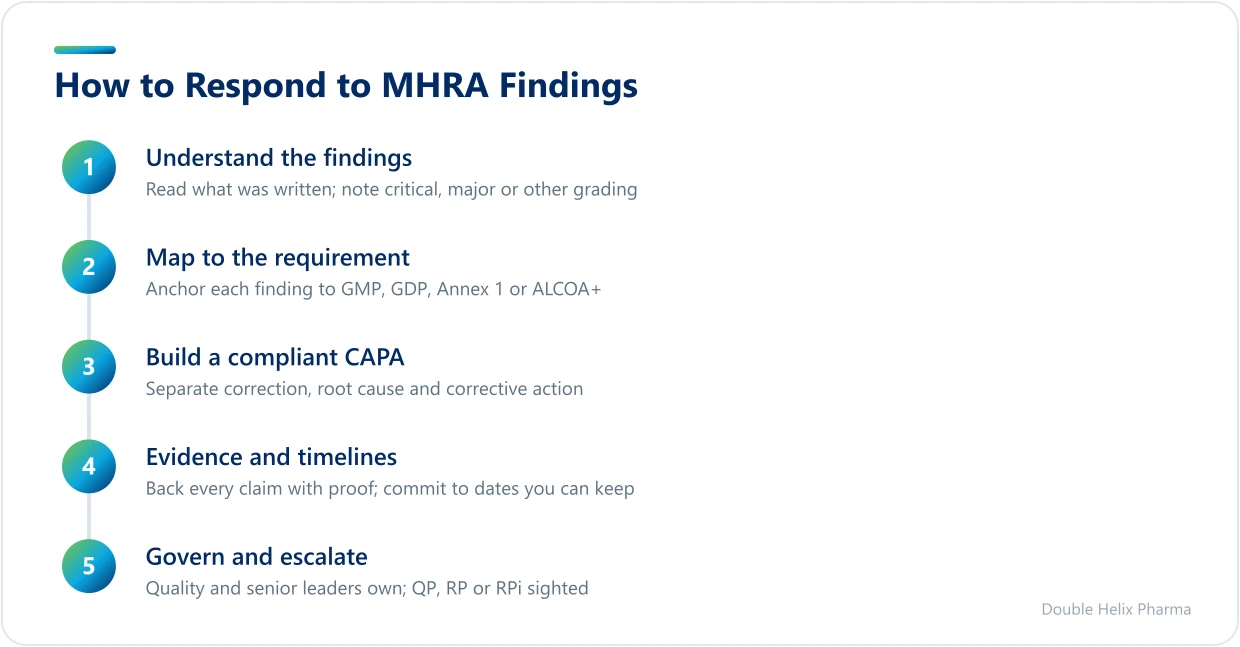
Understand the findings before you respond
The first task is to read what the inspector actually wrote, not what you fear they meant. MHRA findings are classified as critical, major or other (minor), and that grading shapes both the urgency and the depth of your reply. A critical finding signals a deficiency that has produced, or may lead to, a significant risk to patients; a major finding points to a serious shortfall in compliance with EU GMP or GDP; other findings are departures that still require correction.
Resist the temptation to argue the grading in your formal response unless you have a genuine factual basis. If an inspector has mistaken the facts, you may submit a clarification, but disputing a well-founded observation rarely helps and often signals that the underlying issue has not been understood.
Map findings to the underlying requirement
For each observation, identify the specific regulatory expectation behind it — a clause of EU GMP, a GDP guideline, an Annex 1 contamination-control principle, or a data integrity expectation rooted in ALCOA+. Sites importing from third countries should also be clear where 21 CFR 210/211 expectations have informed their own procedures. Anchoring each finding to a requirement keeps the response objective and prevents you from fixing the symptom while missing the rule.
Build a compliant CAPA: correction, root cause and corrective action
A credible reply is structured around CAPA. Inspectors expect you to separate the immediate correction (what you did to make the specific problem safe) from the corrective action (what stops it recurring) and, where relevant, preventive action across similar systems. Conflating these three is one of the most common reasons a response is rejected.
- Immediate correction and risk assessment. Describe the containment step taken and assess product impact, including whether any batches on the market are affected and whether a recall or quarantine is warranted.
- Root cause analysis. Use a recognised technique — five whys, fishbone or fault tree — and apply the risk-management thinking of ICH Q9 so the depth of analysis matches the severity of the finding.
- Corrective and preventive actions. Define specific, owned and dated actions, and state how you will verify their effectiveness rather than simply confirming completion.
Weak root cause analysis is the single biggest failing in inspection responses. "Human error" is almost never a root cause; it is a prompt to ask why the system permitted the error and why it was not detected. ICH Q10 frames CAPA as part of an effective pharmaceutical quality system, so your reply should show the management system working, not a one-off fix.
Evidence, ALCOA+ and realistic timelines
Every claim in your response should be supported by evidence the inspector can rely on: revised SOPs with version numbers, training records, validation or qualification reports, change controls and trend data. Where data integrity is in scope, demonstrate that your records remain attributable, legible, contemporaneous, original and accurate — the ALCOA+ principles — and explain any system or governance changes you have made.
Be deliberate about timelines. Commit to dates you can defend, distinguishing actions already complete from those in progress, and never promise a date you are likely to miss. A missed commitment in a follow-up is far more damaging than an honest, slightly longer timeline agreed up front.
An inspection response is a regulatory commitment. Once a date and an action are in writing to the MHRA, they form part of the record against which your next inspection — and any compliance escalation — will be measured.
Avoid the common pitfalls
- Treating each finding in isolation when several share a common systemic cause.
- Closing actions on paper without objective evidence of effectiveness.
- Over-committing to a long list of actions that the site cannot realistically deliver.
- Editing or back-dating records to "tidy up" — a data integrity breach far graver than the original finding.
Govern the response and prepare for escalation
Ownership matters. The response should be coordinated by the Quality function and formally endorsed by senior management, with the Qualified Person, Responsible Person (RP) or Responsible Person for Import (RPi) sighted on anything touching certification, release or importation. This is a core element of site readiness for your MIA or WDA, and treating it as a routine quality activity rather than a board-level priority is a frequent mistake.
Where findings are critical, or where a pattern of majors suggests a systemic weakness, the MHRA may consider regulatory action including a compliance escalation, conditions on your licence, or referral to its Inspection Action Group. A prompt, transparent response with strong governance is your best protection against escalation. Our case studies show how decisive corrective action and clear regulatory communication can keep a site in control even after difficult inspections.
Use the response to strengthen the system
The best teams treat findings as free intelligence about their quality system. Feed themes from the inspection into your management review, your self-inspection programme and your supplier oversight, so the same gaps are not found at your contract manufacturers or distributors. A genuine systemic fix, demonstrated across related processes, is what turns a critical observation into evidence of a maturing quality culture. If your wider quality framework needs reinforcing, our consultancy services span GMP and GDP audits, QMS design and contract QP, RP and RPi support.
Key takeaways and where to get support
A strong MHRA inspection response is structured, honest and evidence-led: understand the finding and its grading, separate correction from corrective and preventive action, get to a genuine root cause, support every claim with verifiable evidence, and commit only to timelines you can keep. Govern the whole process through Quality and senior management, and use the findings to harden the system rather than merely patch it.
If you are preparing a reply to recent observations, or want an experienced QP to pressure-test your CAPA and root cause analysis before it reaches the inspector, contact our team for confidential, practitioner-led support tailored to your MIA or WDA site.
Regulatory sources
This guidance reflects current UK and EU GMP/GDP requirements. Primary references:
- MHRA — UK Medicines & Healthcare products Regulatory Agency
- EudraLex Volume 4 — EU GMP Guidelines
- MHRA Inspectorate Blog
Always confirm against the latest published version of each source.
Frequently asked questions
How long do we have to respond to MHRA inspection findings?+
Timeframes are set by the MHRA and confirmed in the post-inspection correspondence, and they depend on the severity of the findings; critical deficiencies demand the most urgent attention. Rather than fixating on a fixed number of days, agree a realistic timeline with the inspector and meet it. Submitting on time with strong evidence matters far more than rushing an incomplete reply.
What is the most common reason an MHRA inspection response is rejected?+
Weak root cause analysis is the most frequent failing, typically when 'human error' is offered as a cause rather than examining why the system allowed and failed to detect the error. Responses are also rejected when corrections are confused with corrective actions, or when actions are closed without objective evidence of effectiveness. A response built on ICH Q9 risk thinking and ICH Q10 system governance is far more credible.
Should the Qualified Person sign off the inspection response?+
The response should be coordinated by Quality and endorsed by senior management, with the QP, RP or RPi closely involved in anything affecting batch certification, product release, distribution or importation. Their oversight demonstrates that decisions about product impact and ongoing control have proper accountability. Visible senior and QP ownership also reassures the MHRA that findings are being treated as a priority.