GDP Transport & Supply Chain · 7 min read
Recall Management and Mock Recalls
How UK and EU quality teams should run a pharmaceutical recall and prove readiness through mock recalls, meeting MHRA, EU GMP and GDP expectations.
By Balasubramanian Ramaiah · 9 June 2026 · Updated 16 July 2026
A well-run pharmaceutical recall is one of the clearest tests of whether your quality system actually works under pressure. When a defective or potentially unsafe product reaches the supply chain, the speed and completeness of your response determine patient safety, regulatory standing and commercial reputation in equal measure. This article sets out how UK and EU quality teams should design recall procedures, prove them through mock recalls, and satisfy MHRA and competent-authority expectations.
Why recall readiness is a regulatory expectation, not an optional extra
Under EU GMP Chapter 8 and the corresponding GDP guidelines, every manufacturer, importer and wholesale distributor must operate a documented system to recall defective products promptly and effectively at any point in the supply chain. The MHRA expects this capability to be demonstrable, not merely written down. A recall procedure that has never been exercised is, in practical terms, an untested control.
Recall management also sits squarely within the quality risk management framework of ICH Q9 and the pharmaceutical quality system described in ICH Q10. Both make clear that a company should be able to identify, contain and correct quality defects across the product lifecycle. The ability to reach affected stock quickly is, therefore, an outcome of an effective quality system rather than a standalone activity bolted on at the end.
Where recall obligations bite hardest
Importers and contract manufacturing organisations often carry disproportionate risk because batch ownership, release responsibility and physical distribution may sit with different legal entities. Clear technical agreements that define who initiates a recall, who notifies the authority and who reconciles returned stock are essential. Ambiguity here is a recurring inspection finding.
The anatomy of an effective recall procedure
A robust procedure should leave nothing to improvisation on the day. At minimum it needs to define decision-making authority, classification, communication and reconciliation. The Qualified Person and the responsible person for the relevant activity should have explicit, named roles.
- Trigger and decision criteria — how a potential defect is escalated, who convenes the recall committee, and how the recall decision is documented and risk-assessed.
- Classification and depth — Class I, II or III, and whether the recall reaches wholesaler, pharmacy or patient level. The classification drives urgency and communication channels.
- Notification — how and when the MHRA Defective Medicines Report Centre and other competent authorities are informed, and how Drug Alerts or Recall Notices cascade to customers.
- Logistics and quarantine — how returned product is segregated, labelled and prevented from re-entering saleable stock, including any onward destruction.
- Reconciliation and closure — accounting for distributed versus recovered quantities, with a documented effectiveness check and formal closure report.
Distribution records are the backbone of all of this. If your traceability data is incomplete or slow to query, even a perfect procedure will fail. Robust batch-to-customer records, maintained to ALCOA+ data-integrity principles, are what allow you to identify every consignee within hours rather than days. Our GDP supply chain services focus heavily on exactly this traceability backbone.
Recall classification and timelines
Speed is calibrated to risk. A Class I recall, where the defect is potentially life-threatening, may require action within hours and out-of-hours contact arrangements. Class II defects, which could cause illness or mistreatment but are not life-threatening, and Class III defects, which are unlikely to present a significant hazard, allow correspondingly longer timescales. Your procedure should state target timeframes for each class and for each tier of the supply chain.
Out-of-hours readiness is frequently overlooked. Defects do not respect office hours, and the MHRA expects a 24-hour contact point capable of initiating a recall. A named emergency contact, a maintained call-down list and pre-drafted notification templates remove dangerous delay at the moment it matters most.
Mock recalls: proving the system before you need it
A mock recall is a planned simulation that tests your ability to trace, contact and account for a specific batch without an actual defect being present. It is the single most valuable tool for demonstrating recall readiness to an inspector, and a routine expectation for both manufacturers and wholesale distributors.
A credible mock recall does more than confirm that paperwork exists. It measures performance against the clock and exposes weak points before a real event does.
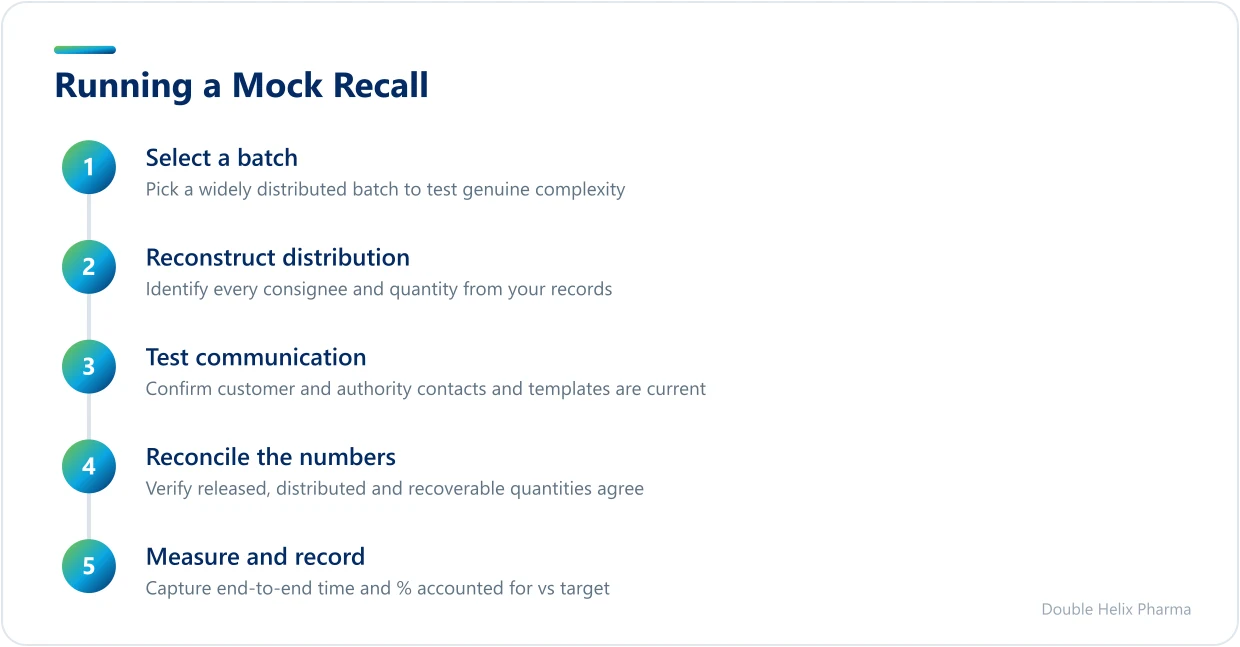
- Select a representative batch — ideally one distributed widely, including to a mix of direct customers and onward distributors, so the exercise tests genuine complexity.
- Reconstruct the distribution picture — identify every consignee and quantity from your records, and record exactly how long retrieval took.
- Test communication — confirm that contact details for customers and the authority are current and that templates can be issued quickly.
- Reconcile the numbers — verify that quantities released, distributed and theoretically recoverable all agree.
- Measure and record — capture the end-to-end time and percentage of stock accounted for, then compare against your stated target.
How often and how rigorously
There is no single mandated frequency, but an annual mock recall is widely regarded as a sensible baseline, with more frequent exercises where distribution is complex or where a previous test underperformed. Vary the scenario each time, weekday versus weekend, a domestic batch versus an exported one, so you are not simply rehearsing the same easy path. Several of our case studies describe how staged mock recalls uncovered traceability gaps that a desk-based review would never have surfaced.
Turning findings into corrective action
The value of a mock recall lies in what you do with the result. Every exercise should generate a documented report with a clear verdict: did you meet your timeline, and did your reconciliation balance? Where it did not, raise a CAPA, assign an owner and a due date, and verify the fix at the next exercise. This closed loop is precisely the continual-improvement behaviour that ICH Q10 expects from a mature quality system.
Common, fixable weaknesses include out-of-date customer contact lists, distribution data held in formats that cannot be queried quickly, unclear escalation routes between an importer and its contract manufacturer, and reconciliation gaps where samples or returns were never logged. None of these are exotic, and all are far cheaper to fix during a simulation than during a Class I event. Broader support for embedding these controls sits within our wider quality and compliance services.
Key takeaways
A credible pharmaceutical recall capability is built, tested and maintained long before any defect emerges. Get the fundamentals right and a recall becomes a controlled, well-rehearsed process rather than a crisis.
- Treat recall readiness as a measurable output of your quality system under EU GMP Chapter 8, GDP guidelines and ICH Q9/Q10.
- Maintain ALCOA+ traceability so any batch can be traced to every consignee within hours.
- Run varied mock recalls at least annually, measure end-to-end time and reconciliation, and close every gap through CAPA.
- Keep a 24-hour contact point and pre-drafted notifications ready for out-of-hours Class I scenarios.
If you would like an independent review of your recall procedure, or a facilitated mock recall that stands up to MHRA scrutiny, talk to our team about how we can help you prove your readiness with confidence.
Regulatory sources
This guidance reflects current UK and EU GMP/GDP requirements. Primary references:
- EMA — GMP/GDP Questions & Answers
- MHRA Inspectorate Blog
- MHRA — UK Medicines & Healthcare products Regulatory Agency
Always confirm against the latest published version of each source.
Frequently asked questions
How often should we perform a mock recall?+
There is no single legally mandated frequency, but an annual mock recall is a widely accepted baseline for manufacturers and wholesale distributors. Run them more frequently where your distribution network is complex, where a previous exercise underperformed, or after significant changes to systems or suppliers. Vary the scenario each time so you test genuine complexity rather than rehearsing the same easy path.
What is the difference between recall classes I, II and III?+
Class I covers defects that are potentially life-threatening and demand the most urgent action, often within hours and including out-of-hours arrangements. Class II covers defects that could cause illness or mistreatment but are not life-threatening, while Class III covers defects unlikely to present a significant hazard. The class drives the urgency, the depth of the recall and the communication channels used.
Who is responsible for initiating a recall at an importer or CMO?+
Responsibility should be defined explicitly in the technical and quality agreement between the parties, because batch ownership, release and physical distribution may sit with different entities. Typically the Qualified Person or the responsible person for the relevant activity holds named authority to initiate a recall and notify the MHRA. Ambiguity over these roles is a recurring inspection finding and should be resolved before any defect arises.