QMS & PQS Implementation · 7 min read
Writing a Quality Manual That People Actually Use
How to write a pharmaceutical quality manual that staff and inspectors actually use: lean, ICH Q10-aligned, structured for the reader and built to stay current.
By Balasubramanian Ramaiah · 9 June 2026 · Updated 13 July 2026
Most organisations have a pharmaceutical quality manual. Far fewer have one that anyone reads after the day it was approved. The difference is rarely the regulation and almost always the writing: a manual that mirrors how your site actually operates becomes a working reference, while one written purely to satisfy an inspector becomes shelf-ware the moment the auditor leaves.
Why most quality manuals fail in practice
The classic failure mode is the manual that paraphrases the regulation back at the reader. Pages of text restating EU GMP Chapter 1 or 21 CFR 211 add no value, because the inspector already has the regulation and your staff cannot act on a paraphrase. A second failure mode is the opposite extreme: the manual that tries to be a procedure, embedding step-by-step instructions that belong in an SOP. When detail lives in the wrong place, it dates quickly, conflicts with the controlled procedure, and quietly erodes trust in the whole document set.
A useful manual sits deliberately between these poles. ICH Q10 is explicit that the Pharmaceutical Quality System is described, not prescribed, at this level. The manual should explain what your quality system is, how its elements connect, and where the governing detail lives, then get out of the way.
What a pharmaceutical quality manual must actually contain
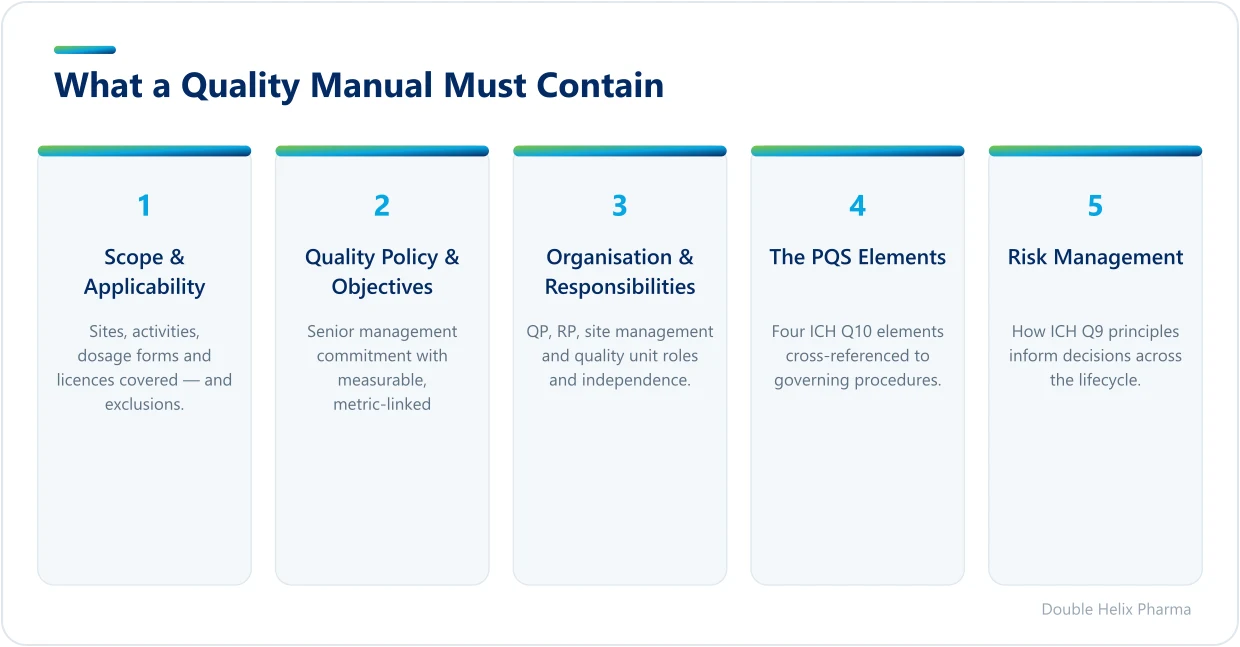
Both EU GMP Chapter 1 and ICH Q10 expect a quality manual (or equivalent documentation) that defines the quality policy and describes the quality management system. In practice, a lean and effective document covers a consistent set of elements.
- Scope and applicability — the sites, activities, dosage forms and licences covered, and crucially what is excluded. An importer's manual looks very different from a sterile manufacturer's, and the scope statement is where you say so.
- Quality policy and objectives — senior management's commitment, expressed in language people recognise, with measurable objectives that link to your quality metrics.
- Organisation and responsibilities — the relationship between the Qualified Person, Responsible Person, site management and the quality unit, including the QP's independence in batch certification.
- The PQS elements — the four ICH Q10 elements (process performance and product quality monitoring, CAPA, change management, and management review), described and cross-referenced to their governing procedures.
- Risk management — how ICH Q9 principles are applied across the lifecycle, and how risk informs decisions rather than decorating them.
- Document and data governance — the documentation hierarchy and your commitment to data integrity and ALCOA+ principles.
Notice what is absent: no instructions, no forms, no parameter tables. The manual points; the procedures do.
Structure for the reader, not the regulation
The temptation to number your manual section-by-section against the regulation is strong and almost always wrong. Inspectors do not need you to recite the structure of Chapter 1 back to them; they need to see that your system meets the intent. Structure instead around how work flows through your organisation, and use a simple cross-reference matrix to demonstrate regulatory coverage.
Use a clear documentation hierarchy
State plainly where each tier of your document set sits and what belongs in it:
- Quality manual — policy and the description of the PQS.
- Policies and standards — site-wide rules and expectations.
- Procedures (SOPs) — the controlled how-to.
- Work instructions, forms and records — the operational detail and the evidence.
When everyone understands this hierarchy, the manual stops competing with the SOPs and starts orienting people towards them. New starters, in particular, should be able to read it in one sitting and understand how the quality system hangs together.
Keep it current, controlled and genuinely owned
A manual that is technically controlled but practically neglected fails its real-world test the day operations diverge from the page. Tie it to your change management process so that structural changes — a new site, a new licence, an outsourced activity, a reorganised quality unit — trigger a review. Bring it into management review under ICH Q10 rather than treating it as a standalone artefact revised only when an audit looms.
Ownership matters as much as control. A manual owned by senior quality leadership, and visibly endorsed by them, carries authority that a document quietly maintained by a single coordinator never will. Avoid the trap of versioning the manual every time a downstream SOP changes; because it references rather than reproduces detail, a well-written manual is stable and only needs revision when the shape of the quality system changes.
If your quality manual needs updating every time an SOP is revised, it is carrying detail it should never have held.
Test it the way an inspector will
Before you approve it, hand the draft to someone who was not involved in writing it — ideally a recent joiner — and ask them to find how a deviation is handled, who certifies batches, or where supplier qualification lives. If they can navigate from the manual to the right procedure in under a minute, it works. If they cannot, the structure needs another pass. This kind of pre-inspection readiness check is exactly what we build into a robust QMS implementation programme, and it consistently exposes gaps long before a regulator does.
Key takeaways: a pharmaceutical quality manual worth keeping
An effective pharmaceutical quality manual is short, structural and stable. It describes the quality system using ICH Q10 and EU GMP Chapter 1 as its frame, points confidently to the procedures that hold the detail, and reads like a document written for the people who run the site rather than the auditor who visits it. Get those choices right and the manual earns its place as a genuine reference; get them wrong and it becomes one more document nobody trusts.
If your manual has drifted into restating regulation or duplicating SOPs, it is worth rebuilding from the structure up. We help UK and EU manufacturers, importers and CMOs design quality systems that withstand inspection and work day to day — see our case studies for examples, explore the full range of our services, or get in touch to talk through your quality manual and wider PQS.
Regulatory sources
This guidance reflects current UK and EU GMP/GDP requirements. Primary references:
- EU GMP Chapter 1 — Pharmaceutical Quality System
- EudraLex Volume 4 — EU GMP Guidelines
- EMA — GMP/GDP Questions & Answers
Always confirm against the latest published version of each source.
Frequently asked questions
What is the difference between a pharmaceutical quality manual and an SOP?+
A quality manual describes the overall quality system at a high level: the quality policy, organisation, responsibilities and the ICH Q10 elements, and it points to where detail lives. An SOP provides the controlled, step-by-step instructions for a specific task. The manual should reference procedures rather than reproduce them, which keeps it stable and prevents conflicting versions of the same instruction.
Is a quality manual mandatory under EU GMP?+
EU GMP Chapter 1 and ICH Q10 expect the pharmaceutical quality system to be documented, including a defined quality policy and a description of the system, which a quality manual satisfies. The exact title is less important than demonstrating that the PQS is described and governed. Most UK and EU manufacturers, importers and CMOs maintain a quality manual as the most practical way to meet this expectation.
How often should a pharmaceutical quality manual be reviewed?+
Review it whenever the shape of your quality system changes, for example a new site, licence, outsourced activity or significant reorganisation of the quality unit, triggered through your change management process. It should also be considered during periodic management review under ICH Q10. Because a well-written manual references rather than duplicates procedural detail, it should not need revising every time a downstream SOP is updated.