QMS & PQS Implementation · 7 min read
The Product Quality Review (PQR/APQR) Explained
A senior QP guide to the product quality review (PQR/APQR): EU GMP scope, trending under ICH Q9, QP and MAH duties, and how to make it a real tool.
By Balasubramanian Ramaiah · 9 June 2026 · Updated 24 June 2026
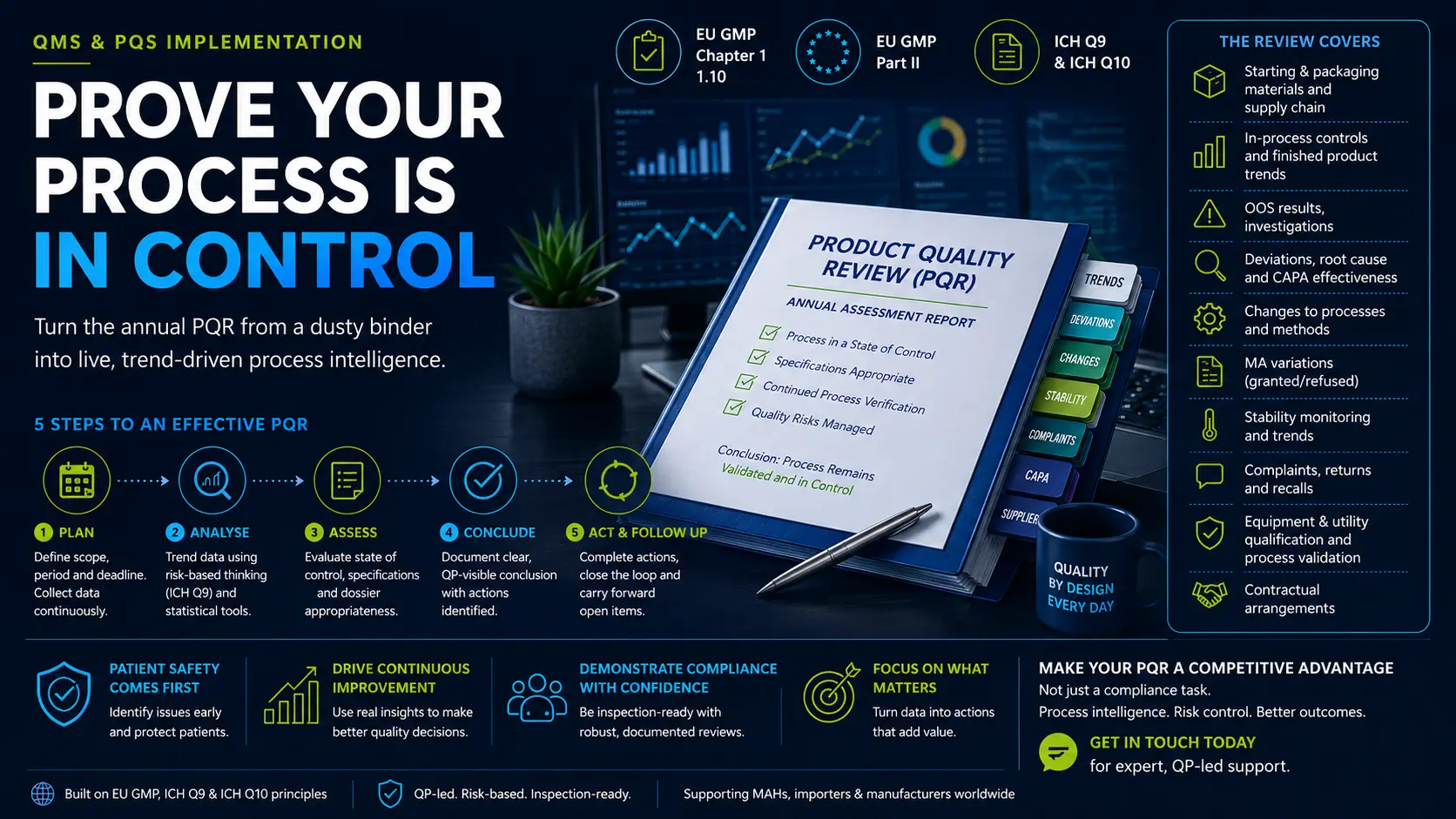
The product quality review (PQR), often called the Annual Product Quality Review (APQR), is one of the most revealing documents in any pharmaceutical quality management system. Done well, it is a genuine engineering and quality tool that surfaces drift before it becomes a deviation; done badly, it is a thick binder nobody reads until an inspector asks for it. This article sets out what the review is, what the regulators expect, and how to make it earn its keep.
What the product quality review is and where it comes from
The product quality review is a periodic, documented evaluation of all licensed medicinal products, carried out to verify the consistency of the existing process, the appropriateness of current specifications for both starting materials and finished product, and to highlight any trends and identify product and process improvements. The requirement sits in EU GMP Part I, Chapter 1 (Pharmaceutical Quality System), and is mirrored for active substances in EU GMP Part II. The US equivalent is the annual review obligation under 21 CFR 211.180(e), which is narrower in wording but similar in intent.
It is deliberately a system-level activity, not a batch-level one. Where batch certification asks “is this lot fit for release?”, the PQR asks “is the process that produced these lots still in a state of control, and is the dossier still an accurate description of reality?” That distinction matters, because it positions the review as a core feedback loop within the pharmaceutical quality system described in ICH Q10.
What a compliant review must cover
Chapter 1.10 of EU GMP is unusually prescriptive about scope. A defensible review covers, at minimum, the elements below. Treating them as a checklist is the wrong instinct; treating each as a question to be answered with evidence and analysis is the right one.
- Starting and packaging materials, especially any from new sources, and the supply chain traceability of active substances.
- Critical in-process controls and finished product results, presented as trends rather than isolated pass/fail statements.
- All batches that failed to meet specification and the resulting investigations.
- All significant deviations and non-conformances, the related investigations, and the effectiveness of the corrective and preventive actions taken.
- All changes made to processes or analytical methods, and the outcome of those changes.
- Marketing authorisation variations submitted, granted or refused, including those for third-country (export-only) dossiers.
- Stability monitoring results and any adverse trends.
- All quality-related returns, complaints and recalls, and the investigations performed.
- The status of relevant equipment and utility qualification and process validation.
- Contractual arrangements, to confirm the technical agreement remains current.
For sterile products, the review should also draw on the contamination control strategy and environmental monitoring trends now expected under Annex 1. A PQR that ignores environmental data for an aseptically filled product is incomplete.
Turning data into insight: trending and ICH Q9
The single most common weakness in a product quality review is the substitution of data presentation for data analysis. Tabulating twelve months of assay results proves only that someone copied a spreadsheet; it does not demonstrate control. Inspectors increasingly expect statistical trending — control charts, capability indices (Cpk/Ppk), or at least a documented rationale for the trending approach chosen.
This is where ICH Q9 quality risk management connects directly to the review. Trends should be evaluated for risk to the patient and to product quality, and the conclusions should feed risk-based decisions: tightening an in-process limit, revalidating a step, or escalating a supplier. The review is also a natural home for confirming that the data underpinning it satisfies ALCOA+ — that the results are attributable, legible, contemporaneous, original and accurate, and that audit trails were reviewed where the data is electronic.
Common findings to avoid
- Reviews completed months after the period closed, so any adverse trend is already historic.
- No documented conclusion on the “state of control” or the validated status of the process.
- Actions raised but never tracked to closure, breaking the loop ICH Q10 depends on.
- Separate reviews by the manufacturer and the Marketing Authorisation Holder that contradict one another.
Roles, the QP and the MAH responsibility split
The manufacturer or importer prepares the review, but the obligation does not end there. EU GMP requires that the quality of the assessment is evaluated and an assessment made of whether corrective and preventive action, or any revalidation, is required. The Qualified Person certifying batches relies on this assessment as part of the assurance that the process remains in control, so the QP should have visibility of the conclusions and any open actions.
Where manufacture is contracted out, the technical agreement must state clearly who compiles the review, who provides which data, and how the Marketing Authorisation Holder verifies that it has been performed. The MAH retains an independent duty to check the review is carried out in a timely manner and is accurate — it cannot simply assume the contract manufacturer has done so. Building this into a coherent quality management system, with defined ownership and escalation routes, is exactly the work covered by our QMS implementation service, and you can see how we have approached it elsewhere in our case studies.
Making the review a tool, not a chore
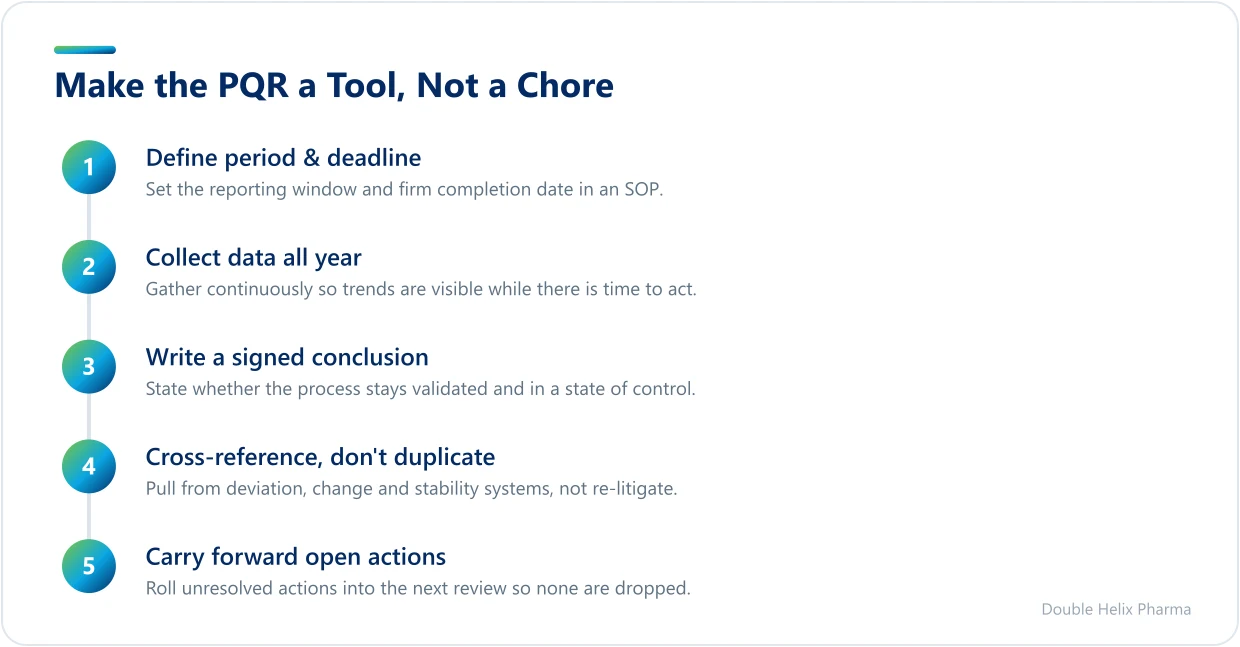
The organisations that get the most from the PQR treat it as live process intelligence. Practical habits that separate a useful review from a compliance artefact include:
- Defining the reporting period and a firm completion deadline in an SOP, and protecting it like any other GMP commitment.
- Collecting data continuously through the year rather than in a year-end scramble, so trends are visible while there is still time to act.
- Writing a clear, signed conclusion that states whether the process remains validated and in a state of control, and whether the specifications and dossier remain appropriate.
- Cross-referencing, not duplicating, the deviation, change control and stability systems — the review should pull from them, not re-litigate them.
- Carrying forward open actions to the next review so nothing is silently dropped.
Grouping closely related products (for example, multiple strengths of the same formulation) is acceptable where scientifically justified, and can sharpen the analysis rather than dilute it — provided the justification is documented and product-specific signals are not lost.
Key takeaways
A strong product quality review is evidence that a manufacturer understands its own processes. It should analyse trends rather than merely report them, connect to quality risk management under ICH Q9, close the feedback loop demanded by ICH Q10, and reach a defensible conclusion on the state of control. Clarity over QP and MAH responsibilities — particularly across contract manufacturing — is what holds the whole exercise together.
If your reviews have become backward-looking binders, or you are unsure how the responsibilities should split across your supply chain, we can help you redesign the process so it actually drives improvement. Explore our full range of services or get in touch to discuss a review of your PQR programme.
Regulatory sources
This guidance reflects current UK and EU GMP/GDP requirements. Primary references:
- EU GMP Chapter 1 — Pharmaceutical Quality System
- EudraLex Volume 4 — EU GMP Guidelines
- EMA — GMP/GDP Questions & Answers
Always confirm against the latest published version of each source.
Frequently asked questions
What is the difference between a PQR and an APQR?+
There is no substantive difference; the terms are used interchangeably. PQR (Product Quality Review) is the wording used in EU GMP Chapter 1, while APQR (Annual Product Quality Review) is common industry shorthand reflecting the typical twelve-month review period. The US annual review under 21 CFR 211.180(e) serves the same purpose with slightly narrower defined scope.
How often must a product quality review be performed?+
EU GMP requires the review to be conducted regularly, which in practice means annually for most licensed products, though a different justified frequency can be defended on a risk basis. Critically, the review should also be completed in a timely manner after the period closes, so that any adverse trend can still be acted upon. A review finalised many months late is a common inspection finding.
Who is responsible for the product quality review under contract manufacturing?+
The manufacturer or importer normally compiles the review, but the Marketing Authorisation Holder retains an independent duty to verify it has been carried out and is accurate. The technical agreement must define who provides which data and who performs the assessment. The Qualified Person should have visibility of the conclusions, as the review supports ongoing assurance that the process remains in control.