QMS & PQS Implementation · 7 min read
Handling Complaints Under GMP
A practical, inspection-ready guide to complaint handling pharma teams can trust: risk-based triage, real root cause, trending, QP oversight and recalls.
By Balasubramanian Ramaiah · 9 June 2026 · Updated 9 July 2026
A complaint is not an administrative nuisance; it is one of the few unfiltered signals you receive about how your product behaves once it leaves your control. Robust complaint handling pharma teams treat each report as potential evidence of a quality defect, a process drift or a patient-safety risk, and they handle it with the same rigour they apply to a batch deviation. This article sets out how UK and EU manufacturers, importers and CMOs build a complaint-handling system that satisfies EU GMP and MHRA expectations and genuinely protects the patient.
Why complaint handling sits at the heart of your PQS
Chapter 8 of the EU GMP guide makes complaints, quality defects and recalls a single, connected discipline, and for good reason: a mishandled complaint is the most common precursor to a recall that arrives too late. Under ICH Q10, the complaint system is one of the principal feedback loops that drives continual improvement of the pharmaceutical quality system. It is where the real-world performance of your product meets the controlled assumptions of your batch records.
Inspectors read your complaints file as a diagnostic of the whole quality system. They look for complaints that were closed without genuine investigation, trends that were never recognised, and decisions about batches on the market that were taken without the Qualified Person being involved. A weak complaint process is rarely an isolated weakness; it usually signals that your feedback mechanisms as a whole are not functioning.
What actually counts as a complaint
Define the term precisely in your procedure. A complaint is any report alleging a quality defect in a medicinal product, whether it concerns physical appearance, packaging, labelling, suspected contamination, lack of efficacy or a suspected falsification. Keep complaints distinct from, but connected to, adverse-event reporting: a single contact can contain both a quality defect and a pharmacovigilance signal, and your system must route each element to the right process without losing either.
Building a defensible complaint-handling process
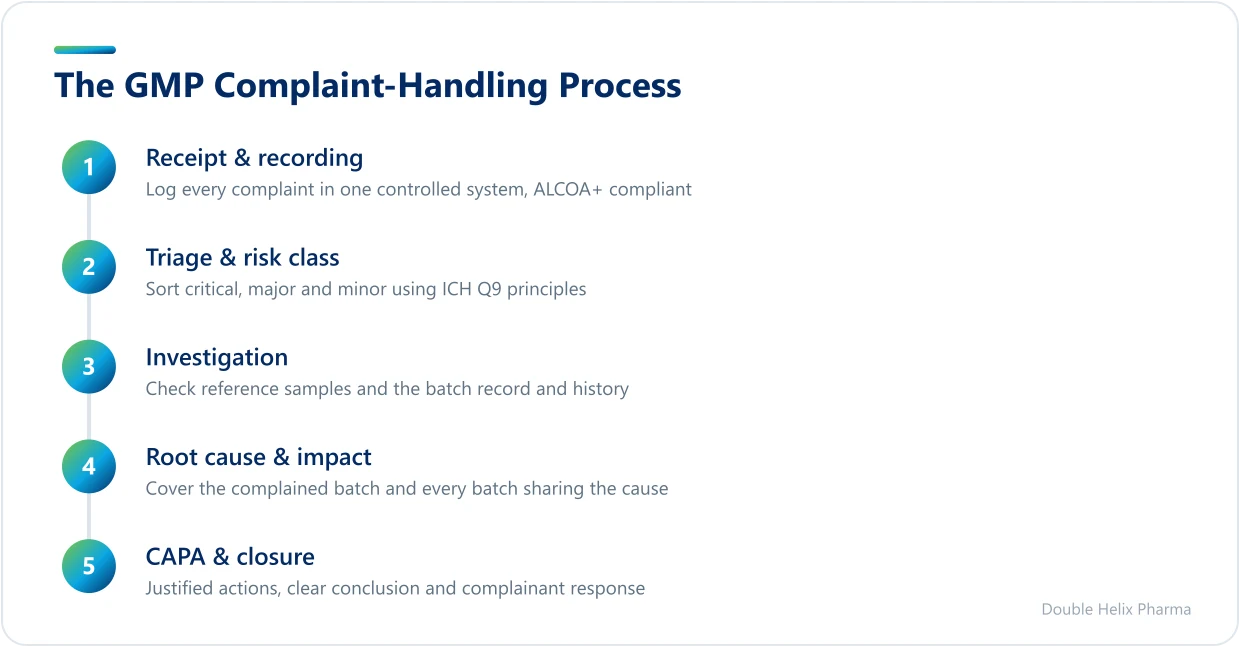
An effective process is staged, documented and time-bound. Every contact, regardless of how it arrives, should pass through the same controlled pathway so that nothing is triaged informally or settled by a phone call that leaves no record.
- Receipt and recording of every complaint in a single controlled system, capturing product, batch, expiry, the nature of the alleged defect and the complainant's details, so that records remain attributable and contemporaneous in line with ALCOA+.
- Triage and risk classification to separate critical defects, which may threaten life or signal falsification, from major and minor issues, using ICH Q9 quality risk management principles rather than instinct.
- Investigation proportionate to that classification, including retrieval and examination of retained reference samples and a review of the relevant batch record and manufacturing history.
- Root cause analysis and impact assessment covering not only the complained-of batch but every other batch that could share the same cause.
- CAPA, decision and closure, with a clear conclusion, justified corrective and preventive actions, and a defined response to the complainant.
Each stage needs an owner and a target timeframe written into the SOP. There is no single regulatory clock, but inspectors expect you to set risk-based timelines, meet them, and escalate when you cannot. Disciplined QMS implementation is what turns this sequence from a flowchart into a process people actually follow under pressure.
Investigation, root cause and the link to the batch
The investigation is where most complaint systems either earn or lose an inspector's confidence. The reflex to record "no fault found" after a cursory look at a returned unit is one of the most frequently cited weaknesses, because it closes the record without explaining the patient's experience or excluding a genuine defect.
Use the reference sample and the batch record together
For any credible defect, retrieve the retained reference and retention samples and compare them against the complaint. Read the batch record and the in-process and release data for that batch, and check whether any deviation, out-of-specification result or change control during manufacture could be relevant. A complaint investigation that never opens the batch record is not an investigation.
Reach a real root cause
As with deviations, "customer error" or "isolated incident" is a description, not a root cause. Ask why the defect was able to occur, reach the market and affect the patient, and whether the same mechanism could affect other batches or products. Where the same defect appears more than once, your system should connect the records rather than treating each as a fresh, unrelated event.
A complaint closed as "no fault found" without examining the reference sample and the batch record is not a closed complaint; it is an open risk with a tidy reference number.
Trending, escalation and the recall decision
Individual complaints matter, but the pattern across them often matters more. Periodic trending of complaints by product, defect type, batch and supplier is an explicit expectation, and it is frequently where an emerging systemic problem first becomes visible. A defect rate that is unremarkable per batch can reveal a serious process drift once plotted across a year.
Escalation must be unambiguous. Your procedure should define when a complaint triggers a quality-defect investigation that could lead to a field alert or recall, and the Qualified Person must be involved in decisions affecting the disposition of product that has been certified and placed on the market. Where a defect could affect distributed stock, the interface with your GDP processes and Responsible Person becomes critical, because the speed and accuracy of any recall depends on distribution records that are complete and current.
Reporting to the authorities
Confirmed quality defects and potential recalls must be reported to the MHRA and other relevant competent authorities within the expected timeframes, and your SOP should name who is accountable for that notification. Failing to report, or reporting late, converts a manageable quality issue into a regulatory one. Our case studies show how a well-rehearsed escalation path turns a frightening defect signal into a controlled, defensible response.
Complaints in outsourced and imported supply chains
Where manufacture is outsourced or product is imported into the UK or EU, complaint handling must be governed by the technical agreement. The contract giver and contract acceptor each need defined roles: who receives the complaint, who investigates, who has access to the batch record, and how information flows back to the party legally responsible for the product. A complaint should never fall into the gap between two companies that each assume the other is handling it.
For importers, the Qualified Person certifying the batch and the Responsible Person under the relevant authorisations both rely on a complaint system that reaches across the border to the original manufacturing site. Build the data-sharing obligations, timelines and language requirements into the quality agreement before the first complaint arrives, not after. Our wider consultancy services frequently start exactly here, repairing complaint flows that fracture at a contractual boundary.
Key takeaways
Strong complaint handling pharma teams share a few habits: they record every complaint in one controlled system, classify by risk, investigate against the reference sample and the batch record, trend relentlessly, and keep the QP firmly in the loop on any decision affecting marketed product. Done well, the complaint system is not a cost centre but an early-warning system that protects patients and your licences alike.
If your complaint procedures, trending or recall readiness need an objective review, talk to our QP-led team about a focused gap assessment. We help UK and EU manufacturers, importers and CMOs turn a fragmented complaints log into an inspection-ready, patient-focused part of the quality system.
Regulatory sources
This guidance reflects current UK and EU GMP/GDP requirements. Primary references:
- EU GMP Chapter 1 — Pharmaceutical Quality System
- EudraLex Volume 4 — EU GMP Guidelines
- EMA — GMP/GDP Questions & Answers
Always confirm against the latest published version of each source.
Frequently asked questions
What is the difference between a complaint and a recall under GMP?+
A complaint is a report alleging a quality defect in a product that has reached the market, while a recall is the action of removing affected product from the supply chain. Not every complaint leads to a recall, but every potential recall should be traceable back to the complaints and quality-defect process that identified the risk. Under EU GMP Chapter 8 the two are deliberately managed together so that a serious complaint cannot be closed without considering whether marketed batches must be withdrawn.
Who is responsible for handling complaints in a pharmaceutical company?+
Day-to-day handling usually sits with the quality unit, but accountability is shared: a designated person should own the complaints system and ensure trending and escalation actually happen. The Qualified Person must be involved in any decision that affects the disposition of certified, marketed product, and for distributed stock the Responsible Person and GDP function are central to executing a recall. In outsourced or imported supply chains these roles must be defined explicitly in the technical or quality agreement.
How quickly must a serious quality defect be reported to the MHRA?+
Confirmed serious quality defects and potential recalls should be reported to the MHRA and other relevant competent authorities promptly, within the timeframes set out in EU GMP and national guidance, rather than waiting for an investigation to fully conclude. Your SOP should name who is accountable for notification and define the trigger points for escalation. Late or omitted reporting is itself an inspection finding and can escalate a manageable defect into a regulatory problem.