GDP Transport & Supply Chain · 7 min read
Qualifying Shipping Lanes for Pharmaceuticals
A UK QP's guide to shipping lane qualification under EU and UK GDP: risk-based route mapping, seasonal temperature profiling and continuous monitoring.
By Balasubramanian Ramaiah · 9 June 2026 · Updated 15 August 2026
Every parcel of temperature-sensitive medicine that leaves your site is travelling a defined route, and shipping lane qualification is how you prove that route keeps the product within its labelled conditions from despatch to delivery. Under EU and UK GDP, the distributor remains responsible for product quality during transit, regardless of how many carriers, transit hubs or borders sit in between. This guide sets out how a UK Qualified Person and Responsible Person approach qualifying a lane so that it stands up to MHRA scrutiny.
What a shipping lane is, and why it must be qualified
A shipping lane is the end-to-end journey a defined product takes between two points using a defined transport mode, packaging configuration and route: the origin, the carriers, the transit and consolidation points, the customs steps and the destination. Two consignments of the same product can travel entirely different lanes, and each lane carries its own thermal and security risks.
The EU GDP guidelines (2013/C 343/01) are explicit that medicinal products must be transported so that their storage conditions are maintained within acceptable limits, and that the required conditions are not exceeded during transit. The MHRA enforces the equivalent expectation in the UK. Qualification is simply the documented evidence that a given lane can do this reliably, rather than an assumption that a courier "usually gets it there in time".
If you cannot describe the lane, you cannot control it. Every uncharacterised leg of a journey is an open deviation waiting to be found at inspection.
Shipping lane qualification: a risk-based framework
A proportionate programme starts with quality risk management under ICH Q9, so that effort concentrates on the lanes and products where patient risk is greatest. Cold-chain biologics moving through multiple hot-climate transit hubs warrant far deeper characterisation than a stable oral solid travelling a short domestic route.
When ranking lanes, weigh factors such as:
- The product's stability profile and labelled storage range, including any permitted excursion data and mean kinetic temperature allowances.
- The transport mode and duration, and the number of handovers, transit points and customs steps in the chain.
- The seasonal and geographic temperature extremes the lane is exposed to across the year.
- The packaging strategy, whether passive insulated shippers, active temperature-controlled units or a refrigerated vehicle.
- The maturity and GDP status of each carrier and logistics provider involved.
This ranking determines the depth of mapping, the number of qualification shipments and the seasonal coverage you can justify. It should be formally recorded and revisited, because routes, carriers and climates change. Structuring this assessment is a core part of our GDP and supply chain service.
Mapping, profiling and qualifying the route
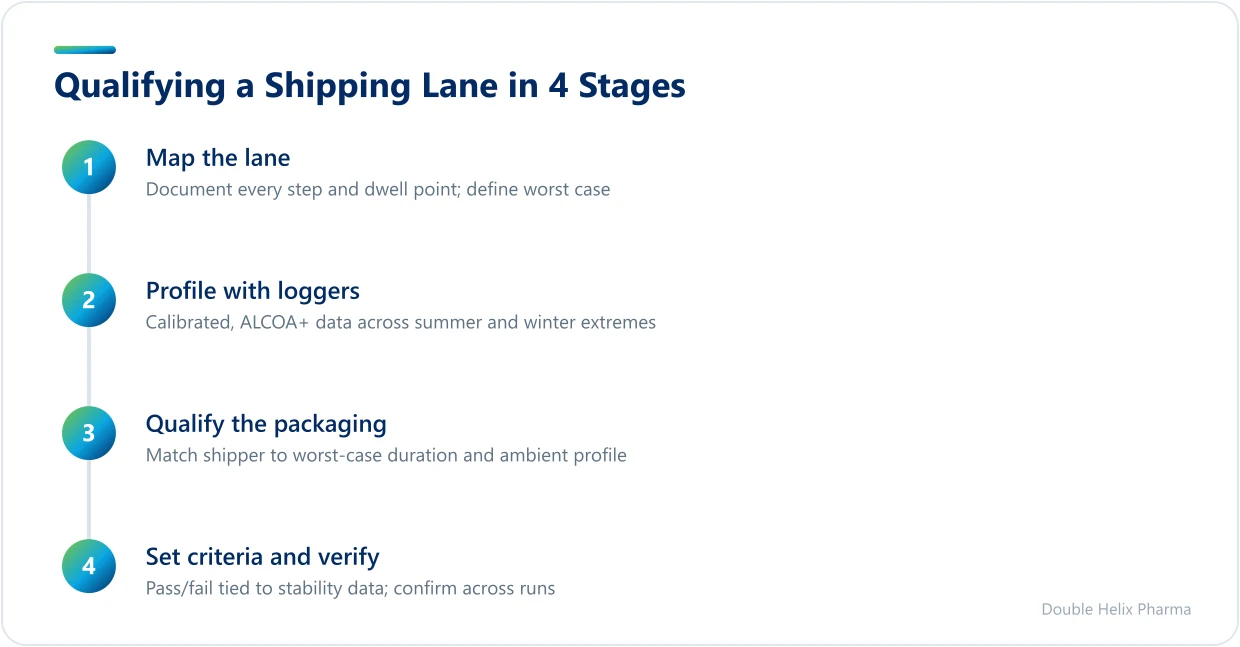
A credible qualification tells a coherent story: what the lane looks like, what it does to the product, and how you have verified that the controls hold. The following stages form the backbone of the exercise.
1. Map the lane and define worst case
Document every physical and administrative step from despatch to receipt, including dwell times on tarmacs, in customs holds and at consolidation centres, where the worst thermal exposure often occurs. From the map, define the worst-case scenario: the longest realistic transit time combined with the most extreme ambient temperatures for the season.
2. Profile with calibrated data loggers
Run characterisation shipments carrying calibrated, qualified temperature data loggers positioned to capture the true product experience, not just ambient air. Data must satisfy ALCOA+ principles, being attributable, legible, contemporaneous, original and accurate, with intact metadata and audit trails so the records are inspection-ready. Cover both summer and winter extremes; a lane qualified only in mild conditions is not qualified for the year.
3. Qualify the packaging against the lane
Match the packaging solution to the mapped worst case. Passive shippers should be qualified to hold the labelled range across the worst-case duration and ambient profile, and active units should be demonstrably capable and monitored. The packaging qualification and the lane qualification are interdependent and should be assessed together.
4. Set acceptance criteria and verify
Define clear pass and fail criteria before you ship, tied directly to the approved product stability data, and confirm that profiling results meet them across the required number of replicate and seasonal runs. Where real-world routes have been strengthened through this work, our case studies show how mapping data translates into reliable distribution.
Carriers, agreements and continuous monitoring
A qualified lane depends on the parties operating it. Under the GDP guidelines, activities that are contracted out must be defined in a written contract, with responsibilities, communication routes and the right to audit clearly set out. A logistics provider that handles medicinal products should be qualified much as any other GDP partner, with its own quality system, training and excursion-handling process.
Qualification is not a one-off certificate. Your quality management system under ICH Q10 must keep each lane under continuous review:
- Trend routine monitoring data and investigate excursions promptly, assessing product impact against stability data before any release decision.
- Trigger re-qualification when the evidence changes: a new carrier, a re-routed leg, a packaging change or a shift in seasonal performance.
- Feed carrier performance, complaints and deviations into periodic management review so adverse trends surface early.
This closed-loop oversight is exactly what an inspector expects when reviewing how you control transportation and outsourced distribution activities.
Common pitfalls that undermine a lane
Even well-intentioned programmes fail in predictable ways. Watch for the following:
- Single-season data. Qualifying only in spring or autumn leaves summer and winter extremes uncharacterised and the lane effectively unproven.
- Ignored dwell time. Treating transit as door-to-door driving time and overlooking airport aprons, customs holds and overnight depots, where most excursions actually happen.
- Uncalibrated or poorly placed loggers. Data that cannot be trusted, or that measures ambient rather than product temperature, is not evidence.
- Static approval. Leaving a lane "qualified" after the carrier, route or packaging has quietly changed, breaking the link between the qualification and reality.
Key takeaways
Effective shipping lane qualification is risk-based, evidence-led and continuously maintained. Anchor it in ICH Q9 and ICH Q10, map the route honestly, profile against seasonal worst case with trustworthy ALCOA+ data, and keep each lane under review as conditions change.
- Define the lane fully, including every dwell point, before you attempt to control it.
- Profile across seasonal extremes with calibrated loggers that capture the product's real experience.
- Qualify packaging and route together against a documented worst case.
- Re-qualify whenever the carrier, route or packaging changes, not on the calendar alone.
If you need experienced QPs and RPs to map your routes, design qualification protocols or strengthen your distribution controls ahead of inspection, explore our full range of consultancy services or get in touch with our team to discuss your requirements.
Regulatory sources
This guidance reflects current UK and EU GMP/GDP requirements. Primary references:
- EMA — GMP/GDP Questions & Answers
- MHRA Inspectorate Blog
- MHRA — UK Medicines & Healthcare products Regulatory Agency
Always confirm against the latest published version of each source.
Frequently asked questions
What is the difference between qualifying a shipping lane and validating a packaging solution?+
Packaging qualification proves that a specific shipper or active unit can hold the labelled temperature range for a defined duration and ambient profile. Shipping lane qualification proves that the actual end-to-end route, with its real handovers, dwell times and seasonal extremes, keeps the product in range. The two are interdependent: a qualified shipper used on an unmapped lane, or a mapped lane with unproven packaging, leaves a gap an MHRA inspector will find.
How many qualification shipments are needed to qualify a lane?+
There is no fixed number in the GDP guidelines; the figure should be justified by risk under ICH Q9. The key requirement is that the data covers the worst-case conditions the lane experiences, which almost always means capturing both summer and winter extremes rather than a single season. Higher-risk cold-chain lanes typically warrant more replicate runs and tighter seasonal coverage than stable, short domestic routes.
When does a qualified shipping lane need to be re-qualified?+
Re-qualification should be triggered whenever the evidence underpinning the lane changes, not simply on a fixed calendar. Common triggers include a new carrier or logistics provider, a re-routed or consolidated leg, a change to the packaging configuration, recurring temperature excursions, or a shift in seasonal performance. Routine monitoring data should be trended through your ICH Q10 quality system so these triggers are identified promptly.