Contract QP, RP & RPi · 7 min read
The QP and the Marketing Authorisation: Staying in Scope
The QP marketing authorisation relationship explained: certifying batches in scope, handling variations and keeping release defensible at MHRA inspection.
By Balasubramanian Ramaiah · 9 June 2026 · Updated 22 July 2026
Every batch a Qualified Person certifies is, in legal terms, a statement that the product conforms to its marketing authorisation. The relationship between the QP marketing authorisation obligation and the daily reality of release is where a great deal of risk hides, because the dossier filed with the regulator and the batch sitting on the floor can drift apart in ways that are easy to miss. This article sets out how an experienced QP stays in scope, where the common traps lie, and how to keep certification defensible under MHRA scrutiny.
What "staying in scope" actually means
The marketing authorisation (MA) is the legal definition of the product. It fixes the composition, the manufacturing and packaging sites, the specifications, the shelf life, the storage conditions and the analytical methods. When a QP certifies a batch under EU GMP Annex 16, they are confirming that it has been manufactured and tested in accordance with that MA and with the principles of Good Manufacturing Practice. There is no separate, looser standard the QP is allowed to apply; the dossier is the benchmark.
Staying in scope therefore means certifying only batches that fall squarely within the terms of the authorisation as currently approved. It sounds obvious, yet the most uncomfortable inspection findings often arise not from outright defects but from quiet divergence: a supplier changed, a test tightened in the lab but never reflected in the licence, a site added in practice before the variation was granted. The QP is the last line that should catch this.
The QP is not the holder of the authorisation
A frequent source of confusion is the boundary between the QP and the Marketing Authorisation Holder (MAH). The MAH owns the licence and is responsible for keeping it accurate and current; the QP certifies batches against it. These are different legal persons with different duties. A QP cannot unilaterally rewrite the dossier, but they absolutely can — and must — refuse to certify when a batch no longer matches what the MAH has had approved. Understanding that split is the foundation of the QP marketing authorisation relationship.
Where the batch and the dossier drift apart
Divergence rarely happens in a single dramatic step. It accumulates. The practical pressure points a QP should watch are well established:
- Specifications. Release and shelf-life limits, methods and acceptance criteria must match the approved MA. A method "improved" by QC without a corresponding variation is a scope breach, however scientifically sound the improvement.
- Sites and manufacturers. Every manufacturing, packaging, testing and importation site involved must be named in the authorisation. Moving a step to a new line or a new contractor ahead of approval puts the batch outside scope.
- Active substance and excipient sources. Suppliers and the route of synthesis are part of the dossier. A new API source needs the variation in place before its material reaches a certified batch.
- Composition and packaging. Formulation, container-closure system and even printed component text are controlled by the MA and the labelling approved with it.
- Shelf life and storage. The expiry assigned and the storage statement applied must be those the regulator has authorised, supported by the registered stability data.
None of these is exotic. They are exactly the items that change during the ordinary life of a product, which is why a disciplined link between change control and the regulatory affairs function matters so much.
Variations: the QP and regulatory affairs interface
The mechanism that keeps the dossier honest is the variation system. When the product or its supply chain changes, the MAH must classify and submit the appropriate variation, and the QP must understand the status of that submission before relying on the change at release. The two functions cannot work in separate silos.
In practice the QP needs a clear answer to one question for any change touching a batch: is this change already approved, or is it still pending? Certifying a batch that depends on an unapproved variation places it outside the authorisation. The cleaner the interface between change control under ICH Q10 and the regulatory affairs team, the less likely such a batch reaches the certification step at all.
A variation in progress is not a variation in force. Until the change is approved, the product is still defined by the dossier as it stands.
This is also where formal quality risk management under ICH Q9 earns its place. Not every divergence carries equal weight, and a structured assessment of impact on quality, safety and the terms of the licence helps the QP and the MAH prioritise variations and decide what genuinely blocks release.
Imported products and the wider supply chain
For products imported into Great Britain, scope has an extra dimension. The QP certifying importation must confirm that the batch conforms to the MA and that the controls expected for imported product have been satisfied, including the relevant testing and oversight arrangements. The Responsible Person for import (RPi) sits alongside this for certain routes, and the boundaries between QP certification and RPi confirmation should be written down, not assumed. We set out how these roles interlock across our consultancy services.
Distribution adds a parallel obligation. Once a batch is certified and released, GDP takes over, and the storage and transport conditions in the field must respect the storage statement approved in the MA. A cold-chain product distributed outside its authorised conditions undermines the very conformity the QP certified. Scope, in other words, does not end at the release signature.
Keeping certification defensible
An inspector will expect the QP to demonstrate, not merely assert, that certified batches were in scope. A few habits make that straightforward:
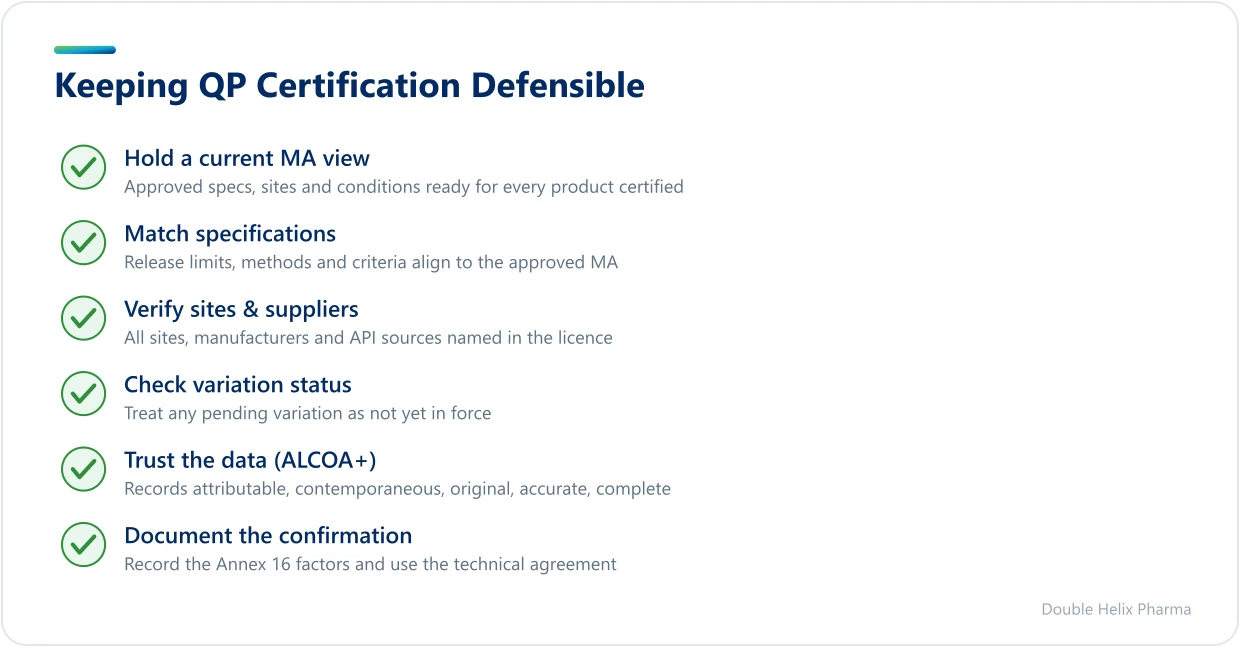
- Hold a current view of the MA. The QP should have ready access to the approved specifications, sites and conditions for every product they certify, and a route to confirm the live status of any variation.
- Trust the data. Certification rests on records that satisfy ALCOA+ — attributable, legible, contemporaneous, original and accurate, plus complete, consistent, enduring and available. If the data cannot be trusted, conformity cannot be claimed.
- Document the confirmation. Annex 16 envisages the QP confirming a defined set of factors. Recording that confirmation, including how reliance on others in the supply chain was justified, turns a judgement into evidence.
- Use the technical agreement. Where steps are outsourced, the technical/quality agreement should make explicit who is responsible for keeping each element aligned to the MA.
The QP's ultimate safeguard is the authority to decline. A batch that cannot be shown to conform to its authorisation should not be certified, whatever the commercial pressure. Documented, principled refusal protects the patient, the licence and the QP personally.
Key takeaways
The QP marketing authorisation relationship comes down to a single discipline: certify only what the dossier currently permits. Keep specifications, sites, suppliers, composition and storage aligned to the approved MA; treat pending variations as not yet in force; and make the change-control-to-regulatory-affairs interface tight enough that out-of-scope batches never reach the release step.
If you need a contract QP who treats marketing-authorisation conformity as the core of every release decision, our contract QP, RP and RPi service is built around exactly that rigour. You can see how we have supported importers and CMOs through our case studies, or contact our team to discuss bringing a Qualified Person onto your licence.
Regulatory sources
This guidance reflects current UK and EU GMP/GDP requirements. Primary references:
- EU GMP Annex 16 — Certification by a Qualified Person and Batch Release
- EMA — GMP/GDP Questions & Answers
- EudraLex Volume 4 — EU GMP Guidelines
Always confirm against the latest published version of each source.
Frequently asked questions
Can a QP certify a batch while a variation to the marketing authorisation is still pending?+
No. Until a variation is formally approved, the product remains defined by the dossier as it currently stands, so a batch that depends on the change is outside scope and should not be certified. The QP must confirm the live status of any relevant variation before release. This is why a tight interface between change control and regulatory affairs is essential.
Who is responsible for keeping the marketing authorisation accurate, the QP or the MAH?+
The Marketing Authorisation Holder owns the licence and is legally responsible for keeping it current through the variation system. The QP does not maintain the dossier but certifies each batch against it under Annex 16. If a batch no longer matches the approved authorisation, the QP must refuse to certify, regardless of commercial pressure.
How does a QP demonstrate at inspection that a certified batch was within scope?+
By holding a current view of the approved specifications, sites, suppliers and storage conditions, and by recording the Annex 16 confirmation for each batch. Records must satisfy ALCOA+ so the data underpinning conformity is trustworthy. Technical agreements should also make clear who keeps each outsourced element aligned to the MA.