Contract QP, RP & RPi · 8 min read
The QP's Role for Investigational Medicinal Products (IMPs)
How QP IMP certification works under EU GMP Annex 13 and MHRA rules: the release decision, importation, comparators, labelling and the risks inspectors probe.
By Balasubramanian Ramaiah · 9 June 2026 · Updated 28 July 2026
Investigational medicinal products carry the same patient-safety burden as licensed medicines, yet they are made and released under far greater uncertainty: evolving processes, partial data and no marketing authorisation to anchor the decision. QP IMP certification is the control point where that uncertainty is reconciled with Good Manufacturing Practice before a batch ever reaches a trial subject. Get the framework right and your clinical supply chain is defensible; get it wrong and you risk dosing patients with product the regulator would never have released.
What an IMP is, and why certification is different
An investigational medicinal product is a pharmaceutical form of an active substance or placebo being tested, or used as a reference, in a clinical trial. That includes products already authorised but used in an unlicensed way, or to gain further information about an approved use. Because the product is still under investigation, the Qualified Person cannot lean on a marketing authorisation as the benchmark for release.
Instead, the reference point is the product specification file and the clinical trial authorisation. The QP certifies against the dossier submitted to the competent authority and the manufacturing arrangements described in it, rather than against a settled, approved process. In Great Britain, manufacture or importation of IMPs requires a Manufacturer's Authorisation for Investigational Medicinal Products (a MIA(IMP)), and that authorisation must name the QP responsible for certification.
The governing framework
The detailed expectations sit in EU GMP Annex 13 (manufacture of investigational medicinal products), read alongside the general principles of EU GMP and the certification requirements of Annex 16. The MHRA enforces the equivalent UK framework. ICH Q9 (quality risk management) and ICH Q10 (pharmaceutical quality system) underpin the whole approach, because IMP manufacture is inherently a higher-risk, lower-data environment where judgement must be proportionate and documented.
QP IMP certification: the decision in practice
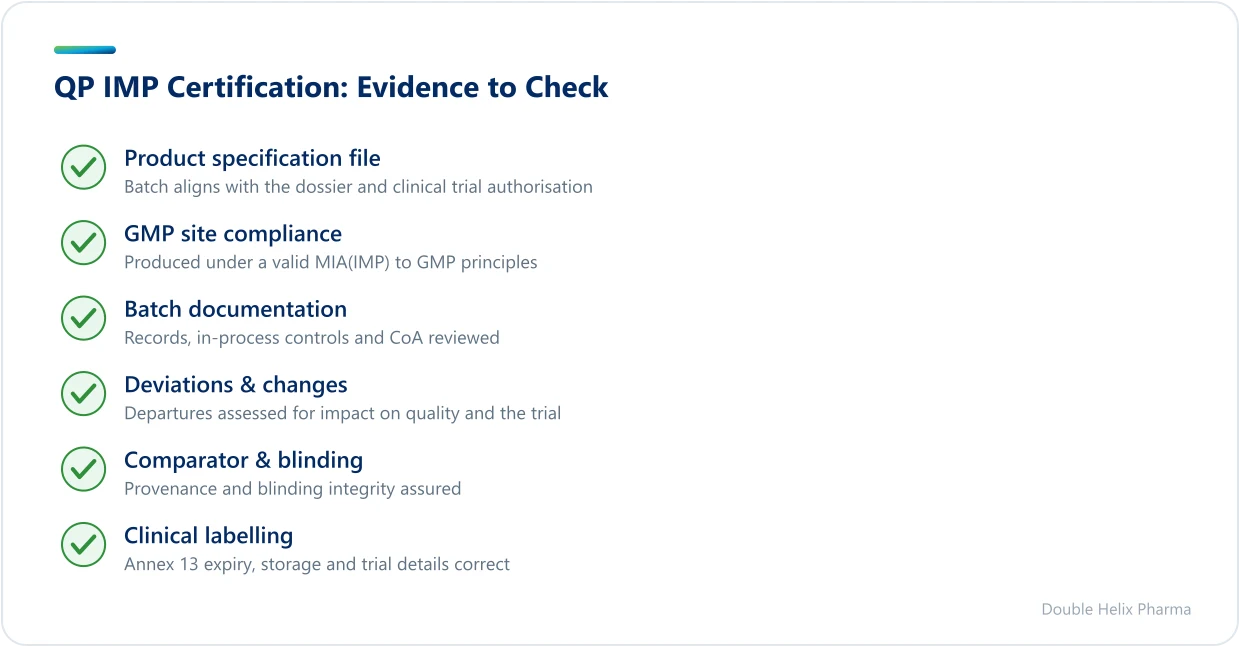
Certification of an IMP batch is a personal, non-delegable judgement that each batch has been manufactured and checked in accordance with the relevant requirements before release for use in a trial. The QP cannot reduce this to a checklist, but in practice they must satisfy themselves on a defined body of evidence:
- Conformance to the product specification file — manufacturing and testing align with the dossier and the clinical trial authorisation.
- GMP compliance of the manufacturing site — the batch was produced under a valid MIA(IMP) to the principles of GMP.
- Batch documentation — batch records, in-process controls and the certificate of analysis have been reviewed and found acceptable.
- Deviations and changes — any departures from the defined process have been assessed for impact on quality and the trial.
- Comparator and blinding integrity — where a licensed comparator is sourced or re-packaged, its provenance and the integrity of blinding operations are assured.
- Labelling — clinical trial labelling meets Annex 13 expectations, including expiry, storage and trial-specific information.
Every record the QP relies on must satisfy ALCOA+: attributable, legible, contemporaneous, original and accurate, plus complete, consistent, enduring and available. A certification that cannot be reconstructed from its underlying data years later will not survive inspection.
Working with incomplete validation
The defining challenge of IMP work is that processes are rarely fully validated, especially in early phase. Annex 13 recognises this: the QP relies more heavily on qualification of equipment and facilities, robust in-process testing and a documented risk assessment than on the formal process validation expected for commercial product. The certification statement must reflect what was actually controlled, not a commercial standard the process has not yet reached. This is precisely where an experienced contract QP, RP and RPi adds value, by calibrating expectations to the trial phase without lowering the bar on patient safety.
Importation and the third-country dimension
Much clinical supply is manufactured outside Great Britain, so IMP importation is common and tightly scrutinised. Where an IMP is imported from a third country, the QP must confirm that each batch has been manufactured to standards at least equivalent to UK and EU GMP, and that appropriate checks have been carried out on import.
For IMPs, the regulatory position on importation testing differs from commercial product: full re-testing on import may be reduced or waived where the QP has documented assurance of the manufacturing and testing arrangements, supported by the product specification file. That assurance does not arrive by default. It rests on supplier qualification, a clear quality and technical agreement, and verified oversight of the overseas site, all set proportionately to risk under ICH Q9. Assuming equivalence without evidence is one of the fastest routes to a critical finding.
An IMP batch certified against assumptions rather than evidence is not a shortcut; it is an inspection finding waiting to be written.
Comparators, labelling and supply-chain integrity
Two areas catch teams out repeatedly. The first is comparator sourcing. When a licensed product is purchased as a comparator and re-packaged or re-labelled for a blinded study, the QP must be confident that the original quality has been preserved and that any manipulation has not compromised the product. The provenance chain, from authorised supply through to clinical site, must be intact and documented.
The second is labelling and storage. Clinical trial labelling is unforgiving: trial reference, period of use, storage conditions and subject identifiers must all be correct, and Annex 13 sets specific content requirements. Storage and distribution then fall under Good Distribution Practice, and a temperature excursion or a break in the chain of custody can undermine an otherwise sound certification. The QP works closely with the Responsible Person to ensure that what was certified is what actually reaches the patient. Our case studies show how a structured approach to comparator control and clinical labelling keeps complex multi-country trials defensible.
Where MHRA inspectors focus
- Certification against a poorly maintained or outdated product specification file.
- Importation assurance asserted without underlying supplier qualification or site oversight.
- Inadequate control or documentation of comparator re-packaging and blinding.
- Clinical labelling errors, particularly on expiry, storage and trial identifiers.
- Deviations closed without a proper assessment of impact on the trial subjects.
Each is avoidable with the right quality system, and each is exactly what an inspector will probe when reviewing IMP batches. If you are mapping these controls across a clinical programme, our full range of services spans both manufacturing and distribution responsibilities.
Key takeaways
Effective QP IMP certification rests on a few durable principles. The QP carries personal, non-delegable accountability for every investigational batch. The reference standard is the product specification file and clinical trial authorisation, not a marketing authorisation. Validation is often incomplete, so certification is a documented, risk-based judgement rather than a formality. And the decision is only as strong as the supplier qualification, comparator control, labelling discipline and GDP arrangements that sit beneath it.
If your organisation is manufacturing, importing or distributing IMPs, scaling a clinical programme, or preparing for an MHRA inspection, Double Helix Pharma UK can provide an experienced contract QP and a defensible certification framework. Explore our contract QP, RP and RPi service or get in touch to discuss your clinical supply requirements.
Regulatory sources
This guidance reflects current UK and EU GMP/GDP requirements. Primary references:
- EU GMP Annex 16 — Certification by a Qualified Person and Batch Release
- EMA — GMP/GDP Questions & Answers
- EudraLex Volume 4 — EU GMP Guidelines
Always confirm against the latest published version of each source.
Frequently asked questions
What does a QP certify an IMP batch against if there is no marketing authorisation?+
For investigational medicinal products the reference point is the product specification file and the clinical trial authorisation, not a marketing authorisation. The QP confirms that the batch was manufactured and checked in line with the dossier submitted to the competent authority and the arrangements described in it. This is governed by EU GMP Annex 13 and certified under the principles of Annex 16, with the equivalent UK framework enforced by the MHRA.
Is full importation testing always required for IMPs made in a third country?+
No. Unlike commercial product, the requirement for full re-testing of imported IMPs can be reduced or waived where the QP holds documented assurance of the manufacturing and testing arrangements, supported by the product specification file. That assurance must rest on genuine supplier qualification, a clear quality agreement and verified oversight of the overseas site, set proportionately to risk under ICH Q9. It is never a default position and assuming equivalence without evidence invites a critical finding.
How does the QP handle comparator products in a blinded clinical trial?+
When a licensed product is sourced as a comparator and re-packaged or re-labelled for blinding, the QP must be satisfied that the original quality has been preserved and that the manipulation has not compromised the product. The provenance chain from authorised supply through to clinical site must be intact and documented. Annex 13 also sets specific clinical-trial labelling requirements that the certified batch must meet.