Contract QP, RP & RPi · 7 min read
The QP Declaration Explained for Importers
What a QP declaration is, why importers need one, and the audit evidence behind it. A practical guide to GMP equivalence under EU GMP, MHRA and ICH Q9/Q10.
By Balasubramanian Ramaiah · 9 June 2026 · Updated 16 September 2026
If your company imports medicinal products into Great Britain or the EU, sooner or later someone will ask you for a QP declaration. It is a deceptively short document that carries significant regulatory weight: a written confirmation, signed by a Qualified Person, that a third-country manufacturing site operates to standards at least equivalent to EU GMP. Misunderstand what it does, who must provide it and when it is valid, and you risk delayed batches, failed inspections and avoidable supply disruption.
What a QP declaration actually is
A QP declaration is a formal statement provided in support of a marketing authorisation application or variation. In it, a named Qualified Person confirms that the active substance used in a finished product is manufactured in accordance with the principles and guidelines of EU GMP, and that the manufacturing sites concerned are subject to appropriate oversight. The legal foundation sits in the medicines directives, with the practical template and expectations set out in the European Commission's guidance on the content of the written confirmation.
It is important to be precise about scope. The declaration is principally about the active pharmaceutical ingredient (API) and the GMP status of the relevant manufacturing operations. It is not the same act as batch certification, and it does not, by itself, release stock to the market. Treat it as an assurance document that underpins the authorisation, not as a substitute for the routine QP certification that follows on a batch-by-batch basis.
How it differs from QP certification
- Purpose: a QP declaration supports the marketing authorisation by confirming GMP equivalence of API manufacture; QP certification confirms an individual batch meets its specification and authorisation before release.
- Frequency: a declaration is provided at application or variation stage and refreshed when sites or arrangements change; certification happens for every batch placed on the market.
- Basis: a declaration rests on audit evidence and GMP knowledge of the site; certification rests on review of batch records, testing and the importation checks required for products from third countries.
Why importers need to take the QP declaration seriously
For an importer, the QP declaration is where regulatory theory meets supply-chain reality. When you bring a finished product or its API from outside the UK or EU, an authority will expect documented assurance that the upstream manufacturing meets the required standard. A weak, outdated or unsupported declaration is a recurring inspection finding, and it can stall a marketing authorisation before a single pack is sold.
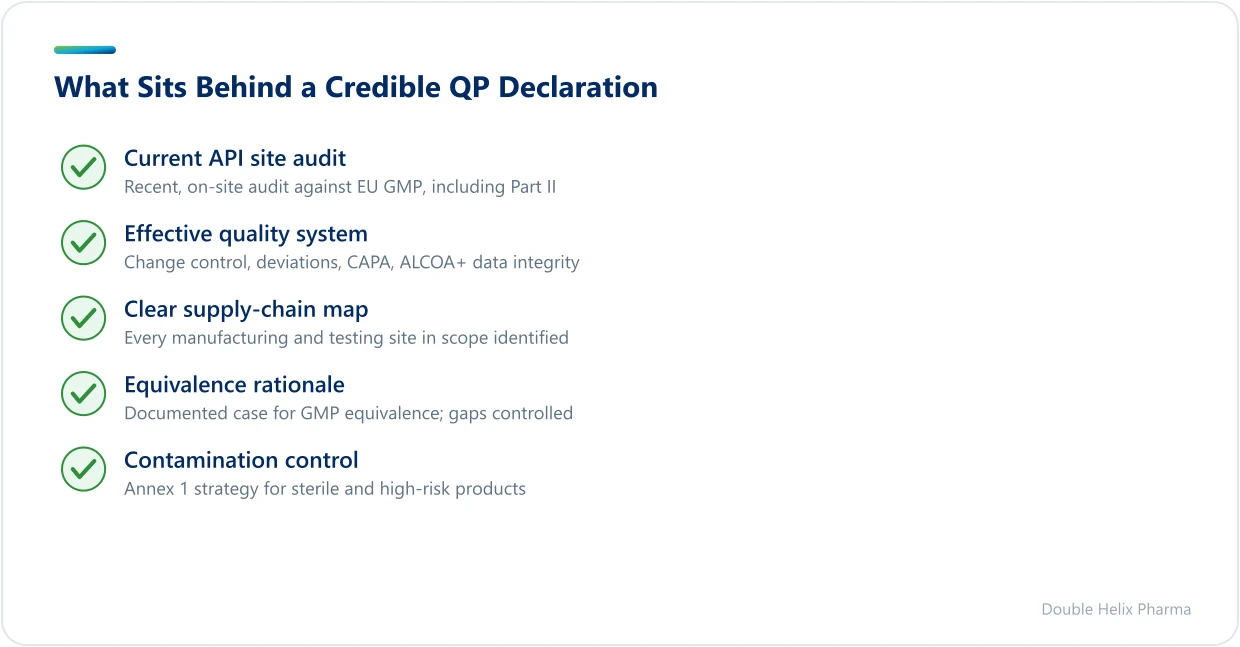
The deeper issue is that the QP signing the declaration is putting their professional judgement, and their name on the regulatory register, behind your supply chain. They cannot do that on trust. Behind every credible declaration sits real evidence: a recent audit of the API manufacturer, a clear picture of the contamination control and quality systems in place, and a defensible rationale for why the site is equivalent to EU GMP. If your supplier management programme cannot produce that evidence, the declaration cannot honestly be signed.
A QP declaration is only as strong as the audit and oversight that sit behind it. The signature is the visible part; the documented assurance is what an inspector will actually test.
What sits behind a credible declaration
A QP will not sign a written confirmation as a paperwork formality. The expectation, consistent with ICH Q9 on quality risk management and ICH Q10 on the pharmaceutical quality system, is that the declaration is the conclusion of a structured assurance process. In practice that means several things have to be in place.
- A current audit of the API site, ordinarily on-site and recent, conducted by suitably qualified auditors against the relevant parts of EU GMP, including Part II for active substances.
- Evidence of an effective quality system, covering change control, deviations, CAPA and data integrity assessed against ALCOA+ principles, so that records are attributable, legible, contemporaneous, original and accurate.
- A clear supply-chain map, identifying every manufacturing and testing site in scope, so the declaration covers exactly what is used in the product.
- A documented equivalence rationale, explaining why the third-country operation meets standards at least equivalent to EU GMP, and how any gaps are controlled.
For sterile and high-risk products, that evidence base extends to the revised Annex 1 expectations on contamination control strategy. A declaration that ignores the realities of aseptic manufacture will not survive scrutiny, however neatly it is worded.
Common pitfalls importers should avoid
Treating the declaration as a one-off
A QP declaration is not a permanent certificate. It reflects the state of the supply chain at a point in time. New API sites, transferred processes, changed testing arrangements or a significant deterioration in a supplier's GMP status all undermine the original confirmation. Build declaration review into your change-control and supplier-management cycle rather than rediscovering the issue during an inspection.
Confusing GB and EU expectations
Since the UK left the EU, importers must be clear about which framework applies. The MHRA sets the expectations for Great Britain, while EU authorities govern products placed on the EU market, and the routes for importation and certification are not identical. Map your flows carefully and make sure the right QP, under the right authorisation, is providing the right assurance for each market.
Outsourcing the signature without the substance
Engaging a contract QP is entirely legitimate and often sensible. What does not work is expecting any QP to sign a declaration without the underlying audits and oversight in place. A credible contract QP service will insist on seeing, or commissioning, the evidence first, because the signature is a personal regulatory commitment, not a clerical task.
How to get your QP declaration right
Getting the QP declaration right is fundamentally a project-management exercise wrapped around sound quality science. Start by mapping the full manufacturing and testing chain for the product, identify which sites the declaration must cover, and confirm that each has a current, defensible audit behind it. Close any gaps in supplier oversight and data integrity before, not after, you ask a QP to put their name to the confirmation. Then keep the declaration alive by re-examining it whenever the supply chain changes.
If you are preparing an application, onboarding a new third-country supplier, or responding to an inspection finding, our independent UK Qualified Persons can help you build the evidence base and provide the declaration with confidence. Explore our contract QP, RP and RPi services, see how we have supported importers and manufacturers in our case studies, or review the full range of quality and compliance services we offer. When you are ready to discuss your supply chain, get in touch with our QP team for a confidential, practical conversation.
Regulatory sources
This guidance reflects current UK and EU GMP/GDP requirements. Primary references:
- EU GMP Annex 16 — Certification by a Qualified Person and Batch Release
- EMA — GMP/GDP Questions & Answers
- EudraLex Volume 4 — EU GMP Guidelines
Always confirm against the latest published version of each source.
Frequently asked questions
Is a QP declaration the same as QP batch certification?+
No. A QP declaration is a written confirmation, provided in support of a marketing authorisation, that the active substance is manufactured in line with EU GMP and that the relevant sites have appropriate oversight. QP certification is a separate, batch-by-batch act that confirms an individual batch meets its specification and authorisation before it is released to the market. You need both, but they answer different questions at different points in the product lifecycle.
Who is allowed to sign a QP declaration?+
Only a named Qualified Person eligible under the relevant medicines legislation can sign, and they must be acting under the appropriate manufacturing or importation authorisation for the market concerned. The QP is making a personal regulatory commitment, so they will expect to review the supporting audits and quality evidence before signing. A contract QP can provide this service, provided the underlying oversight is genuinely in place.
How often should a QP declaration be reviewed or updated?+
A declaration reflects the supply chain at a point in time, so it should be revisited whenever something material changes, such as a new API manufacturing or testing site, a process transfer, or a significant change in a supplier's GMP status. Good practice is to link declaration review to your change-control and supplier-management programme rather than treating it as a one-off document. This avoids discovering an outdated confirmation during an inspection.