Contract QP, RP & RPi · 7 min read
Contract QP vs In-House QP: Cost, Risk and Control
Contract QP vs in-house: compare cost, compliance risk and control for UK and EU batch certification, and choose the right Qualified Person model for your site.
By Balasubramanian Ramaiah · 9 June 2026 · Updated 14 September 2026
Deciding between a contract QP vs in-house Qualified Person is one of the more consequential resourcing choices a UK or EU manufacturing and importation site will make. The Qualified Person sits at the legal heart of batch certification under EU GMP and the UK Human Medicines Regulations, so the model you choose shapes your cost base, your compliance risk and the degree of day-to-day control you retain. This article sets out the practical trade-offs so quality leaders can make a defensible, evidence-based decision.
What the QP role actually demands
Before weighing the options, it helps to be precise about what the role requires. A Qualified Person named on a Manufacturer's/Importer's Authorisation (MIA) carries personal legal accountability for certifying that every batch released to the market has been manufactured and checked in accordance with GMP and the marketing authorisation. That responsibility is grounded in EU GMP Annex 16 and is non-delegable: the QP cannot sign away the judgement, even if technical assessments are performed by others.
The practical workload is broader than signing the register. It spans review of batch records against ALCOA+ data integrity principles, oversight of deviations and out-of-specification investigations, supplier and contract acceptor assurance, and confidence in the pharmaceutical quality system as a whole under ICH Q10. Annex 1 has sharpened expectations further for sterile products, and the QP must be satisfied that contamination control strategies are genuinely effective. Whichever staffing model you adopt, the standard expected of the person certifying does not move.
Contract QP vs in-house: the cost comparison
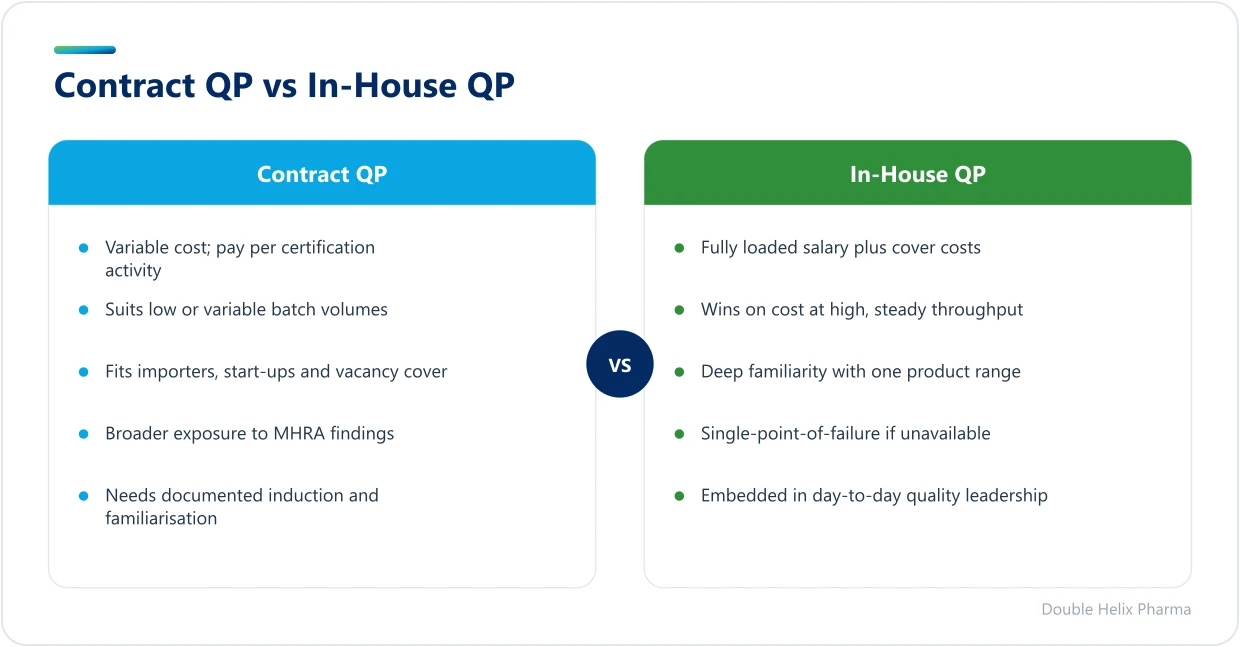
Cost is usually where the conversation starts, and a fair comparison looks beyond the headline day rate. An in-house QP carries a fully loaded salary, employer's National Insurance, pension, training, professional indemnity and the cost of cover during absence. A contract QP is engaged for defined activity, so you pay for certification and oversight rather than for a permanent seat.
When in-house tends to win on cost
High-volume sites certifying batches frequently, every working day, generally justify a permanent QP. At sustained throughput the per-batch economics favour an employed resource embedded in the operation, and the role can absorb adjacent quality leadership duties.
When contract tends to win on cost
Lower or variable batch volumes, importation-only operations, start-ups awaiting MIA approval, and sites bridging a vacancy or parental leave often find a contract QP arrangement markedly more efficient. You convert a large fixed overhead into a proportionate variable cost and avoid paying for capacity you do not yet use.
Weighing the risk
Risk should be assessed through the lens of ICH Q9 quality risk management rather than gut feel. Two failure modes dominate. The first is the single-point-of-failure risk inherent in relying on one employed QP: illness, resignation or a sudden surge in workload can leave a site unable to release product, with direct commercial and supply consequences.
The second is competence and currency. An in-house QP working within a single product range builds deep familiarity but can narrow over time. A contract QP working across multiple clients typically brings broader exposure to MHRA inspection findings, current regulatory expectation and remediation patterns. The counter-risk is that a contractor must be properly inducted; a QP who does not truly understand your processes, your data systems and your contamination control strategy is a liability regardless of contract type. Robust knowledge transfer and documented familiarisation are essential either way.
The regulator does not recognise a discount on accountability for contracted QPs. Annex 16 expectations, MHRA scrutiny and personal legal responsibility apply identically whether the certifying QP is employed or engaged under a services agreement.
Who really holds control?
A common misconception is that an employed QP gives the business more control. In reality the QP must retain professional independence in the certification decision; commercial pressure to release a doubtful batch is precisely what the role exists to resist. Control, properly understood, is about governance and information flow rather than reporting lines.
What matters is whether the QP has unfettered access to batch records, deviation data, complaint trends and the quality management system, and whether their authority and duties are clearly defined in writing. For a contract QP this is formalised through a technical agreement and clear scope; for an employee it sits within the job description and the site quality manual. A well-drafted contract arrangement frequently produces sharper definition of responsibilities than an informal in-house setup that has drifted over the years.
- Access: guarantee real-time visibility of records, deviations and OOS investigations.
- Authority: document the QP's right to halt release and to escalate.
- Availability: define response times and contingency cover for both models.
- Accountability: name the QP on the MIA and keep the responsibilities matrix current.
Choosing the right model for your site
There is rarely a single correct answer, and many organisations run a hybrid: an employed quality lead supported by a contract QP for peak load, holiday cover or specialist product types. Work through these questions before deciding:
- What is your genuine batch certification frequency, today and across the next 24 months?
- Do you have credible cover if your sole QP is unavailable for an extended period?
- How specialised are your products, and how current must regulatory knowledge be?
- Are you pre-MIA, scaling, or managing a vacancy where flexibility has real value?
- Can you evidence to the MHRA that your chosen model delivers effective oversight?
Importers and virtual manufacturers in particular often find that a contract model fits the operating reality, while established high-throughput sites lean in-house. Reviewing how comparable organisations have structured the role can sharpen the decision; our case studies illustrate several of these arrangements in practice.
Key takeaways
The contract QP vs in-house decision is not about which is inherently superior, but which fits your volume, risk profile and need for control. The legal standard for certification is fixed by Annex 16 and UK regulation regardless of employment model, so the real question is how you secure consistent, independent, well-informed QP oversight at a sensible cost.
- Cost favours in-house at high, steady throughput and contract at low or variable volume.
- Risk centres on cover and currency; mitigate single-point-of-failure through documented contingency.
- Control comes from governance, access and written authority, not from a reporting line.
If you are weighing the right QP model for your operation, our team can assess your authorisation scope, batch volumes and risk profile and recommend a proportionate approach. Contact Double Helix to discuss contract QP support or a review of your current arrangements.
Regulatory sources
This guidance reflects current UK and EU GMP/GDP requirements. Primary references:
- EU GMP Annex 16 — Certification by a Qualified Person and Batch Release
- EMA — GMP/GDP Questions & Answers
- EudraLex Volume 4 — EU GMP Guidelines
Always confirm against the latest published version of each source.
Frequently asked questions
Is a contract QP legally equivalent to an in-house QP?+
Yes. The legal accountability for batch certification under EU GMP Annex 16 and UK regulation is identical whether the Qualified Person is employed or engaged on contract. The QP must be named on the Manufacturer's/Importer's Authorisation in both cases, and the personal, non-delegable responsibility for the certification decision is the same. The MHRA applies no lower standard to a contracted QP.
Does using a contract QP mean we lose control over batch release?+
No, provided governance is set up correctly. Control comes from documented authority, unfettered access to batch records and quality data, and a clear technical agreement defining scope and response times. In practice a well-drafted contract arrangement often gives sharper role definition than an informal in-house setup. The QP must always retain independent judgement on certification regardless of employment model.
When is a contract QP more cost-effective than hiring in-house?+
A contract QP is usually more efficient for lower or variable batch volumes, importation-only operations, start-ups awaiting MIA approval, or sites bridging a vacancy or leave. You pay for defined certification activity rather than a fully loaded permanent salary plus cover. High-volume sites certifying batches daily generally justify an employed QP on per-batch economics.