QMS & PQS Implementation · 7 min read
A Right-Sized QMS for Small Pharma and Startups
A right-sized QMS for small pharma is proportionate, not reduced. How to build a compliant, inspection-ready PQS that scales with your pipeline.
By Balasubramanian Ramaiah · 9 June 2026 · Updated 21 September 2026
A right-sized QMS for small pharma is the difference between a quality system that protects your product and one that quietly suffocates a young company. Startups, virtual biotechs and lean CMOs do not need a fifty-binder system designed for a multinational; they need a proportionate Pharmaceutical Quality System that satisfies EU GMP and the MHRA, scales with the pipeline, and never becomes shelfware. This article sets out how to build exactly that.
Why "right-sized" is a regulatory expectation, not a shortcut
There is a persistent myth that a smaller company must simply do "less" quality. The regulations say something more nuanced. ICH Q10 explicitly describes the Pharmaceutical Quality System as something to be applied across the lifecycle "in a manner that is appropriate and proportionate" to each stage. ICH Q9 on Quality Risk Management makes the same point from the other direction: the effort, formality and documentation of the QMS should be commensurate with the level of risk.
In other words, proportionality is the rulebook, not a deviation from it. An MHRA inspector does not expect a clinical-stage company with one product to operate the same change-control machinery as a high-volume sterile manufacturer. What they expect is that the system you do have is defined, followed, and demonstrably effective. A right-sized QMS is therefore a deliberately scoped system, not a watered-down one.
Start with the core processes, not the document tree
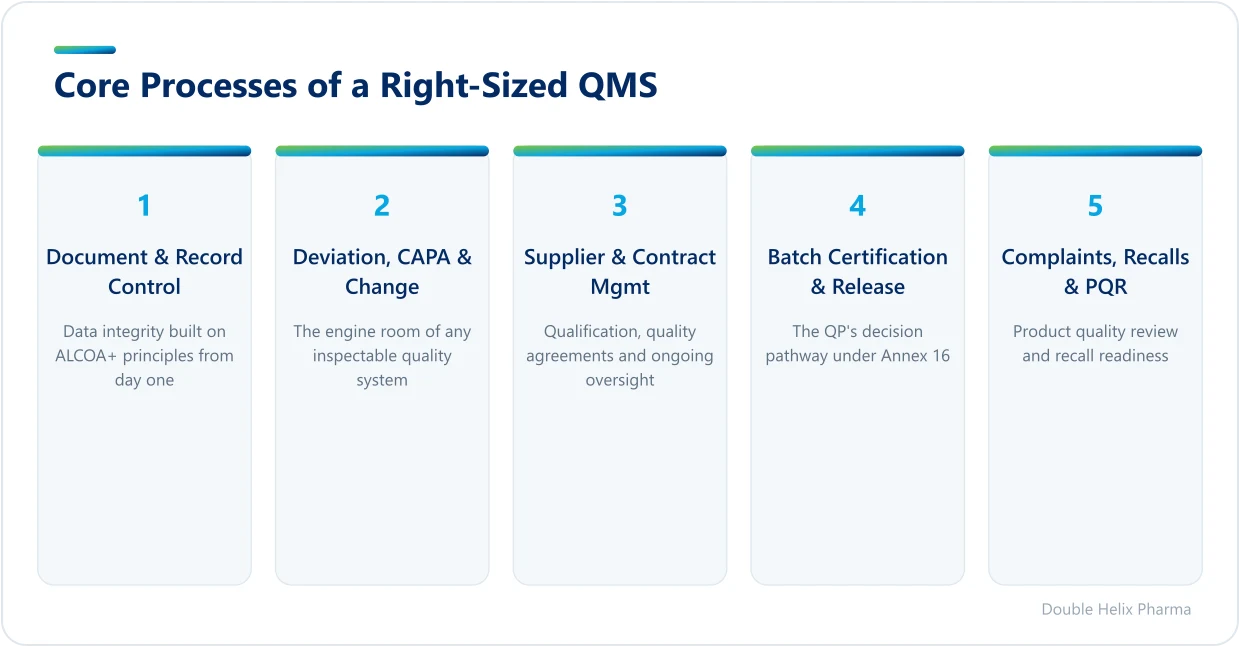
The most common failure in early QMS design is building the library before agreeing the processes. Teams write thirty SOPs, then discover half describe activities the company does not yet perform. Begin instead with the handful of GMP/GDP processes that genuinely carry risk for your operation. For most small pharma and importer set-ups, the essential spine is:
- Document and record control — including data integrity built on ALCOA+ principles from day one.
- Deviation, CAPA and change control — the engine room of any inspectable system.
- Supplier and contract management — qualification, technical/quality agreements and ongoing oversight.
- Batch certification and release — the QP's decision pathway under Annex 16.
- Complaints, recalls and product quality review.
- Training and the quality management review.
Everything else can be layered in as activities begin. A focused set of well-written, genuinely used procedures will always outperform a sprawling library that nobody opens.
Let risk decide the depth
Use ICH Q9 to calibrate how much process each area needs. A virtual company outsourcing all manufacture should invest heavily in supplier oversight and the technical agreement, and comparatively little in equipment qualification it does not own. A startup edging towards sterile fill under Annex 1 must front-load contamination control strategy long before the first engineering batch. Let the risk profile, not a generic template, set the depth.
Build a QMS small pharma teams will actually use
A right-sized QMS for small pharma only delivers value if the people running it can operate it without a dedicated department. Three design choices make that possible.
Keep the documentation hierarchy shallow. A quality manual, a tier of core SOPs, and supporting templates or forms is usually enough. Resist nesting policies beneath policies. Every layer you add is a layer someone must review, version and train against.
Right-size the electronic tooling. A validated eQMS is powerful, but a small company can remain fully compliant with a well-controlled documented system and a simple, access-controlled log for deviations and changes — provided data integrity and audit-trail expectations are met. Buy the platform when transaction volume justifies it, not before.
Make roles explicit. In a lean structure one person often wears several hats. That is acceptable, but conflicts of interest must be managed and the independence of the quality decision preserved. Where headcount simply does not exist, a contract QP, Responsible Person (RP) or RPi can supply the regulated role without the overhead of a permanent hire. We explore practical models for this on our services overview.
Designing for inspection from day one
Inspection-readiness is not a project you run before an MHRA visit; it is a property of a system that was built honestly. A right-sized QMS earns this naturally because there is less to maintain and therefore less that drifts out of date.
An inspector is rarely impressed by volume. They are reassured by a system where the documented process, the records, and the behaviour of the people all tell the same story.
Three habits keep a small system audit-ready. First, close deviations and CAPAs to realistic timelines and record the rationale — overdue actions are among the most frequent inspection findings. Second, run a genuine management review at a sensible cadence so that quality metrics actually inform decisions. Third, keep your supplier and contract-acceptor oversight live, because in an outsourced model that is where most of your real risk sits. Our QMS implementation service is built specifically around achieving this proportionate, inspection-ready state, and you can see how it plays out in practice in our case studies.
Scaling the system as you grow
The point of starting lean is not to stay lean forever; it is to avoid building capability you will not use for two years. A well-architected small QMS is designed to be extended without being rebuilt.
- Anchor everything to the PQS framework of ICH Q10. If your core processes already map to that structure, adding new elements is expansion, not reinvention.
- Phase new processes to pipeline milestones. Introduce stability programme governance, process validation lifecycle controls or full 21 CFR 210/211 alignment for the US market as those activities actually arrive.
- Revisit your risk assessments at each stage gate. A new product, a new market or a new manufacturing site changes the risk picture and should trigger a proportionate increase in QMS depth.
Designed this way, the system grows by accretion rather than by painful, disruptive overhaul, and the cost of compliance tracks the maturity of the business.
Key takeaways
A right-sized QMS for small pharma is a proportionate, fully compliant system, not a reduced one. Build the core risk-bearing processes first, let ICH Q9 set the depth, keep documentation and tooling shallow enough to actually operate, and anchor everything to ICH Q10 so the system scales cleanly with your pipeline. Honesty in design is what makes it inspection-ready.
If you are standing up a quality system for the first time, or your current one has outgrown — or outpaced — your operation, our QPs can help you scope something that fits. Get in touch to talk through a proportionate QMS for your stage of growth.
Regulatory sources
This guidance reflects current UK and EU GMP/GDP requirements. Primary references:
- EU GMP Chapter 1 — Pharmaceutical Quality System
- EudraLex Volume 4 — EU GMP Guidelines
- EMA — GMP/GDP Questions & Answers
Always confirm against the latest published version of each source.
Frequently asked questions
How small can a pharma QMS be and still satisfy the MHRA?+
There is no minimum size, only a requirement that the system is appropriate and proportionate to your operations and risks, as set out in ICH Q10. A startup with one outsourced product can run a very lean system provided the core processes — document control, deviations and CAPA, change control, supplier oversight and batch release — are defined, followed and effective. The MHRA assesses whether your system works, not how many SOPs it contains.
Do we need a validated electronic QMS from the start?+
No. A small company can remain fully compliant with a well-controlled documented system and simple, access-controlled logs, as long as data integrity and ALCOA+ expectations are met. A validated eQMS becomes worthwhile when transaction volume, multiple sites or team size make manual control inefficient. Buying the platform too early often adds cost and validation burden without proportionate benefit.
Can a contract QP or RP work within a small company's own QMS?+
Yes, and it is a common, fully legitimate model. A contract QP, Responsible Person or RPi operates within your documented system and named processes, supplying the regulated decision-making and oversight without the cost of a permanent senior hire. The arrangement must be defined in a written agreement, and the independence of the quality decision must be preserved.