Site Readiness (MIA/WDA) · 7 min read
Pre-Application Readiness: What to Do Before You Apply
A senior QP's guide to licence readiness before an MIA or WDA application: scope, an operating quality system, named persons and a mock inspection.
By Balasubramanian Ramaiah · 9 June 2026 · Updated 13 July 2026
Most failed or delayed MHRA applications fail for the same reason: the applicant applied before the site was actually ready. Licence readiness is the discipline of proving, with objective evidence, that your quality system, premises, named persons and processes are genuinely operating before you submit — not merely written down on paper. Get this right and the pre-licensing inspection becomes a confirmation exercise; get it wrong and you invite findings, remediation and months of avoidable delay.
What licence readiness actually means
Whether you are pursuing a Manufacturer's / Importer's Authorisation (MIA) or a Wholesale Dealer's Authorisation (WDA(H)), the MHRA does not grant a licence on the strength of intention. It grants one when it is satisfied, at inspection, that you can do lawfully and reliably what you are asking to do. That is the heart of licence readiness: a state in which every claim in your application is backed by an operating system that has already generated records.
The single most common error we see is confusing documented with demonstrated. A pristine quality manual proves you can write; a populated deviation log, completed training records and an executed self-inspection prove you can run. Inspectors look for the latter. A useful internal test before you apply: for every procedure you have written, can you produce at least one record showing it has been used in anger?
Define the scope before anything else
Scope drives the entire application, so settle it first. The activities, dosage forms and operations you list determine which parts of EU GMP and GDP apply to you, which named persons you need, and what the inspector will examine. Ambiguity here is expensive: an over-broad scope invites scrutiny of capabilities you do not yet have, while an under-scoped application forces a variation later.
Questions to resolve early
- What do you physically do to the product? Manufacture, assembly, primary or secondary packaging, importation and QP certification all sit on an MIA; storage and onward supply of unchanged product sit on a WDA(H). Many organisations need both.
- Which product types? Sterile versus non-sterile is pivotal — sterile operations bring the full weight of Annex 1 contamination control. Biologicals, controlled drugs and investigational products each add specific requirements.
- Where does material originate? Importation from a third country triggers QP certification obligations under Annex 16; importation under a WDA from an approved-country list triggers the need for a Responsible Person (Import).
Our site readiness service exists precisely to lock down scope before a single form is filled in, because every downstream decision flows from it.
Build the evidence the inspector will ask for
A pre-licensing inspection is, in practice, a test of whether your pharmaceutical quality system is real. Aligned to ICH Q10, your system needs to be visibly working across the elements inspectors reliably probe. Before you apply, confirm you can evidence each of the following.
- Document control. Approved, version-controlled SOPs with a functioning change-control process — not a folder of drafts.
- Deviations and CAPA. A live system with real entries, root-cause analysis and closed-out actions. An empty log is a red flag, not a clean sheet.
- Quality risk management. Risk assessments performed and documented in the spirit of ICH Q9, with rationale that an inspector can follow.
- Training and competence. Records demonstrating that the people doing the work are qualified to do it, including your named persons and their deputies.
- Self-inspection. At least one completed internal audit cycle, with findings and corrective actions, showing the system can scrutinise itself.
- Data integrity. Controls meeting ALCOA+ across paper and electronic records, with audit trails reviewed. (For US-facing operations, recognise the parallels with 21 CFR 210/211, though the frameworks are not interchangeable.)
The Site Master File draws these threads together. It must describe the site as it genuinely is on the day of inspection — an accurate, current SMF signals control; an aspirational one signals the opposite.
Premises, equipment and named persons
Readiness is physical as well as documentary. The premises and equipment named in your application should be qualified and operational, with installation and operational qualification records available and any environmental monitoring already generating trended data. For sterile manufacture, your contamination control strategy under Annex 1 must be implemented and evidenced, not merely planned.
Equally, your named persons must be in post and demonstrably eligible before you submit. An MIA cannot stand without an eligible Qualified Person; a WDA(H) requires a named Responsible Person (and an RPi where importation applies). Each needs documented authority, a clear job description, and unfettered access to the data and decisions their role demands. Crucially, build in deputy cover from the outset — an inspector will reasonably ask what happens when your sole QP or RP is unavailable, and "we have not arranged that yet" is not an answer that inspires confidence.
Run a mock inspection before the real one
The most effective readiness check is to simulate the inspection itself. A robust gap assessment or mock inspection, conducted by someone independent of the team that built the system, surfaces the weaknesses you have grown blind to. It tests not only your documents but your people: can your QA lead retrieve a batch record under questioning, explain a deviation, or walk an auditor through change control without hesitation?
Treat the findings as a gift. Every gap closed before submission is a finding the MHRA will not raise — and remediating in calm conditions is far cheaper than remediating against an inspection clock. Our case studies consistently show that applicants who invest in a realistic dry run reach licence grant faster and with fewer post-inspection actions than those who go in cold.
Key takeaways
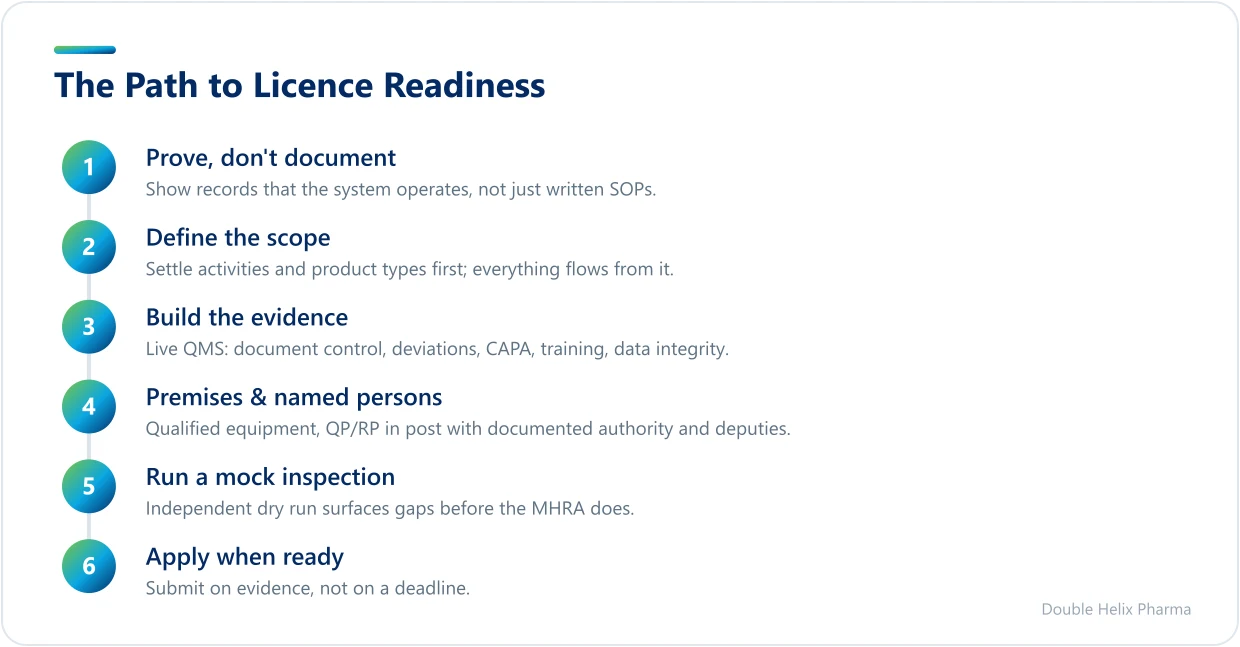
Licence readiness is not a document you produce; it is a state you reach and can prove. Settle your scope first, build a quality system that has already generated real records, qualify your premises and named persons, and stress-test the whole thing with an independent mock inspection before you submit. Apply when you are ready — not when you are merely in a hurry.
If you would like an experienced QP's view on whether your site is genuinely ready to apply, or support across the full readiness programme, explore our consultancy services or get in touch for a confidential, practical conversation.
Regulatory sources
This guidance reflects current UK and EU GMP/GDP requirements. Primary references:
- MHRA — UK Medicines & Healthcare products Regulatory Agency
- EudraLex Volume 4 — EU GMP Guidelines
- MHRA Inspectorate Blog
Always confirm against the latest published version of each source.
Frequently asked questions
How do I know if my site is ready to apply for an MIA or WDA?+
You are ready when every claim in your application is backed by objective evidence that the system is already operating, not merely written. In practice that means version-controlled SOPs with real usage records, a populated deviation and CAPA log, at least one completed self-inspection cycle, qualified premises and equipment, and named persons in post with documented authority and deputy cover. If you cannot produce a record for each procedure you have written, you are not yet ready.
What is the difference between a documented and a demonstrated quality system?+
A documented system exists on paper: procedures, a quality manual and templates that describe how work should be done. A demonstrated system has generated records that prove the work is actually being done that way, such as completed deviations, executed change controls and training evidence. MHRA inspectors assess the demonstrated system, so the records matter far more than the prose.
Should I run a mock inspection before applying for a licence?+
Yes. An independent mock inspection or gap assessment simulates the MHRA pre-licensing inspection and surfaces weaknesses your own team has grown blind to, testing both your documents and your people. Every gap you close beforehand is a finding the regulator will not raise, and remediating in calm conditions is far cheaper than doing so against an inspection clock. Applicants who invest in a realistic dry run typically reach licence grant faster and with fewer post-inspection actions.