Site Readiness (MIA/WDA) · 7 min read
MHRA Deficiency Classification: Critical, Major, Minor
How MHRA deficiencies are graded critical, major or minor, the patient-risk logic behind each grade, and how to respond to protect your MIA or WDA.
By Balasubramanian Ramaiah · 9 June 2026 · Updated 27 June 2026
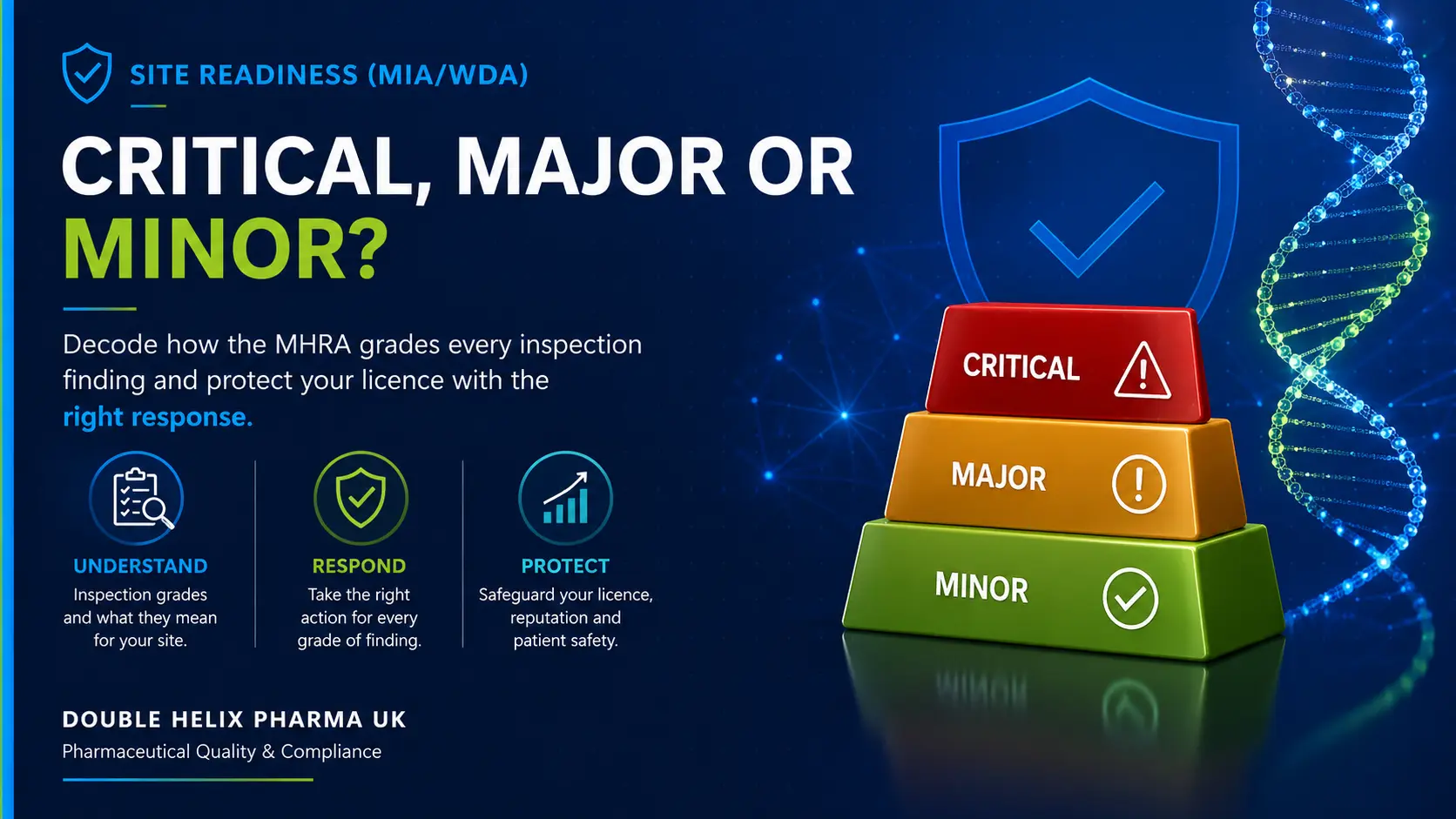
When the MHRA closes an inspection, the conversation that matters is rarely about the number of findings; it is about their classification. MHRA deficiencies are graded as critical, major or other (minor), and that single label determines whether you face a routine compliance letter, a Compliance Management process, or a referral that puts your licence and your supply at risk. Understanding how inspectors weigh a finding, and how to respond, is one of the most practical compliance skills a quality team can build.
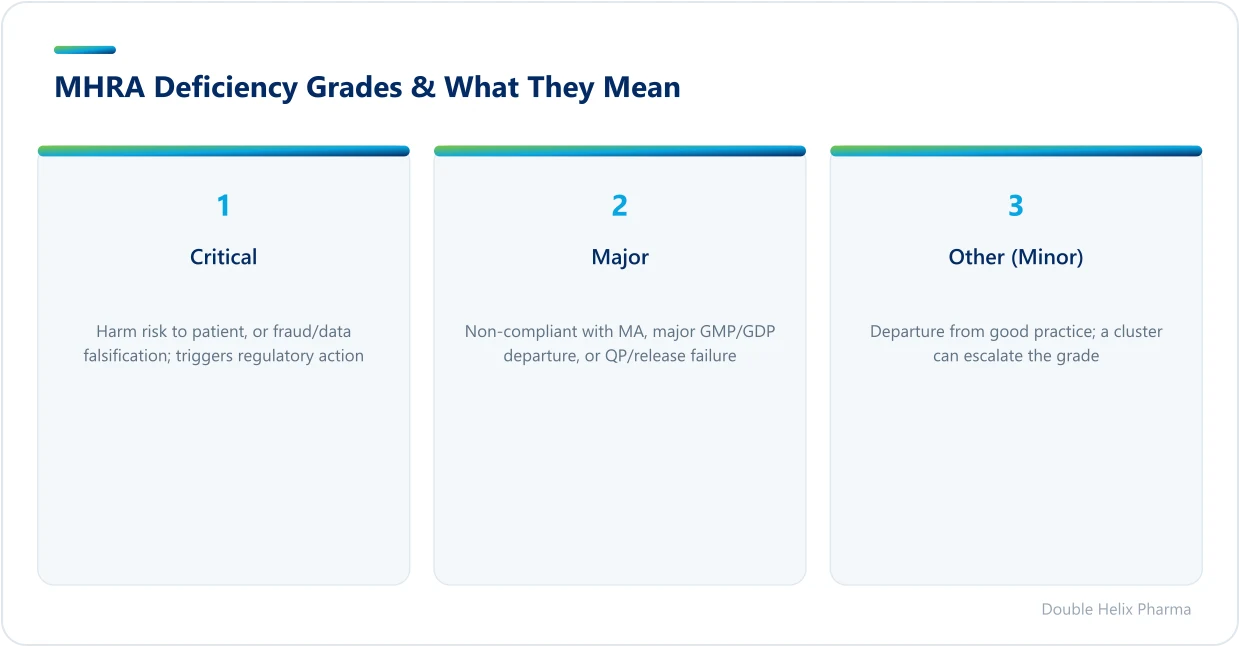
This article sets out how the three categories are defined, the logic behind the grading, and the response and escalation pathways that follow each. It draws on EU GMP, the PIC/S inspection model and ICH Q9 risk principles, which together underpin how the UK inspectorate reasons about patient risk.
How the MHRA classifies deficiencies
UK GMP and GDP inspections use a three-tier grading scheme, harmonised with the PIC/S approach and long-established across EU inspectorates. Each deficiency is assessed against a single overriding question: what is the potential impact on product quality and, ultimately, on the patient?
Critical deficiency
A critical deficiency is one that has produced, or may lead to, a significant risk of producing a product that is harmful to the patient. It also covers any observation involving fraud, data falsification or deliberate misrepresentation. A critical finding signals that a fundamental control has failed: sterility assurance compromised in an aseptic process, batch release without a valid certification basis under Annex 16, or audit trails disabled to conceal results. Critical deficiencies almost always trigger formal regulatory action and are frequently the cause of a referral to the Inspection Action Group.
Major deficiency
A major deficiency is non-critical but has produced, or may produce, a product not compliant with its marketing authorisation; or indicates a significant deviation from EU GMP or GDP; or indicates a failure to carry out satisfactory release procedures, or a failure of the Qualified Person to fulfil their duties. A combination of related "other" deficiencies, none individually major, can be aggregated and graded major where together they represent a systemic failure. In practice, major findings are the most common serious outcome and the most negotiable in terms of remediation timelines.
Other (minor) deficiency
An "other" deficiency, commonly called minor, cannot be classified as either critical or major but indicates a departure from good manufacturing or distribution practice. These findings still require correction; treating them as cosmetic is a mistake, because a cluster of minor findings in the same area is precisely how inspectors evidence a weak underlying system and escalate the overall grade.
The risk logic behind the grade
Classification is not a tariff applied mechanically to a list of breaches. Inspectors reason in the language of ICH Q9: severity of potential harm, probability of occurrence and detectability. The same nonconformance can be graded differently depending on context. A single uncontrolled spreadsheet used for an informal calculation is unlikely to be critical; the same spreadsheet used to release sterile product without a validated check may well be.
The grade follows the patient, not the paperwork. Ask of every finding: if this control failed on a real batch, who could be harmed and how likely is it that we would catch it first?
Three factors consistently push a finding up the scale: evidence of patient exposure, any hint of data integrity failure, and signs that the issue is systemic rather than isolated. A well-investigated one-off deviation with effective CAPA is viewed very differently from the same deviation recurring across three product quality reviews. This is why mature trending and an honest quality management system are among the strongest mitigations against severe classification.
Why classification matters: the consequences of MHRA deficiencies
The category assigned drives everything that happens next. The immediate output is a post-inspection letter listing the MHRA deficiencies and the deadline for your written response, but the regulatory weight differs sharply by grade.
- Critical: typically results in a non-compliance outcome, possible referral to the Inspection Action Group, and in serious cases suspension or revocation of the MIA or WDA, product recall, or a statement of non-compliance that propagates through the EU/EEA via EudraGMDP.
- Major: usually a compliance escalation requiring a robust CAPA plan and, often, a follow-up or re-inspection to verify remediation before the site is considered compliant.
- Other (minor): generally addressed through your normal CAPA process and confirmed at the next routine inspection, provided the response is credible and timely.
A pattern of unresolved or repeat findings across cycles is itself an escalation trigger, regardless of the individual grades. Inspectors read your history; a major finding that reappears having been declared closed is far more damaging than the original observation.
Responding to MHRA deficiencies effectively
The quality of your response often influences the outcome as much as the findings themselves. A defensive or superficial reply can convert a manageable position into an escalated one.
Get the root cause right
Each deficiency demands a documented root-cause analysis, not a restatement of the symptom. Use a structured method, distinguish correction from corrective action, and resist the temptation to attribute systemic problems to "human error". Where findings are related, address the common cause once rather than patching each instance.
Make CAPA commitments realistic and evidenced
Commit only to dates you will meet, and show interim risk control where full remediation takes time. Inspectors respond well to a credible plan with owners, milestones and effectiveness checks; they respond badly to optimistic deadlines that later slip. Verifying effectiveness, rather than assuming it, is a recurring theme in our wider guidance on remediation and inspection outcomes.
Challenge classification only with evidence
You may make a factual representation if you believe a deficiency has been mis-graded, but do so with data, not indignation. A measured, evidence-based case for downgrading a finding can succeed; an emotional rebuttal rarely does and can erode inspector confidence in your judgement.
Building a site that grades well
The most reliable way to avoid critical and major findings is to engineer your quality system so that the controls protecting the patient cannot quietly fail. That means live data governance under ALCOA+, deviation and CAPA systems that actually close the loop, and a Qualified Person with genuine authority and unfettered access to release data. Proactive gap assessment and mock inspection, conducted with an inspector's mindset, surface the very issues that would otherwise be classified against you. Our site readiness service for MIA and WDA holders is built around exactly this preventative approach.
Key takeaways
- MHRA deficiencies are graded critical, major or other (minor), and the grade follows potential patient risk, not the volume of paperwork.
- Data integrity failures, evidence of patient exposure and systemic patterns are the factors most likely to escalate a finding.
- Critical findings can lead to referral, suspension or recall; major findings require robust CAPA and often re-inspection; minor findings must still be corrected and trended.
- A clear, root-cause-led response with realistic, evidenced CAPA frequently shapes the outcome as much as the original observation.
If you want an independent, inspector's-eye assessment of where your site sits before the MHRA forms its own view, or support in drafting a response to recent findings, contact our team to arrange a confidential gap assessment or mock inspection.
Regulatory sources
This guidance reflects current UK and EU GMP/GDP requirements. Primary references:
- MHRA — UK Medicines & Healthcare products Regulatory Agency
- EudraLex Volume 4 — EU GMP Guidelines
- MHRA Inspectorate Blog
Always confirm against the latest published version of each source.
Frequently asked questions
What is the difference between a critical, major and minor MHRA deficiency?+
A critical deficiency has produced, or risks producing, a product harmful to the patient, or involves fraud or data falsification. A major deficiency is non-critical but indicates non-compliance with the marketing authorisation, a significant GMP/GDP departure, or a failure of release procedures or QP duties. An 'other' or minor deficiency is a departure from good practice that is neither critical nor major, though a cluster of minor findings can be aggregated and escalated.
What happens if you receive a critical deficiency from the MHRA?+
A critical finding usually results in a non-compliant inspection outcome and may be referred to the Inspection Action Group. Depending on severity, consequences can include suspension or revocation of your MIA or WDA, product recall, and a statement of non-compliance published via EudraGMDP. You must submit a robust root-cause analysis and CAPA plan promptly, and a follow-up inspection is typically required before compliance is restored.
Can you challenge how the MHRA has classified a deficiency?+
Yes, you can make a factual representation if you believe a finding has been mis-graded, but it must be evidence-based rather than emotional. Present objective data showing why the patient-risk profile does not support the assigned grade. A measured, well-documented case can occasionally lead to a downgrade, whereas an unsupported rebuttal tends to undermine inspector confidence in your quality judgement.