Site Readiness (MIA/WDA) · 7 min read
Named Persons on a Licence: QP, RP and Production
Named persons licence guide: how the QP, RP, RPi and production roles work on a UK MIA or WDA, their eligibility, scope, authority and inspection readiness.
By Balasubramanian Ramaiah · 9 June 2026 · Updated 13 July 2026
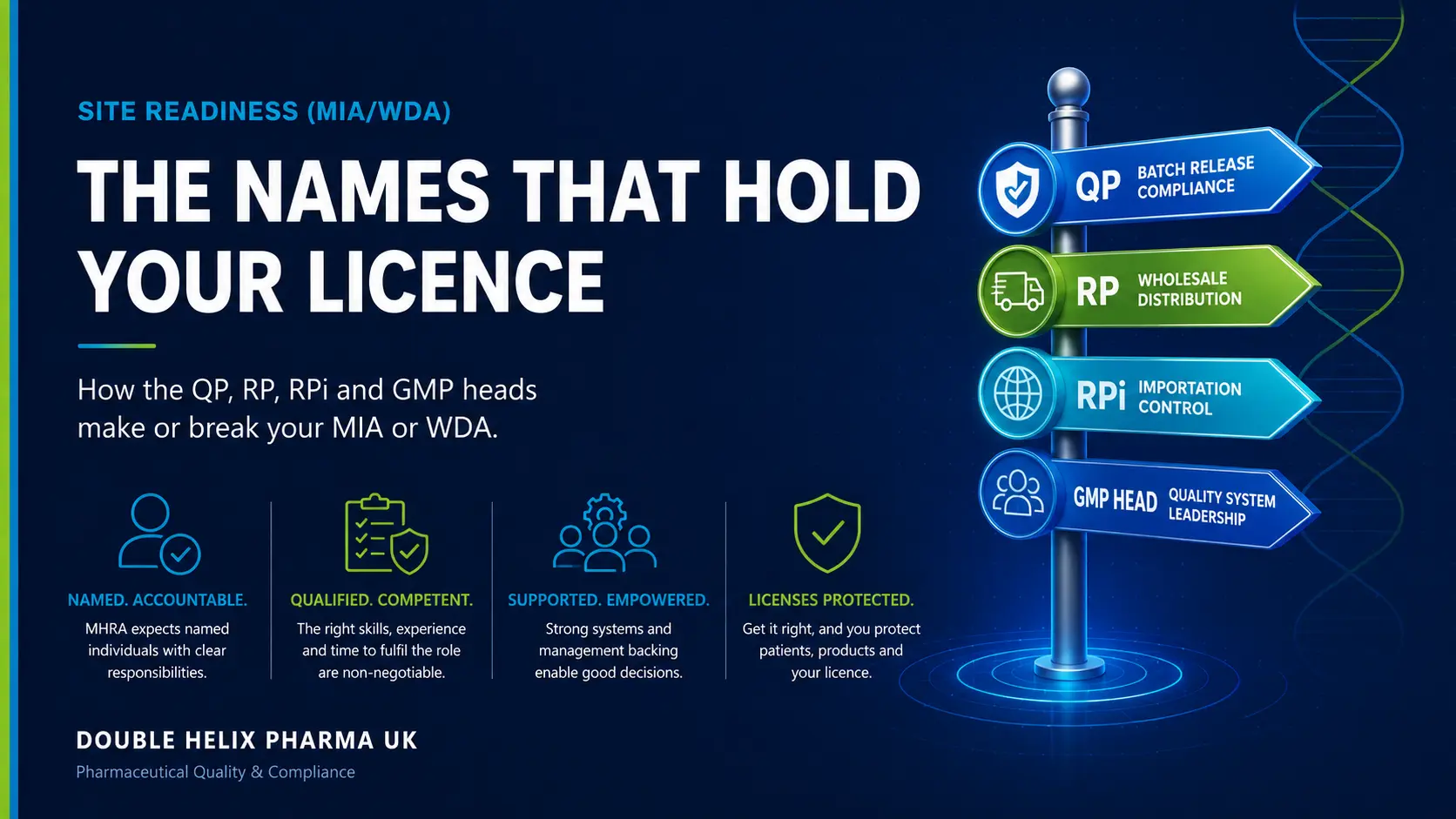
Every Manufacturer's or Importer's Authorisation (MIA) and Wholesale Dealer's Authorisation (WDA) rests on people, not just systems, and the question of named persons licence arrangements is where many site-readiness projects either hold together or fall apart. Regulators do not licence a building; they licence a set of activities discharged by named, accountable individuals. Get those names, their scope and their availability right and your authorisation has a defensible spine. Get them wrong and you risk a stalled application, a critical inspection finding, or a site that cannot lawfully release or distribute product.
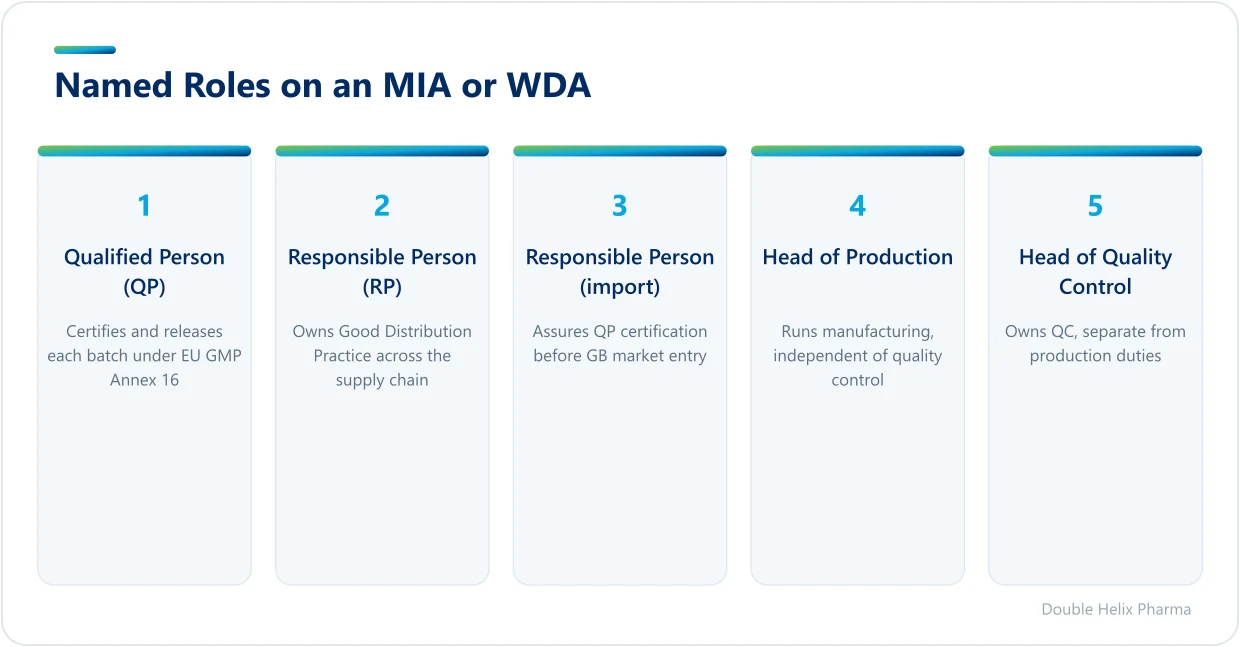
Why the people on a licence matter as much as the site
It is easy to focus a readiness programme on premises, equipment and procedures and treat personnel as an annex. In practice the MHRA assesses whether the legally required roles are filled by eligible, available people with genuine authority. The pharmaceutical quality system described in ICH Q10 only works when accountable individuals sit behind it, and the quality risk management principles of ICH Q9 assume someone with standing makes the call when evidence is marginal.
A licence therefore names specific functions. On an MIA you will see one or more Qualified Persons (QPs) and, in EU GMP terms, a defined role for production and for quality control. On a WDA you will see a Responsible Person (RP), and where importation into Great Britain is in scope, a Responsible Person (import), or RPi. These are not interchangeable titles; each carries distinct legal duties, and an inspector will expect the named individual to own and defend them.
The Qualified Person (QP): certification and release
The QP is the individual legally responsible, under EU GMP Annex 16, for certifying that each batch of a medicinal product has been manufactured and checked in accordance with its marketing authorisation and the principles of Good Manufacturing Practice. You cannot hold a valid MIA without at least one named QP, and the certification decision is personal and, for that final act, non-delegable.
The QP may, and must, rely on a robust quality system and on the work of others, but the signature is theirs alone. That is why a QP named on a named persons licence must have qualifications and experience genuinely matched to the products in scope. A QP fluent in solid oral dose is not automatically suitable for sterile manufacture under the revised Annex 1 contamination control expectations, nor for biologicals or for the importation and certification of finished product from a third country.
Eligibility in brief
- Qualifications: an eligible degree-level scientific background meeting the criteria set out in medicines legislation.
- Experience: documented practical experience, including qualitative and quantitative analysis and the activities relevant to the certification undertaken.
- Recognition: assessment through the route operated by the relevant professional bodies, so the individual can be named with confidence.
- Relevant scope: experience that maps to your dosage forms and processes, not merely a generic QP profile.
The Responsible Person (RP) and RPi: oversight of distribution and import
Where your authorisation covers wholesale distribution, the Responsible Person named on the WDA is accountable for the quality system that keeps Good Distribution Practice (GDP) intact, from procurement through storage to onward supply. The RP ensures medicines are sourced from and supplied to authorised parties, that storage and transport conditions are controlled, and that falsified-medicine safeguards and recall arrangements actually function.
The Responsible Person (import), or RPi, is a distinct named role created for the importation of certain medicines into Great Britain from listed countries. The RPi provides assurance that imported products have been certified by a QP under an appropriate quality system before they are placed on the GB market. Confusing the RP, RPi and QP roles, or assuming one person can casually cover all three without the right eligibility and scope, is a common and avoidable readiness error.
A name on the licence is only as strong as the authority, time and access behind it. Inspectors look past the title to the substance of the role.
Production and quality control: the GMP management roles
EU GMP Chapter 2 sets the expectation that the head of production and the head of quality control are clearly identified, suitably qualified and independent of one another, with defined and non-overlapping responsibilities. While the QP is the role most visible on the face of an MIA, these production and quality management positions form the operational backbone the QP relies on.
For a site-readiness assessment this means more than naming individuals on an organisation chart. You need documented job descriptions, a clear separation of duties between production and quality control, deputising arrangements, and evidence that each person has the authority and resources to act. Where roles are shared across a small organisation, the rationale and the safeguards against conflicts of interest must be explicit and defensible.
Keeping named persons valid through change
Naming the right people is not a one-off event at licensing; it is a state you must maintain. The authorisation has to reflect reality at all times, which means updating it promptly when a named person joins, leaves or changes scope, and ensuring continuity of cover for leave, illness and resignation.
- Confirm eligibility and scope first. Verify that each proposed QP, RP or RPi has qualifications and experience matched to the activities and products on the authorisation.
- Document authority and access. Set out reporting lines, decision rights and unfettered access to batch records, deviations, CAPA, complaints and quality data.
- Submit the variation properly. Add or change a named person through the appropriate MHRA licence variation, with supporting evidence of suitability.
- Plan deputy cover. A single named person with no deputy is a single point of failure that can halt release or distribution.
- Embed before go-live. Ensure each named person is genuinely inducted into your site, systems and product knowledge before they certify, release or sign anything.
The figurehead problem
The most damaging pattern is the name on paper who is absent in practice, lacking access, time or independence. Inspectors test this quickly by asking a QP to walk through recent certifications, or an RP to evidence supplier qualification and temperature excursion handling. Thin answers write the finding for you. Build the status of every named person into your change-control and quality-management routines so the register and the reality never drift apart.
Key takeaways
Sound named persons licence arrangements are a substantive control, not a clerical formality. Map each role, the QP for certification and release, the RP for GDP distribution, the RPi for GB importation, and the heads of production and quality control, to an eligible individual whose experience genuinely fits your products. Give them documented authority, unfettered access to the data behind their decisions, and dependable deputy cover; submit variations correctly; and keep the licence current as people and processes change. Whether a role is held by an employee or engaged on contract, the personal accountability is identical, and so is the regulator's expectation that it is genuinely exercised.
If you are standing up a new MIA or WDA, preparing for inspection, or filling a vacancy in a critical role, our independent QPs, RPs and RPi can help you get the people side of your authorisation right. Explore our site readiness (MIA/WDA) service, see how we have supported manufacturers, importers and distributors in our case studies, or review our full range of quality and compliance services. When you are ready to discuss the named persons on your licence, get in touch with our team for a confidential, practical conversation.
Regulatory sources
This guidance reflects current UK and EU GMP/GDP requirements. Primary references:
- MHRA — UK Medicines & Healthcare products Regulatory Agency
- EudraLex Volume 4 — EU GMP Guidelines
- MHRA Inspectorate Blog
Always confirm against the latest published version of each source.
Frequently asked questions
What is the difference between a QP, an RP and an RPi on a licence?+
A Qualified Person (QP) is named on a Manufacturer's or Importer's Authorisation and is legally responsible under EU GMP Annex 16 for certifying and releasing each batch of a medicinal product. A Responsible Person (RP) is named on a Wholesale Dealer's Authorisation and is accountable for maintaining Good Distribution Practice across the supply chain. The Responsible Person (import), or RPi, is a separate role for importing certain medicines into Great Britain from listed countries, providing assurance that products have been QP-certified before reaching the GB market.
Can one person hold more than one named role on a licence?+
It is possible for a suitably qualified individual to hold more than one named role, but it is never automatic. Each role carries distinct eligibility criteria and duties, so the person must genuinely satisfy the requirements for every position and have the time, authority and independence to discharge each one. EU GMP Chapter 2 also expects production and quality control responsibilities to remain independent, so any overlap must be justified, documented and free of conflicts of interest.
How do we add or change a named person on an existing MIA or WDA?+
You add or change a named person through a licence variation submitted to the MHRA, supported by evidence that the individual is eligible and suitable for the activities on the authorisation. Confirm their qualifications and experience match your products and processes before submitting, and ensure they are properly inducted into your site and systems before they certify, release or sign anything. Keep the licence current by updating it promptly whenever a named person joins, leaves or changes scope, and maintain dependable deputy cover.