Site Readiness (MIA/WDA) · 7 min read
Broker Registration for Medicines
A practical UK guide to medicines broker registration: who must register with the MHRA, GDP brokering obligations, quality systems and inspection readiness.
By Balasubramanian Ramaiah · 9 June 2026 · Updated 13 July 2026
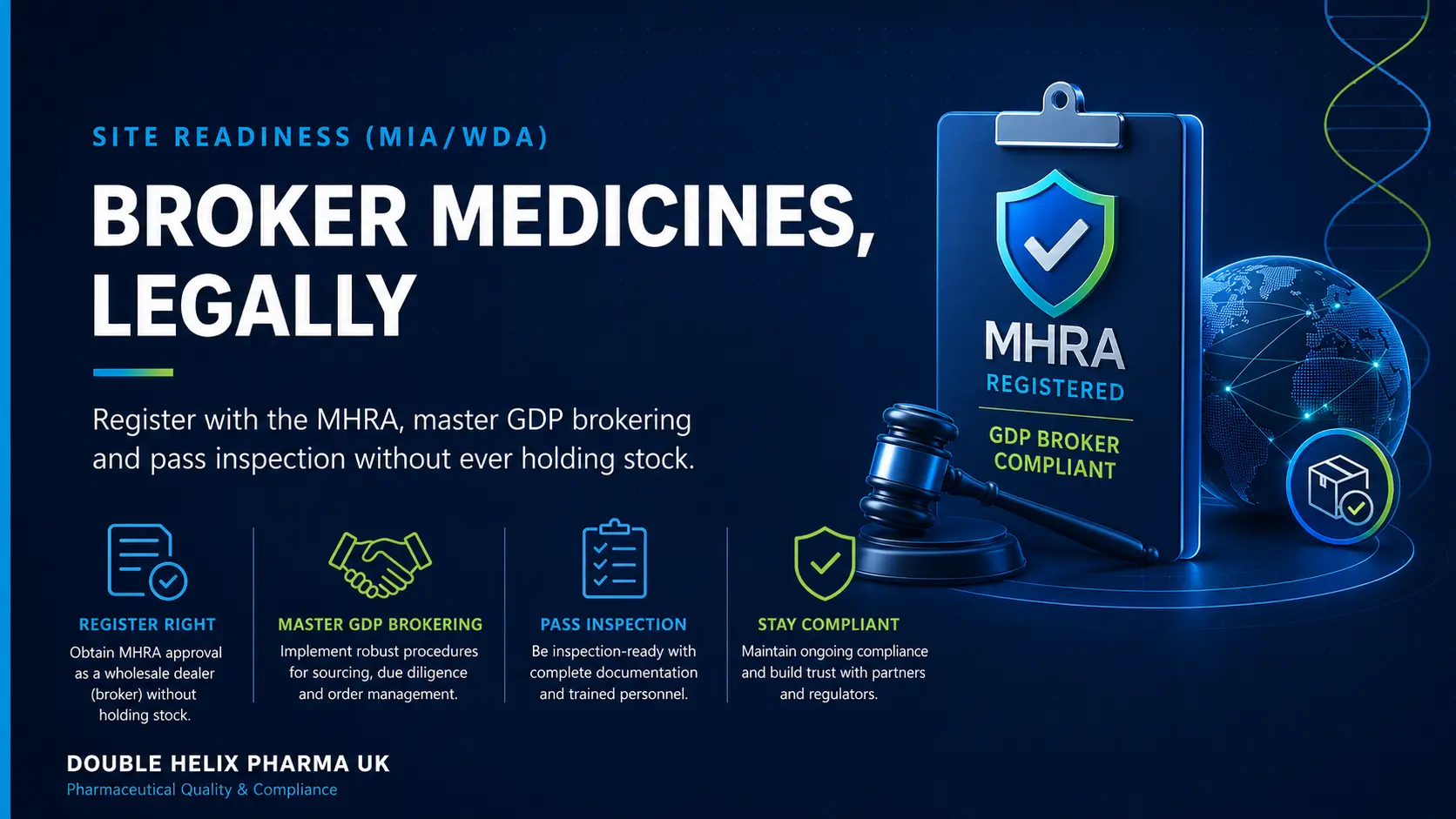
For companies that buy and sell medicines without ever physically handling, storing or supplying them, medicines broker registration is a legal prerequisite under the Human Medicines Regulations 2012, not an optional formality. If your business arranges transactions in licensed medicinal products for the UK market, the MHRA expects you to be entered on the brokers register before you trade. This article explains who needs to register, what good practice looks like, and how to get site-ready for inspection.
What broking actually means and why medicines broker registration applies
Brokering is defined narrowly. A broker negotiates the buying and selling of medicinal products on behalf of others, but never takes ownership of the goods, never physically possesses them, and never controls their storage or transport. The moment you hold, store or supply stock, you have crossed into wholesale distribution and need a Wholesale Dealer's Authorisation (WDA(H)) instead.
Because brokers deal only in products authorised in the UK or EU, the activity sits inside the medicines supply chain even though no warehouse is involved. That is precisely why the regulator treats it seriously: a broker can introduce falsified or unfit product into legitimate trade through poor counterparty checks alone. Registration brings these intermediaries into the same oversight framework as licensed wholesalers.
Broker, wholesaler or importer?
Drawing the line correctly is the single most common pitfall. If you procure from a supplier and arrange onward sale while title and physical custody pass directly between two third parties, you are broking. If you ever invoice as the owner of the stock, or direct where it is held, you require a WDA(H). Getting this wrong invalidates your registration and exposes every transaction you have arranged.
The legal framework and Good Distribution Practice
Brokers operate under the EU Guidelines on Good Distribution Practice of medicinal products for human use (2013/C 343/01), which dedicate a specific chapter to brokering. The MHRA enforces these expectations in Great Britain through the Human Medicines Regulations 2012. Although a broker holds no stock, the GDP principles of quality risk management still apply, and the regulator expects the discipline of a properly governed quality system behind every deal.
The core obligations are proportionate but firm:
- Brokers must only source from authorised wholesale dealers or manufacturers and only supply to persons who are themselves authorised to receive medicines.
- A quality system must be in place, documented and maintained, even without physical operations.
- Emergency procedures, including participation in recalls and handling of falsified medicines alerts, must be defined and tested.
- Records of every transaction must be retained and be readily retrievable for inspection.
A broker never touches the product, but is fully accountable for the integrity of the transactions they arrange. Documentation is the only evidence the regulator can inspect.
Building a compliant broker quality system
Without a building to walk through, an inspector judges a broker almost entirely on procedures and records. Your quality system is therefore the substance of the registration, not a supporting file. It should reflect the principles of ICH Q9 (quality risk management) and ICH Q10 (pharmaceutical quality system), scaled sensibly to a transaction-only operation.
Counterparty qualification
The heart of broking compliance is knowing exactly who you are dealing with on both sides. Before any deal, verify that the supplier holds a valid manufacturing or wholesale authorisation and that the recipient is entitled to receive the product. Authorisation status should be confirmed against the relevant regulator's register and re-checked periodically. This due diligence sits naturally alongside formal supplier and customer qualification controls and should be evidenced with dated records.
Documentation and data integrity
Every transaction record must capture the product, quantity, batch where available, supplier, recipient and dates. Apply ALCOA+ principles so that records are attributable, legible, contemporaneous, original and accurate, and remain complete, consistent, enduring and available. Strong data integrity is what turns a thin paper trail into defensible evidence during an inspection.
Falsified medicines and recall readiness
Brokers must be able to act fast when something goes wrong. You need a written procedure to identify and quarantine suspect or falsified product, to notify the MHRA, and to communicate up and down the chain you have arranged. Recall procedures must name a responsible person and define escalation, so that a single phone call can trigger a coordinated response.
Preparing for MHRA assessment and inspection
Registration is submitted through the MHRA Process Licensing Portal and reviewed against the GDP brokering requirements. The application asks you to declare the categories of products you broker, the address from which you operate, and the name of the person responsible for the quality system. Although brokers are not legally required to name a Responsible Person in the way a WDA(H) holder must, in practice the regulator looks for clear, competent accountability for compliance.
To be genuinely ready, assemble the following before you apply:
- A documented quality system with current, version-controlled procedures.
- Evidence of counterparty qualification and an approved supplier and customer list.
- A transaction record template that captures all required fields.
- Defined recall, complaint and falsified-medicines procedures with named accountabilities.
- Training records demonstrating that staff understand GDP brokering obligations.
Many organisations underestimate how much scrutiny a "paper-only" activity attracts. A focused gap analysis ahead of submission almost always pays for itself; you can see how this works in practice across our site readiness case studies. The goal is simple: no surprises when the inspector calls.
Common pitfalls that delay registration
In our experience the same issues recur, and each one is avoidable:
- Activity misclassification — describing wholesale or importation as broking, or vice versa, which leads to the wrong authorisation entirely.
- Thin quality systems — copied templates that do not reflect how the business actually transacts.
- Weak counterparty evidence — verbal assurances rather than dated checks against authorisation registers.
- No tested emergency procedures — recall and falsified-medicines processes that exist on paper but have never been rehearsed.
- Unclear accountability — no single, competent person owning GDP compliance.
Addressing these early shortens the assessment timeline and reduces the risk of conditions being placed on your registration.
Key takeaways
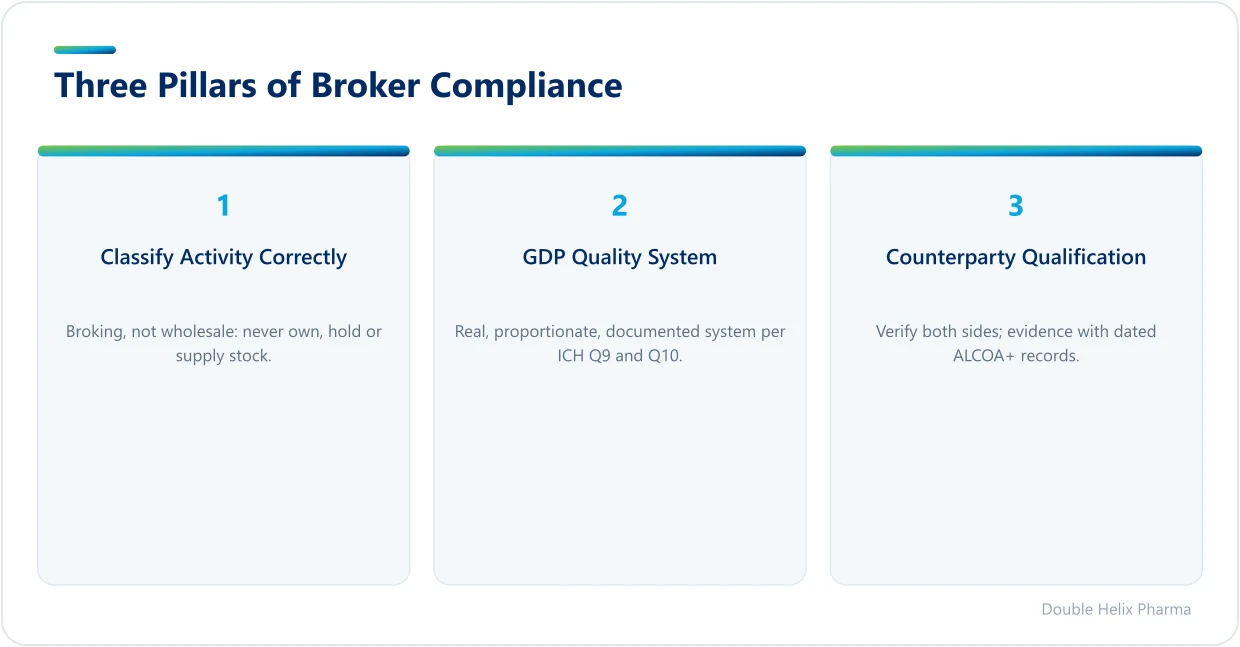
Medicines broker registration is mandatory for any UK business that negotiates the buying and selling of authorised medicines without owning or handling them. Compliance rests on three pillars: correctly classifying your activity, operating a real and proportionate GDP quality system, and proving rigorous counterparty qualification through ALCOA+ records. Because there is no warehouse to inspect, your documentation is the registration.
If you are establishing a broking operation, transitioning from wholesale, or strengthening an existing registration ahead of inspection, our team can help you build the quality system, run a pre-submission gap analysis and prepare your evidence pack. Explore our site readiness (MIA/WDA) service or contact our QP and RP team for a confidential discussion about your medicines broker registration.
Regulatory sources
This guidance reflects current UK and EU GMP/GDP requirements. Primary references:
- MHRA — UK Medicines & Healthcare products Regulatory Agency
- EudraLex Volume 4 — EU GMP Guidelines
- MHRA Inspectorate Blog
Always confirm against the latest published version of each source.
Frequently asked questions
Do I need a WDA(H) or a broker registration?+
It depends entirely on whether you take ownership or possession of the medicines. If you only negotiate buying and selling between authorised parties and never hold, store or supply stock yourself, you need a broker registration. The moment you own the goods or control their storage or transport, you require a Wholesale Dealer's Authorisation, WDA(H), instead.
Does a medicines broker need a Responsible Person?+
A broker is not legally required to name a Responsible Person in the same way a WDA(H) holder must, because no physical operations take place. However, the GDP brokering chapter still requires a documented quality system with clear, competent accountability for compliance. In practice the MHRA expects to see a named, suitably experienced individual owning that responsibility.
What records must a medicines broker keep?+
Brokers must retain a record of every transaction they arrange, capturing the product, quantity, batch where available, the supplier, the recipient and the relevant dates. These records must follow ALCOA+ data integrity principles and be readily retrievable for MHRA inspection. Evidence of counterparty qualification, such as dated checks of supplier and customer authorisation status, should be kept alongside them.