QMS & PQS Implementation · 7 min read
Building a Strong Pharmaceutical Quality Culture
A practical guide to building a strong quality culture pharma teams can defend at inspection, with behavioural markers, leadership signals and metrics under EU GMP.
By Balasubramanian Ramaiah · 9 June 2026 · Updated 23 September 2026
A strong quality culture pharma organisations rely on is not a poster in the corridor or a line in the quality manual; it is the sum of the decisions people make when no one is auditing them. For UK and EU manufacturers, importers and CMOs operating under EU GMP and MHRA expectations, culture is now treated as a measurable, inspectable attribute of the pharmaceutical quality system. This article sets out what a mature quality culture looks like in practice and how to build one that survives inspection, leadership change and commercial pressure.
Why quality culture pharma leaders can no longer treat as soft
Regulators have moved decisively from documents to behaviours. ICH Q10 frames the pharmaceutical quality system as a management responsibility, with senior leaders explicitly accountable for fostering an environment in which quality is the shared goal. ICH Q9 (R1) reinforces this by recognising that subjectivity and culture directly influence the quality of risk-based decisions. When the MHRA assesses a site, deficiencies around data integrity, repeated deviations and weak CAPA effectiveness are increasingly read as cultural symptoms, not isolated technical failures.
The practical consequence is that an inspector who sees backdated records, untrended out-of-specification results or a quality unit that is routinely overruled will conclude that the culture is permissive, regardless of how polished the SOPs appear. Culture is the lens through which every other observation is interpreted.
The behavioural markers of a mature quality system
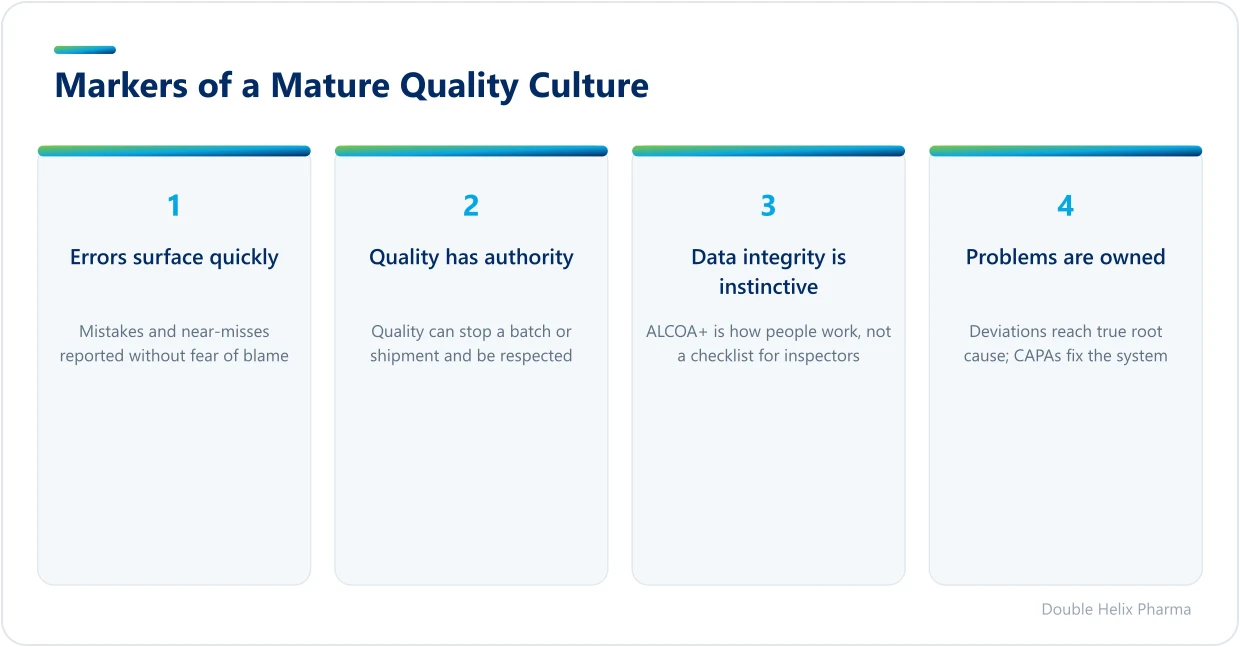
A healthy culture is recognisable from a handful of consistent behaviours rather than from any single metric. In our audit work the strongest sites share the following traits.
- Errors surface quickly. Operators report mistakes and near-misses without fear, because the organisation treats honest disclosure as more valuable than a clean-looking record.
- The quality unit has real authority. Quality can stop a batch, reject a supplier or halt a shipment, and that decision is respected by operations and commercial functions.
- Data integrity is instinctive. ALCOA+ principles — attributable, legible, contemporaneous, original and accurate, plus complete, consistent, enduring and available — are how people work, not a checklist they recite for inspectors.
- Problems are owned, not deflected. Deviations are investigated to genuine root cause, and CAPAs change the system rather than blaming an individual.
Where any of these is absent, the gap is rarely solved by more training. It is solved by changing what leadership rewards, tolerates and measures.
Leadership, the quality unit and the tone from the top
Culture is set far less by what executives say than by what they fund, escalate and protect. ICH Q10 and EU GMP Chapter 1 place unambiguous responsibility on senior management for resourcing the quality system and for management review that actually drives action. Three behaviours separate genuine commitment from window dressing:
Visible decisions under pressure
When a release deadline collides with an open investigation, the decision the site leadership takes — and how visibly the quality unit's judgement is upheld — teaches the workforce more than any value statement. A single overruled QP decision can undo years of cultural investment.
Resourcing quality as a system
Chronic understaffing of QA, a perpetual deviation backlog or QPs and Responsible Persons stretched across too many sites are structural signals that quality is subordinate to throughput. Treating these as cultural risks, not just operational ones, is the mark of mature governance.
Management review that bites
Effective management review interrogates quality metrics, complaint trends and audit outcomes, then assigns owners and deadlines. Where review is a slide deck no one revisits, the culture learns that quality data is decorative.
Building culture into the quality system, not bolting it on
Culture cannot be mandated, but it can be engineered through the design of the quality system itself. The aim is to make the right behaviour the easy behaviour. Practical levers include:
- Design out the temptation to falsify. Review data-integrity controls, audit trails and access rights so that shortcuts are technically difficult and obvious when attempted. This is increasingly relevant under modern expectations such as Annex 1's emphasis on contamination control strategy, where behaviour and system design are inseparable.
- Make reporting frictionless. Simplify deviation and near-miss reporting so the cost of speaking up is low. A backlog of trivial, easy-to-raise reports is healthier than silence.
- Trend the human signals. Monitor repeat deviations, overdue CAPAs, training compliance and recurring audit themes as leading indicators of cultural drift.
- Extend culture across the supply chain. Under GDP and EU GMP, your suppliers and contract acceptors are part of your system. Supplier audits and quality agreements should probe behaviours and data integrity, not just paperwork.
A well-structured QMS implementation is the most reliable vehicle for embedding these levers, because it ties expected behaviours to procedures, metrics and management accountability. Our case studies show how sites have used QMS redesign to turn a permissive culture into a measurable, defensible one, and the wider range of services we offer is built around sustaining that change.
Measuring and sustaining quality culture pharma teams can defend at inspection
Because culture is now inspectable, it must be measurable. No single number captures it, so triangulate using a balanced set of indicators rather than chasing a vanity metric.
- Lagging indicators: recurring deviations, CAPA effectiveness and recurrence rates, complaint trends, and critical or major findings from internal and regulatory audits.
- Leading indicators: near-miss and error-reporting rates, speak-up survey results, time-to-escalation, and the proportion of CAPAs that change the system rather than retrain a person.
- Behavioural evidence: documented examples of quality decisions upheld under commercial pressure, and management-review actions closed on time.
A culture that cannot be evidenced is, to an inspector, a culture that does not exist. The organisations that fare best are those that can show the trend, the decision and the consequence.
Sustaining the gain is the hardest part. Culture decays under reorganisation, acquisition and senior turnover, so it needs periodic, honest reassessment — ideally through independent eyes that are not invested in the existing narrative.
Key takeaways
For any quality culture pharma programme to hold up under MHRA and EU GMP scrutiny, it must be led visibly from the top, engineered into the quality system, and measured with both leading and lagging indicators. Treat culture as inspectable evidence, not sentiment: make honesty cheaper than concealment, give the quality unit real authority, and trend the human signals before they become deficiencies.
If you would like an independent, practitioner-led view of where your culture genuinely sits — and a roadmap to strengthen it ahead of inspection — get in touch with our QP and compliance team to arrange a confidential discussion.
Regulatory sources
This guidance reflects current UK and EU GMP/GDP requirements. Primary references:
- EU GMP Chapter 1 — Pharmaceutical Quality System
- EudraLex Volume 4 — EU GMP Guidelines
- EMA — GMP/GDP Questions & Answers
Always confirm against the latest published version of each source.
Frequently asked questions
What is quality culture in a pharmaceutical context?+
Quality culture is the set of shared values and everyday behaviours that determine how people act on quality when no one is watching. Under ICH Q10 it is a management responsibility, and the MHRA increasingly reads recurring deviations, data-integrity issues and weak CAPAs as cultural symptoms. In practice it shows up as how quickly errors are reported and whether the quality unit's decisions are respected under pressure.
How do regulators such as the MHRA assess quality culture during an inspection?+
Inspectors rarely score culture directly, but they infer it from evidence: data-integrity findings, deviation and CAPA trends, the authority of the quality unit, and how release decisions are taken under commercial pressure. ICH Q9 (R1) explicitly recognises that culture and subjectivity affect risk-based decisions. A site that can demonstrate upheld quality decisions and honest reporting will be viewed far more favourably than one with polished SOPs but permissive behaviour.
How can a company measure its quality culture?+
Use a balanced set of indicators rather than a single metric. Lagging indicators include recurring deviations, CAPA effectiveness, complaint trends and audit findings; leading indicators include near-miss reporting rates, time-to-escalation and speak-up survey results. Combining these with documented examples of quality decisions upheld under pressure gives an inspectable, defensible picture of culture over time.