Site Readiness (MIA/WDA) · 7 min read
Setting Up a New Pharma Site: A Readiness Roadmap
A senior QP's phased roadmap for new pharma site setup: scope, MIA/WDA licensing, building an operating quality system, qualification and MHRA readiness.
By Balasubramanian Ramaiah · 9 June 2026 · Updated 21 August 2026
A new pharma site setup is one of the most demanding programmes a quality team can run: you are building facilities, systems and people in parallel, against a fixed inspection date you cannot see in advance. Whether you are standing up an MIA-licensed manufacturing site, a WDA(H) distribution operation or an importer hub, the licence is earned by the maturity of what you build long before the MHRA arrives. This roadmap sets out the sequence that keeps a greenfield site on track and inspection-ready.
Start with scope, not square footage
The single most consequential decision is also the earliest: exactly what will this site be authorised to do? Scope drives everything downstream — the licence type, the facility design, the validation burden, the named roles and the depth of your quality system. Fix it before you pour concrete.
Decide whether you need a Manufacturer's/Importer's Authorisation (MIA), a Wholesale Dealer's Authorisation (WDA(H)) under GDP, or both, and which activities sit on each. An MIA covering manufacture, assembly, batch certification or importation requires a named Qualified Person; a WDA(H) requires a named Responsible Person. The activities, dosage forms and product categories you claim must mirror your real, validated capability — over-claiming scope is one of the fastest routes to findings at inspection.
Map the regulatory framework early
Anchor the programme in the right standards from day one rather than retrofitting them. For manufacture, that means EU GMP Part I, with ICH Q10 shaping the pharmaceutical quality system and ICH Q9 governing quality risk management. Sterile operations must be designed to Annex 1 and its contamination control strategy from the first floor plan, not bolted on later. Distribution activities follow the GDP guidelines, and any data-generating system must satisfy ALCOA+ principles. If you intend to supply markets that expect alignment with 21 CFR 210/211, build to that bar from the outset.
A phased roadmap for new pharma site setup
Treating the build as a single push invites chaos. Sequence it into phases with clear gates, so that each stage is genuinely complete before the next begins:
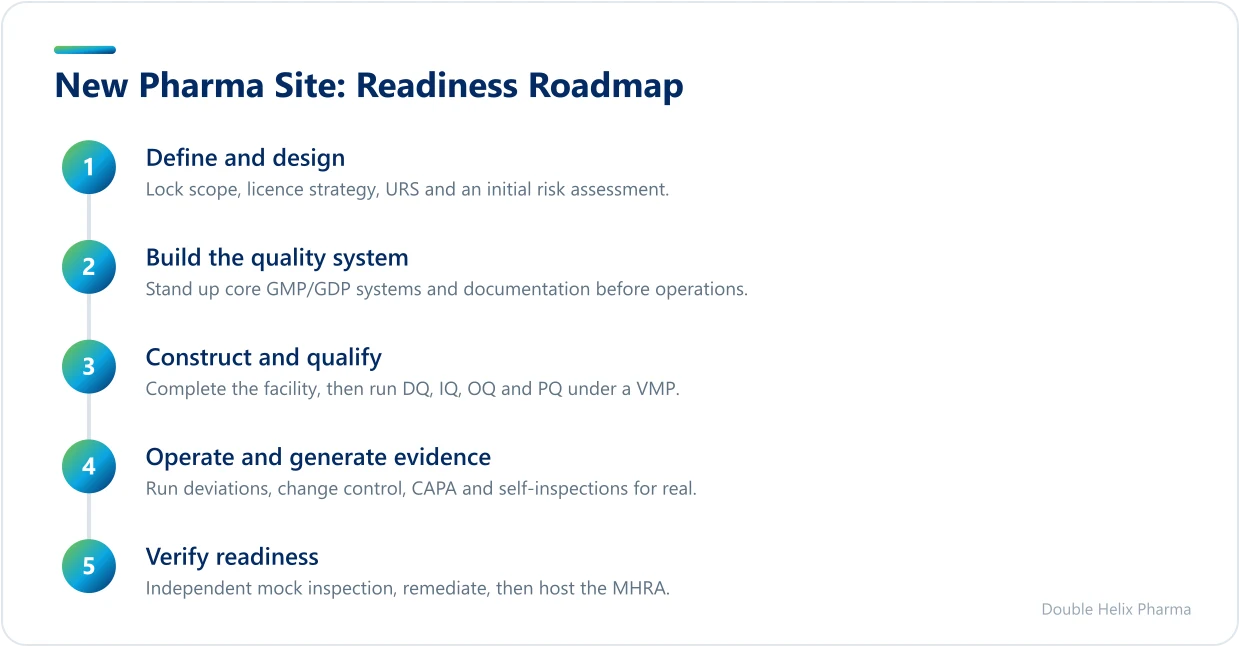
- Define and design. Lock scope, licence strategy and the high-level quality plan. Produce a User Requirements Specification for facilities, utilities and equipment, and an initial risk assessment of the whole operation.
- Build the quality system. Stand up the core GMP/GDP systems and the documentation hierarchy before operations begin, so the site has a framework to operate within from its first activity.
- Construct and qualify. Complete the facility, then run commissioning and qualification (URS through to DQ, IQ, OQ and PQ) under an approved validation master plan.
- Operate and generate evidence. Run the systems for real — deviations, change controls, CAPAs and self-inspections — so that by inspection you can show a track record, not pristine, unused procedures.
- Verify readiness. Conduct an independent mock inspection or gap assessment, remediate findings, then submit and host the MHRA pre-licensing inspection.
The discipline of gates matters. A facility qualified before its quality system exists, or a licence application submitted before systems have generated any records, simply moves the problems into the inspection itself.
Build the pharmaceutical quality system before you operate
Inspectors do not assess intentions; they assess systems with evidence behind them. The quality management system must exist, be approved and be operating before meaningful GMP or GDP activity starts. At minimum, have the following running with real records:
- An approved Site Master File describing the site, its operations and its quality system.
- A clear organisational structure with segregated production and quality functions and an independent quality unit.
- Change control, deviation management, CAPA, complaints and recall procedures — used, not merely written.
- Document control, training management and a self-inspection programme on a defined schedule.
- Supplier and contractor qualification, with quality agreements where activities are outsourced.
The most common and costly error on a new site is applying with a documentation set that has never generated evidence. A deviation log with closed entries, a CAPA that has run its full lifecycle and an executed change control tell an inspector far more than a shelf of immaculate SOPs. Where appropriate, we describe how clients reached this point in our case studies.
Facilities, qualification and data integrity
Physical readiness and data readiness must mature together. Facilities, utilities and equipment should be commissioned and qualified against an approved validation master plan, with a documented, risk-based rationale for the extent of testing. Tie qualification back to your User Requirements Specification so that every critical requirement is demonstrably verified.
Designing in data integrity
Data integrity cannot be inspected into a site afterwards. Computerised systems should be specified, validated and configured so that records are attributable, legible, contemporaneous, original and accurate — and complete, consistent, enduring and available — from the moment they go live. Define access controls, audit trails and audit-trail review before the first batch or first goods receipt, not in response to a finding. For sterile manufacture, the contamination control strategy required by Annex 1 should be an output of facility design and qualification, evidenced through environmental monitoring and process simulation.
Prove readiness, then invite the regulator
A satisfactory MHRA pre-licensing inspection is the gate to authorisation, so the goal is to reach the starting line in genuinely good order rather than hoping to remediate live. The most reliable way to test that is an independent assessment by someone who will challenge the site as a regulator would — examining whether systems are operating, whether records withstand scrutiny and whether the named QP or RP has documented authority and unfettered access to the data they need.
Resourcing the named roles early is part of readiness, not an afterthought. An MIA needs an eligible Qualified Person, with documented deputy cover so that batch certification is never dependent on one individual; a WDA(H) needs a named Responsible Person. Both should be embedded in the quality system well before inspection, not introduced on the day.
Key takeaways
A successful new pharma site setup is a sequenced programme, not a sprint to a submission date. Fix scope first, anchor the build in EU GMP, ICH Q9 and Q10, GDP and ALCOA+, and stand up an operating quality system before activity begins so that you arrive at inspection with evidence rather than intentions. Qualify facilities and design in data integrity in parallel, then prove readiness through an independent assessment before you invite the MHRA.
If you are planning a greenfield site, a new licence variation or an importer hub, our team provides hands-on site readiness support, independent mock inspections and contract QP and RP cover across the full range of our consultancy services. To map a realistic, inspection-ready route for your project, contact our team for a confidential discussion.
Regulatory sources
This guidance reflects current UK and EU GMP/GDP requirements. Primary references:
- MHRA — UK Medicines & Healthcare products Regulatory Agency
- EudraLex Volume 4 — EU GMP Guidelines
- MHRA Inspectorate Blog
Always confirm against the latest published version of each source.
Frequently asked questions
What is the first step in setting up a new pharma site?+
Define the scope before anything else: exactly which activities, dosage forms and product categories the site will be authorised for, and therefore which licence you need. Scope determines your licence type (MIA, WDA(H) or both), the facility design, the validation burden and the named roles. Getting this wrong early forces expensive rework, while an accurate, validated scope keeps the entire programme aligned with what the MHRA will actually inspect.
Do I need an MIA or a WDA for a new site?+
It depends on the activities. Manufacture, assembly, batch certification and importation of medicinal products require a Manufacturer's/Importer's Authorisation (MIA) with a named Qualified Person, while storage and wholesale distribution under GDP require a Wholesale Dealer's Authorisation (WDA(H)) with a named Responsible Person. Many sites need both; you should decide early which activities sit on each licence, as this shapes the whole submission and readiness plan.
How do you prepare for an MHRA pre-licensing inspection on a new site?+
Build and operate your pharmaceutical quality system before meaningful activity begins, so that by inspection you can show real records rather than unused procedures. Qualify facilities and equipment against an approved validation master plan and design data integrity in from the start. The most reliable final check is an independent mock inspection or gap assessment that challenges the site as a regulator would, allowing you to remediate findings before you formally submit.