Contract QP, RP & RPi · 7 min read
Naming a QP on Your Manufacturing Licence
How to name a QP on a licence the right way: eligibility, scope, MHRA variations and governance for your UK or EU MIA, with employed or contract QPs.
By Balasubramanian Ramaiah · 9 June 2026 · Updated 10 September 2026

Every Manufacturer's or Importer's Authorisation (MIA) in Great Britain and the EU must have at least one Qualified Person standing behind it, and the decision to name a QP on a licence is rarely a formality. It is a regulatory act that ties a named individual's professional judgement to your authorisation, and the MHRA expects that person to be eligible, available and genuinely in control of certification. Get the appointment wrong and you can stall a licence application, fail an inspection or be left without the cover you need to release product.
What naming a QP on your licence actually means
A Qualified Person is the individual legally responsible, under EU GMP Annex 16, for certifying that each batch of a medicinal product has been manufactured and checked in accordance with its marketing authorisation and the principles of Good Manufacturing Practice. You cannot hold a valid MIA without one. When you name a QP on a licence, you are formally declaring to the competent authority that this person will discharge that duty for the activities your authorisation covers.
The responsibility is personal and, for certification, non-delegable. A QP may rely on others and on a robust pharmaceutical quality system, but the certification decision is theirs alone. That is why the appointment carries weight: the QP's name sits on a public register against your site, and an inspector will expect them to defend every certification they sign.
Where the QP appears on the authorisation
On a UK MIA, named QPs are listed explicitly, with scope tied to the dosage forms and activities the licence permits; the same principle applies to an EU manufacturing authorisation. The named QP must have relevant qualifications and experience for the product types in question, whether that is sterile manufacture, solid oral dose, biologicals or the importation of finished product from a third country.
Why naming a QP on your licence is more than a paperwork exercise
It is tempting to treat the appointment as an administrative box to tick before a licence variation. In reality the regulator is testing something more fundamental: that the certification function is real, resourced and independent. A QP named on paper but absent in practice, or lacking access to batch records and quality data, is a serious finding waiting to happen.
The named QP must be able to exercise genuine professional judgement: documented authority, time to do the job properly, and the standing to stop a release if the evidence does not support it. The expectations of ICH Q10 on the pharmaceutical quality system, and ICH Q9 on quality risk management, sit directly behind this: certification is the visible output of a quality system the QP must be able to trust.
A QP named on a licence but unable to exercise independent judgement is a compliance liability, not an asset. The regulator looks past the name to the substance.
Eligibility: who can be named
Not everyone with a quality title can be named. A QP must satisfy the eligibility criteria in the medicines legislation: the right combination of academic qualifications, practical experience and recognition through a professional body's assessment route.
- Qualifications: an eligible degree-level background in the relevant scientific disciplines, meeting the criteria the directives specify.
- Experience: documented practical experience in qualitative and quantitative analysis, testing and the activities relevant to the certification being undertaken.
- Eligibility assessment: recognition via the route operated by the professional bodies, so the individual can be put forward and named with confidence.
- Relevant scope: experience that genuinely matches the product types and processes on your authorisation, not merely a generic QP background.
The competent authority will scrutinise the proposed QP's suitability for your operations. Naming someone whose experience does not align with your dosage forms, for example a QP with no aseptic background for a sterile site, invites challenge. Match the person to the licence, not just the title to the form.
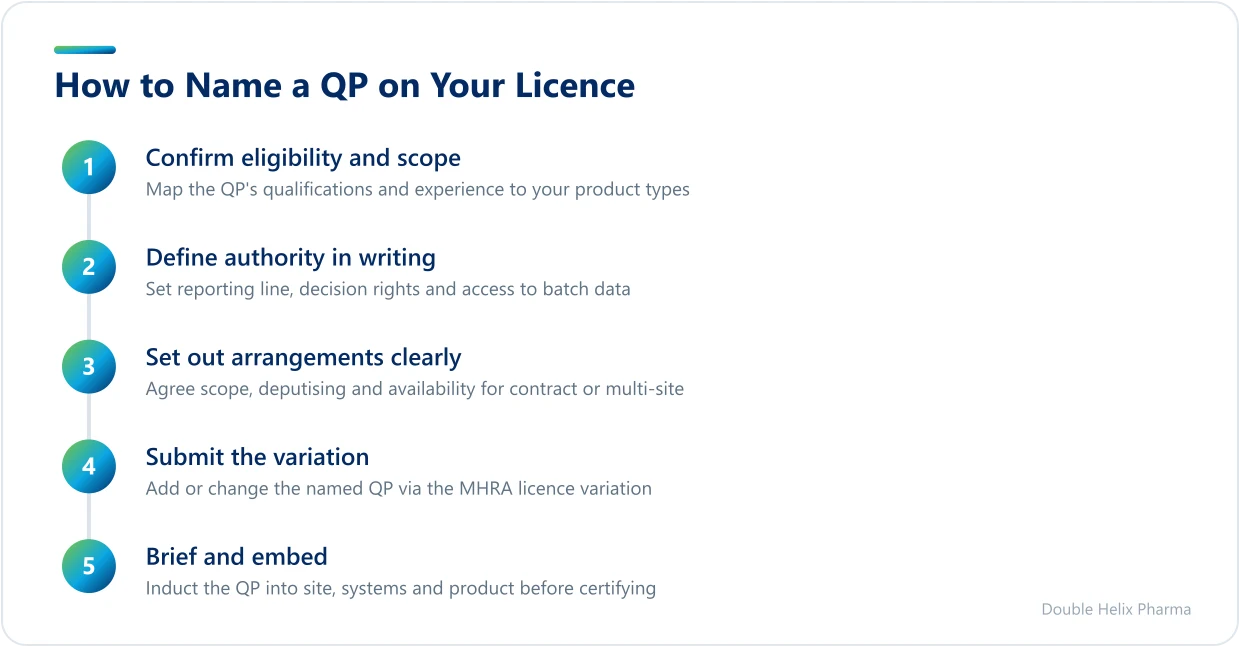
How to name a QP on your licence: the practical steps
Whether you are applying for a new MIA, adding a QP or replacing one who is leaving, the mechanism is a licence application or variation submitted to the MHRA. The administrative path is straightforward; the substance is where applications succeed or fail.
- Confirm eligibility and scope. Verify the proposed QP's qualifications and experience map to the activities and product types on the authorisation before you submit anything.
- Define authority in writing. Document the QP's reporting line, decision rights and unfettered access to batch records, deviations, CAPA and stability data.
- Set out arrangements clearly. Where a QP works across multiple sites or on contract, a written technical or quality agreement should define scope, responsibilities, deputising and availability.
- Submit the variation. Add or change the named QP through the appropriate licence variation, ensuring supporting information demonstrates suitability for the role.
- Brief and embed. Ensure the QP is genuinely inducted into your site, systems and product knowledge before they certify a single batch.
For organisations bridging a vacancy, awaiting a permanent hire or needing specialist cover, naming a contract QP on your licence is a legitimate, well-established route. The legal accountability is identical to that of an employed QP; what differs is the commercial model and the need for crisp governance.
Keeping the appointment valid
Naming a QP is not a one-off event. The arrangement must be maintained: continued availability, deputy cover for leave and absence, and prompt updates when a QP joins or leaves. A licence that lists a departed QP, or has no working cover, is exposed. Build QP status into your change-control routines so the register always reflects reality.
Common pitfalls when naming a QP
The figurehead QP
The most damaging error is naming a QP for the certificate alone, without the access, time and authority to do the job. Inspectors test this quickly by asking the QP to walk through recent certification decisions. If the answers are thin, the finding writes itself.
Mismatched scope
A QP qualified for solid oral dose is not automatically suitable for sterile products subject to the revised Annex 1 contamination control expectations. Confirm the named individual's experience genuinely covers your processes, especially for sterile and biological operations.
Confusing GB and EU requirements
Since the UK left the EU, the routes for the GB and EU markets are no longer identical. Importation into Great Britain, EU certification and the interaction with GDP distribution arrangements all need mapping so the right QP, under the right authorisation, covers the right activity. Note too that the QP role under an MIA is distinct from the Responsible Person role under a wholesale dealer's authorisation.
No cover plan
A single named QP with no deputy is a single point of failure: leave, illness or resignation can halt release. Plan contingency cover before you need it, not during a supply crisis.
Key takeaways
To name a QP on a licence correctly, treat the appointment as a substantive control rather than a clerical step. Confirm the individual's eligibility and that their experience matches your product types; give them documented authority and unfettered access to the data behind certification; submit the variation properly; and keep the arrangement, including deputy cover, current as people and processes change. Whether the QP is employed or contracted, the personal accountability under Annex 16 is the same, as is the regulator's expectation that the role is genuinely exercised.
If you are setting up a new MIA, replacing a departing QP or need reliable cover for your authorisation, our independent UK Qualified Persons can help you appoint the right person and put the governance in place. Explore our contract QP, RP and RPi services, see our case studies, or review our full range of quality and compliance services. When you are ready to discuss naming a QP on your licence, get in touch with our QP team.
Regulatory sources
This guidance reflects current UK and EU GMP/GDP requirements. Primary references:
- EU GMP Annex 16 — Certification by a Qualified Person and Batch Release
- EMA — GMP/GDP Questions & Answers
- EudraLex Volume 4 — EU GMP Guidelines
Always confirm against the latest published version of each source.
Frequently asked questions
Do you have to name a QP on a manufacturing licence?+
Yes. You cannot hold a valid Manufacturer's or Importer's Authorisation in Great Britain or the EU without at least one named Qualified Person. The QP is legally responsible under EU GMP Annex 16 for certifying batches before release, and the competent authority lists the named QP against the licence. Operating an MIA without an eligible, available named QP is a serious compliance breach.
Can a contract QP be named on our licence instead of an employee?+
Yes. Naming a contract QP on your authorisation is a well-established and legally equivalent route, and the personal accountability for certification is identical to that of an employed QP. What matters is that the contracted QP is eligible for your product types, has documented authority and unfettered access to your batch records and quality data, and that a clear written agreement defines scope, availability and deputy cover. The MHRA applies no lower standard to a contracted QP.
How do we add or change a named QP on an existing MIA?+
You add or change a named QP through a licence variation submitted to the MHRA, supported by information demonstrating the individual's eligibility and suitability for the activities on the authorisation. Confirm their qualifications and experience match your dosage forms before submitting, and ensure they are properly inducted into your site and systems before certifying any batch. Keep the licence current by updating it promptly whenever a QP joins or leaves.