Site Readiness (MIA/WDA) · 7 min read
MIA vs WDA: Which Licence Do You Need?
MIA vs WDA: a UK QP's practical guide to choosing the right MHRA licence for manufacture, import, storage and wholesale distribution of medicines.
By Balasubramanian Ramaiah · 9 June 2026 · Updated 20 September 2026
One of the most common questions we field from new manufacturers, importers and distributors is deceptively simple: MIA vs WDA — which licence do you actually need? The answer turns on what your business physically does with a medicinal product, not on what you call yourself. Get the distinction wrong and you risk regulatory delay, failed inspections, or operating unlawfully under the Human Medicines Regulations 2012.
The core distinction: what each licence authorises
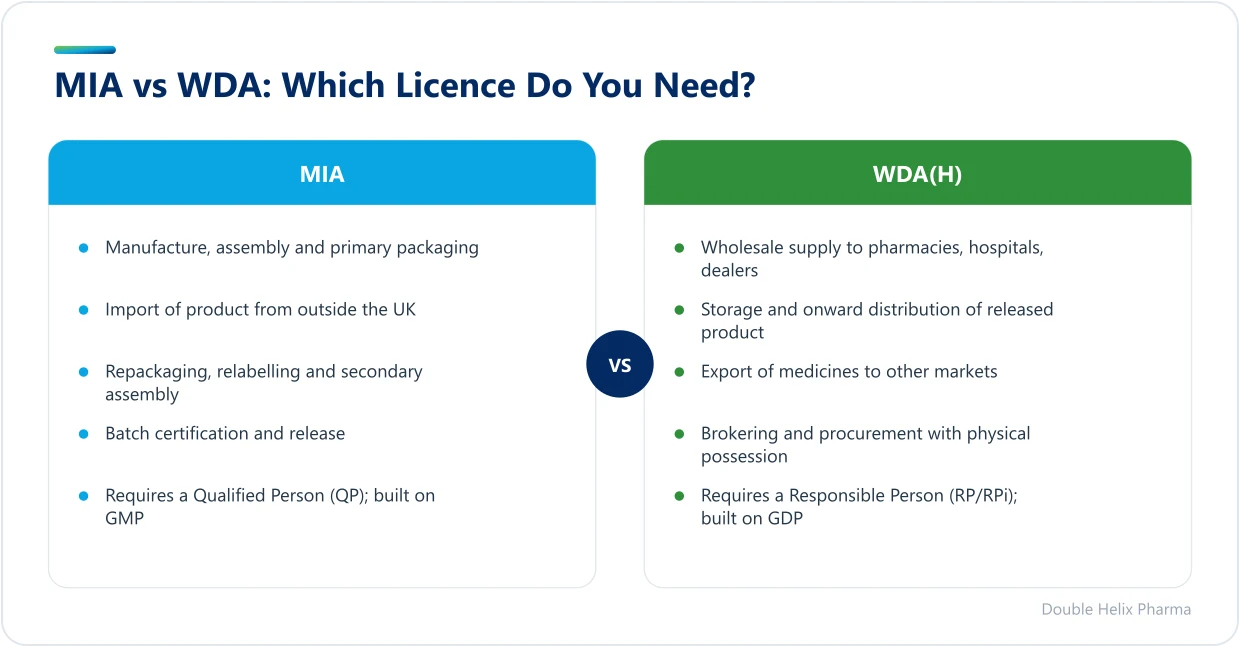
In the UK, the MHRA issues two principal authorisations for handling licensed medicines. A Manufacturer's / Importer's Authorisation (MIA) permits you to manufacture, assemble or import medicinal products. A Wholesale Dealer's Authorisation (WDA(H)) permits you to procure, hold, supply or export those products to anyone other than the patient. The first is governed by EU GMP (the Orange Guide principles, retained in UK law); the second by GDP — Good Distribution Practice.
The shorthand we use with clients is straightforward: if the product changes — in its primary or secondary packaging, its formulation, its batch identity, or its release status — you are manufacturing. If the product merely moves — bought, stored and onward-supplied unchanged — you are distributing. That single test resolves the majority of MIA vs WDA queries before we even look at the detail.
When you need an MIA
An MIA is required whenever your operation involves a manufacturing step on a licensed product. This is broader than most people assume and explicitly includes:
- Full manufacture — synthesis, formulation, filling and primary packaging of the dosage form.
- Secondary assembly — labelling, secondary packaging, or repackaging, even where you never touch the product itself.
- Importation from outside the UK — products imported from a third country require an MIA holding the relevant import authorisation, with batch certification by a Qualified Person before release.
- Certification and batch release — the QP function under Annex 16 sits firmly within the MIA.
Critically, an MIA brings the Qualified Person (QP) obligation. No batch of a licensed medicine may be released to the UK market without QP certification. The MIA also demands a pharmaceutical quality system aligned with ICH Q10, contamination control consistent with Annex 1 for sterile products, and data integrity controls meeting ALCOA+ expectations. Manufacturers exporting to or supplying the US market will recognise these as broadly analogous to the cGMP requirements of 21 CFR 210/211, though the two frameworks are not interchangeable.
When you need a WDA(H)
A Wholesale Dealer's Authorisation is required if you buy, hold, supply or export licensed medicines without altering them. Typical WDA(H) activities include:
- Wholesale supply to pharmacies, hospitals, other wholesalers or healthcare professionals.
- Storage and onward distribution of finished, released product.
- Export of medicines to other markets.
- Brokering and procurement where physical possession is taken.
The WDA(H) is built on GDP and obliges you to name a Responsible Person (RP) — and, where products are imported into the UK from countries on an approved list, a Responsible Person (Import), or RPi. The RP safeguards product integrity, supply-chain bona fides, temperature control, and the handling of returns, recalls and falsified-medicine risks under the Falsified Medicines Directive framework retained in UK law. Where a WDA holder sources stock, robust supplier and customer qualification is the single control inspectors scrutinise most closely.
Do you ever need both?
Frequently, yes. A site that imports finished product from a third country and also distributes it will hold an MIA (for the import and QP certification) and a WDA(H) (for the wholesale supply). Contract manufacturers, virtual MA holders and importers commonly run parallel authorisations, each with its own named person and its own quality system scope. The two are complementary, not mutually exclusive.
How to decide: a practical decision path
Work through these questions in order. The first "yes" usually tells you which licence dominates:
- Do you change the product — formulate, fill, label, repackage, or re-test? If yes, you need an MIA.
- Do you import finished product from outside the UK? If yes, you need an MIA with import scope and a QP.
- Do you take possession of released product to store, supply or export it unchanged? If yes, you need a WDA(H) with an RP (and an RPi where importing from an approved country).
- Do you do both? You will hold both authorisations.
Underpinning all of this is ICH Q9 quality risk management: the MHRA expects your licence scope, premises, equipment and personnel to be justified by a documented assessment of product and patient risk. Naming a person is not enough — you must demonstrate the system behind them. Our case studies illustrate how that justification is built and defended at inspection.
Common mistakes that derail applications
Across countless readiness projects, the same avoidable errors recur:
- Assuming a WDA covers repackaging. Any change to packaging or labelling is a manufacturing activity and requires an MIA — a frequent and costly misjudgement.
- Underestimating the named-person requirement. The QP, RP and RPi must be eligible, contactable and genuinely involved. A name on paper without authority will not survive inspection.
- Applying for too narrow a scope. Variations take time; mapping your real and near-future activities up front avoids stalled growth.
- Treating the application as paperwork. The licence reflects a functioning quality system. Inspectors assess what you do, not only what you wrote.
Key takeaways: settling MIA vs WDA for your site
The MIA vs WDA decision comes down to one question — do you change the product, or simply move it? Manufacture, assembly, repackaging and third-country import sit under the MIA with a Qualified Person; storage, supply and export of unchanged product sit under the WDA(H) with a Responsible Person. Many businesses legitimately need both, and the right scope is the one that matches what you actually do, evidenced by a quality system that holds up under MHRA scrutiny.
If you are mapping activities to the correct authorisation, preparing for a pre-licensing inspection, or need contract QP, RP or RPi cover, our site readiness specialists can scope the right licence and get you inspection-ready. Talk to our team for a confidential, no-obligation discussion of your project.
Regulatory sources
This guidance reflects current UK and EU GMP/GDP requirements. Primary references:
- MHRA — UK Medicines & Healthcare products Regulatory Agency
- EudraLex Volume 4 — EU GMP Guidelines
- MHRA Inspectorate Blog
Always confirm against the latest published version of each source.
Frequently asked questions
Can one company hold both an MIA and a WDA at the same time?+
Yes, and many do. A business that imports finished medicines from a third country and then distributes them will typically hold an MIA for the import and QP certification, and a WDA(H) for the wholesale supply. Each authorisation has its own scope, its own named person and its own quality-system responsibilities, but the two operate in parallel without conflict.
Does repackaging or relabelling a medicine need an MIA or a WDA?+
It needs an MIA. Any change to the primary or secondary packaging, including relabelling, repackaging or assembly, is classed as a manufacturing activity under UK law, even if you never alter the product itself. A WDA(H) only permits you to store and supply medicines in the state in which you received them, so repackaging under a wholesale licence alone would be non-compliant.
What is the difference between a Responsible Person (RP) and an RPi?+
Both sit under a WDA(H). The Responsible Person oversees GDP compliance for wholesale activities generally, safeguarding product integrity, supply-chain verification, storage and recalls. The Responsible Person (Import), or RPi, is the additional named role required when importing certain medicines into the UK from countries on an approved list, providing specific assurance over those imported products before they enter the supply chain.