Site Readiness (MIA/WDA) · 7 min read
MHRA Inspection Types Explained
A senior QP guide to the main MHRA inspection types - pre-approval, routine, for-cause and follow-up - and how to make your MIA or WDA site ready for each.
By Balasubramanian Ramaiah · 9 June 2026 · Updated 14 July 2026
Most quality teams treat an MHRA inspection as a single, monolithic event, but the agency runs several distinct kinds of visit, each with its own trigger, scope and stakes. Understanding the MHRA inspection types you might face — and why the inspectorate has chosen a particular one — lets you prepare proportionately rather than scrambling to defend everything at once. This guide sets out the main categories, what drives each, and how to make your site demonstrably ready for whichever lands on your calendar.
Why the type of inspection matters
The MHRA does not inspect at random. Its Inspectorate, Enforcement and Standards Division allocates resources using a risk-based model: the type, frequency and depth of an inspection reflect your licence category, product risk, compliance history and any intelligence the agency holds. A first-time applicant for a Manufacturer's or Importer's Authorisation (MIA) is approached very differently from a long-established site with a clean record, and both differ again from a site that has just reported a serious recall.
For your quality team, the practical consequence is that preparation should be calibrated. A pre-approval inspection rewards evidence that systems are designed and ready; a routine periodic inspection rewards evidence that they have operated consistently since the last visit; a for-cause inspection rewards a credible, closed-out story around the specific problem that triggered it. Treating all three identically wastes effort and leaves real gaps exposed.
The main MHRA inspection types explained
Within the GMP and GDP framework, the inspections you are most likely to encounter fall into a handful of recognisable categories. They are not mutually exclusive — a routine inspection can become for-cause mid-visit — but each starts from a different premise.
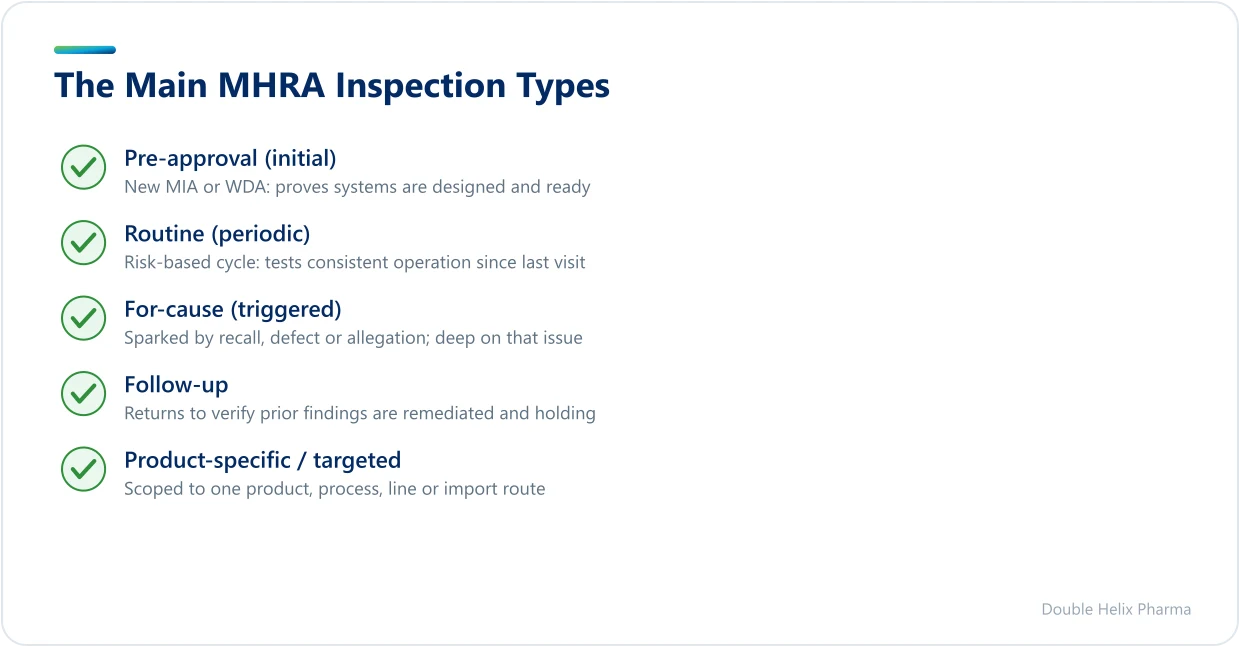
Pre-approval (initial) inspections
Before the MHRA grants a new MIA or Wholesale Dealer's Authorisation (WDA), it inspects the site to confirm the operation described on paper exists in practice. These inspections scrutinise whether your premises, equipment, quality management system and named personnel — the Qualified Person on an MIA, the Responsible Person on a WDA — are genuinely capable of doing what the licence permits. The bar is design and readiness: the inspector is asking whether the system can work, not yet whether it has worked over years.
Routine (periodic) inspections
Once licensed, sites are re-inspected on a risk-based cycle. Historically many GMP sites were visited on an approximately two-year rhythm, but the MHRA adjusts the interval according to risk, so a strong compliance history can extend it and a weak one can shorten it. A routine inspection is broad and systems-based: data integrity, quality risk management aligned with ICH Q9, the pharmaceutical quality system under ICH Q10, deviation and CAPA handling, and — for sterile manufacturers — conformance with the revised Annex 1. The inspector tests whether your systems have operated consistently since the last visit.
For-cause (triggered) inspections
A for-cause inspection is prompted by a specific signal: a serious recall, a pattern of defect reports, a whistleblower allegation, a referral from another regulator, or unresolved deficiencies from a prior visit. These are narrower in headline scope but far deeper on the triggering issue. The inspector arrives with a hypothesis and pursues the thread relentlessly — the excursion that led to an investigation, that led to a CAPA, that led to whether anyone verified the fix actually held.
Follow-up inspections
Where a previous inspection closed with significant findings, the MHRA may return specifically to verify that your remediation landed. The focus is evidence of effective, sustained corrective action: not a plan, but proof that the commitments in your response have been implemented and are holding. Producing a tidy CAPA log that no one can demonstrate in practice is the classic way to fail one of these.
Product-specific and other targeted inspections
Some visits are scoped tightly around a particular product, process or activity — for example, the certification arrangements for a specific medicinal product, an importation route from a third country, or a single manufacturing line. The MHRA also participates in international programmes and may inspect on behalf of, or alongside, other authorities under mutual recognition arrangements.
Announced versus unannounced — a cross-cutting distinction
Cutting across every category above is whether the visit is announced or unannounced. Most routine GMP and GDP inspections are notified in advance, giving you time to assemble documentation and the right people. But the MHRA reserves the right to inspect unannounced, and frequently does so where there is a compliance concern or a for-cause trigger. The lesson is uncomfortable but simple: a site that is only ready when it has had four weeks' warning is not actually ready. Genuine inspection readiness means your back room can retrieve the correct, current document within minutes on any ordinary working day.
An inspection is rarely lost on the day the inspector arrives. It is lost in the months beforehand, in the gaps no one rehearsed.
How to prepare for each MHRA inspection type
Effective preparation maps your effort to the likely visit. The fundamentals are common to all of them, but emphasis shifts.
- Know your licence and your risk profile. Your product types, dosage forms, sterile or non-sterile status and compliance history all shape which inspection you are most likely to get and how deep it will go.
- Keep the quality system demonstrable, not just documented. Across all types, the recurring failure is that a control exists on paper but the responsible person cannot evidence it live. Audit-trail review, deviation closure and CAPA effectiveness are the usual pressure points.
- For pre-approval, prove design and readiness. Make sure premises, equipment qualification, the QMS and named QP or RP arrangements are complete and coherent before you invite scrutiny.
- For routine, prove consistency over time. Trend your quality metrics, show that management review under ICH Q10 actually drives decisions, and confirm data-integrity controls reflect ALCOA+ in practice.
- For for-cause and follow-up, prove the specific story is closed. Be able to walk the inspector end to end through the triggering event and the corrective action, with effectiveness checks that demonstrably held.
A well-run mock inspection is the most reliable way to test all of this under realistic pressure, converting findings you would have received from the regulator into internal actions you control. Structured site readiness and MIA/WDA support exists precisely to close that gap before the inspectorate finds it, and our case studies show how that preparation plays out in practice across different licence types.
Key takeaways
The MHRA inspection types you encounter are deliberate choices made on a risk basis, and each carries a different burden of proof — readiness for pre-approval, consistency for routine, a closed-out story for for-cause and follow-up. The cross-cutting variable is whether the visit is announced or unannounced, which is why durable readiness, not last-minute preparation, is the only reliable defence. Map your effort to the likely inspection, keep your quality system demonstrable on any ordinary day, and rehearse the threads an inspector will actually pull.
If you want an experienced QP and RP perspective on which inspection your site is most exposed to — and a practical plan to be ready for it — get in touch with our team or explore the full range of our compliance services.
Regulatory sources
This guidance reflects current UK and EU GMP/GDP requirements. Primary references:
- MHRA — UK Medicines & Healthcare products Regulatory Agency
- EudraLex Volume 4 — EU GMP Guidelines
- MHRA Inspectorate Blog
Always confirm against the latest published version of each source.
Frequently asked questions
How much notice does the MHRA give before an inspection?+
Most routine GMP and GDP inspections are announced, typically giving a site several weeks to prepare documentation and ensure key personnel are available. However, the MHRA reserves the right to inspect unannounced and regularly does so where there is a compliance concern or a for-cause trigger. The practical implication is that a site should be able to retrieve current, correct documentation and present its quality system on any ordinary working day, not only when warned in advance.
What is the difference between a routine and a for-cause MHRA inspection?+
A routine inspection is scheduled on a risk-based cycle and is broad and systems-based, testing whether your quality system has operated consistently since the last visit across areas such as data integrity, deviations, CAPA and, for sterile sites, Annex 1. A for-cause inspection is triggered by a specific signal such as a serious recall, recurring defect reports or a whistleblower allegation, and is narrower in headline scope but far deeper on the triggering issue. Preparing for the latter means being able to walk an inspector end to end through the specific event and demonstrate that corrective action has held.
How often does the MHRA inspect a licensed site?+
The interval is set on a risk basis rather than a fixed legal period, so it varies with your licence type, product risk and compliance history. Many GMP sites have historically been inspected on roughly a two-year rhythm, but a strong compliance record can extend the interval while significant findings can shorten it or trigger a follow-up visit. Because the cycle is risk-driven, sustaining a clean inspection history is one of the most effective ways to reduce inspection burden over time.