Site Readiness (MIA/WDA) · 8 min read
How the MHRA Inspection Process Works (and Timelines)
A senior QP's guide to the MHRA inspection process: inspection types, stage-by-stage flow, how deficiencies are classified, realistic timelines and readiness.
By Balasubramanian Ramaiah · 9 June 2026 · Updated 22 July 2026
For any UK manufacturer, importer or wholesaler, understanding the MHRA inspection process is the difference between hosting a confident, well-evidenced visit and scrambling to explain gaps in front of an inspector. Inspections are how the agency verifies that your site operates to the standards underpinning your MIA or WDA(H), and they follow a recognisable rhythm from notification through to a graded report and follow-up. This guide walks through each stage, the realistic timelines involved, and what mature quality teams do to stay ready year-round.
Why the MHRA inspects, and the types of inspection
The MHRA inspects to confirm continued compliance with Good Manufacturing Practice (EU GMP) or Good Distribution Practice (GDP), and to protect patients from products that are unsafe, ineffective or falsified. An inspection is not an audit of paperwork alone; it tests whether your pharmaceutical quality system, built on the principles of ICH Q10 and the risk thinking of ICH Q9, actually governs day-to-day operations.
Most sites encounter several inspection types over their lifecycle:
- Pre-licensing inspections before an MIA or WDA(H) is granted, confirming the site is fit for the activities requested.
- Routine (periodic) inspections on a risk-based cycle once you are licensed.
- For-cause inspections triggered by a specific concern, such as a recall, a serious complaint, a defect report or intelligence.
- Product-specific or follow-up inspections to verify remediation after a previous unsatisfactory outcome.
The frequency of routine inspections is driven by risk, not a fixed calendar. A sterile manufacturer working to Annex 1, or an importer certifying third-country product, will typically be seen more often than a low-risk distributor, because the consequences of failure are greater.
How the MHRA inspection process works, stage by stage
While every visit is tailored to the site, the MHRA inspection process follows a consistent arc that you can plan around. Treating it as a defined sequence, with clear internal ownership, removes most of the surprises.
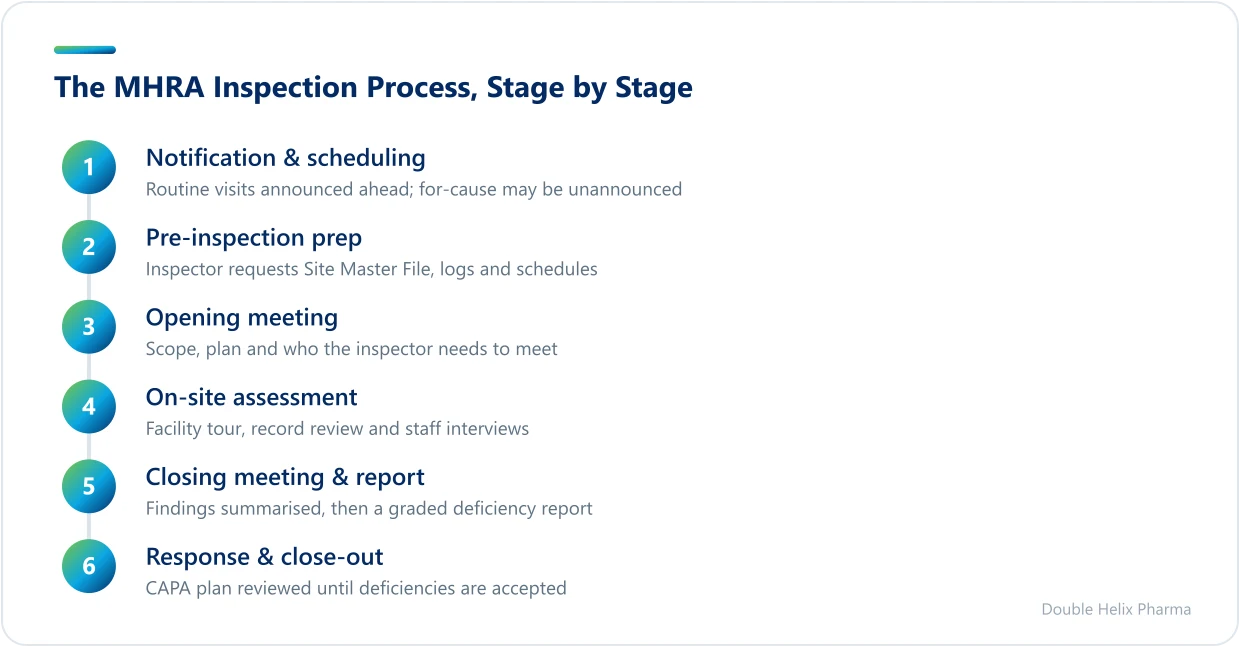
- Notification and scheduling. Routine inspections are usually announced in advance, often with several weeks' notice, allowing you to confirm logistics and assemble your team. For-cause inspections may be short-notice or unannounced.
- Pre-inspection preparation. The inspector may request documents ahead of the visit, such as your Site Master File, organisational chart, list of products, deviation and recall logs and the schedule of activities.
- Opening meeting. The inspector sets out the scope, the plan for the days ahead and who they need to meet.
- The inspection itself. A combination of facility tour, observation of operations, document and record review, and interviews with staff at every level.
- Daily wrap-ups. Emerging findings are usually discussed each day so there are no surprises and you can begin gathering evidence.
- Closing meeting. The inspector summarises the findings and their likely classification before leaving site.
- The inspection report. A formal report listing deficiencies follows, to which you must respond with a corrective and preventive action (CAPA) plan.
- Response, review and close-out. The MHRA assesses your response and evidence, and confirms when the deficiencies are accepted as addressed.
Throughout, inspectors expect data that is attributable, legible, contemporaneous, original and accurate — the ALCOA+ principles — and they will follow a thread from a procedure into the records it generates to see whether the system genuinely works.
What inspectors actually look at
Expect scrutiny of the core GMP or GDP systems: change control, deviation and CAPA management, complaints and recall, self-inspection, supplier and contractor oversight, and training. For manufacturers, qualification and validation, contamination control and batch certification under Annex 16 carry significant weight. For distributors, the focus shifts to temperature control, bona fide checks, the Responsible Person's role and the integrity of the supply chain under GDP. In all cases, data integrity and the behaviour of your quality culture are tested continuously, not in isolation.
How deficiencies are classified
Findings are graded by the risk they pose to product quality and patient safety, and the classification drives both your timeline and the consequences:
- Critical: a deficiency that has produced, or may produce, a product harmful to the patient, or that involves fraud or data integrity failure. Critical findings can lead to suspension or revocation of a licence and demand immediate action.
- Major: a non-critical deficiency that may produce a product not meeting its marketing authorisation, or a significant departure from GMP/GDP, or a failure to carry out satisfactory batch release.
- Other: a deficiency that cannot be classed as critical or major but represents a departure from good practice.
The pattern matters as much as the individual finding. A cluster of "other" deficiencies pointing at the same weak system can, in aggregate, signal a major concern about whether your quality system is in control.
An inspection does not judge whether your SOPs are well written. It judges whether your organisation can consistently do what those SOPs say, and prove it. Inspectors look for evidence, not intent.
Realistic timelines: from notification to close-out
There is no single fixed duration, because the schedule depends on the site's complexity, the inspection type and how quickly you remediate. As a practical guide to the moving parts:
- Notice period: routine inspections are commonly announced several weeks ahead; for-cause or triggered inspections can be unannounced.
- On-site duration: typically one to several days, scaling with the size of the site and the breadth of activities.
- Report issue: the formal deficiency report follows the visit, usually within a few weeks.
- Your response: you are expected to respond promptly with a CAPA plan; critical findings demand near-immediate action, while major and other findings follow agreed timeframes.
- Close-out: the overall cycle hinges on the quality of your response. Robust, root-cause-based CAPAs with real evidence close quickly; superficial fixes invite further questions and prolong the process.
The single biggest variable you control is the strength of your remediation. A precise, evidenced response to findings shortens the path to close-out far more reliably than promising fast but unproven fixes.
Preparing so the inspection confirms what you already know
The best-run sites treat inspection readiness as a continuous state rather than a project that starts when the notification arrives. That means keeping your Site Master File current, running a genuine self-inspection programme, closing deviations and CAPAs on time, and rehearsing how staff explain their work. A mock inspection or independent site readiness assessment is one of the most effective ways to surface weaknesses while you still control the timeline — before the regulator finds them for you.
Practical habits that consistently pay off include maintaining an inspection-ready document index, nominating a trained host and scribe, briefing subject-matter experts so they answer the question asked, and ensuring your named QP or Responsible Person can demonstrate real oversight. We have seen across our case studies that organisations who invest in these routines move through inspections with markedly fewer findings and far less disruption.
Key takeaways
Understanding the MHRA inspection process demystifies what can feel like an intimidating event: notification, preparation, an on-site assessment of your systems against EU GMP or GDP, a graded report, and a CAPA-driven close-out whose speed you largely determine. Anchor your readiness in ICH Q9, ICH Q10 and ALCOA+, keep your core quality systems operating with real evidence, and treat every day as though an inspector could walk in — because, in a for-cause scenario, they can.
If you are preparing for a pre-licensing or routine inspection, recovering from findings, or simply want an independent view of where you stand, our team provides end-to-end site readiness support and the full range of QP, audit and quality consultancy services. Contact us to discuss your inspection readiness and build a plan that holds up on the day.
Regulatory sources
This guidance reflects current UK and EU GMP/GDP requirements. Primary references:
- MHRA — UK Medicines & Healthcare products Regulatory Agency
- EudraLex Volume 4 — EU GMP Guidelines
- MHRA Inspectorate Blog
Always confirm against the latest published version of each source.
Frequently asked questions
How much notice does the MHRA give before an inspection?+
Routine, periodic inspections are usually announced in advance, often with several weeks' notice so you can confirm logistics and assemble your team. For-cause inspections, triggered by a recall, complaint, defect report or specific intelligence, may be short-notice or entirely unannounced. Because of this, mature sites treat inspection readiness as a continuous state rather than something that begins when a notification arrives.
How are MHRA inspection findings classified?+
Deficiencies are graded as critical, major or other, based on the risk they pose to product quality and patient safety. A critical finding has produced or may produce a harmful product, or involves data integrity or fraud, and can lead to licence suspension or revocation. A pattern of repeated 'other' findings pointing at the same weak system can, in aggregate, indicate a major concern about whether your quality system is genuinely in control.
How long does it take to close out an MHRA inspection?+
There is no single fixed duration, because close-out depends on the site's complexity and, above all, the quality of your corrective and preventive action response. The deficiency report typically follows the visit within a few weeks, after which you respond with a CAPA plan; critical findings demand near-immediate action. Robust, root-cause-based responses supported by real evidence close far faster than superficial fixes, which simply invite further questions and prolong the process.