QMS & PQS Implementation · 7 min read
The Management Review Meeting: Making It Count
A practical guide to management review pharma teams can use: ICH Q10 inputs, the right attendees, cadence and turning data into board-level decisions.
By Balasubramanian Ramaiah · 9 June 2026 · Updated 2 August 2026
The management review is the one meeting where the pharmaceutical quality system (PQS) is supposed to look itself in the eye. Done well, an effective management review pharma process turns scattered data into board-level decisions, demonstrable oversight and continual improvement. Done badly, it becomes a slideshow that satisfies nobody, least of all an MHRA inspector reading the minutes.
Why management review matters under ICH Q10 and EU GMP
Management review is not an optional management ritual. It is one of the four elements of the pharmaceutical quality system described in ICH Q10, sitting alongside process performance and product quality monitoring, the CAPA system and change management. EU GMP Chapter 1 makes senior management explicitly accountable for an effective PQS, and the review is the mechanism by which that accountability is exercised and evidenced.
The regulatory expectation is straightforward: senior management must periodically take ownership of quality performance, confirm the system remains in a state of control, and direct resources where they are needed. The same logic runs through 21 CFR 210/211 and the GDP guidelines, where responsible persons and senior staff are expected to ensure the quality system is reviewed and kept fit for purpose. An inspector is entitled to ask not only whether reviews happen, but whether they actually change anything.
Inputs: what a genuine review must consume
A review is only as good as the data feeding it. ICH Q10 sets clear expectations for inputs, and a credible meeting should draw on, as a minimum:
- Process performance and product quality monitoring, including trends from product quality reviews (PQRs/APRs).
- CAPA status, ageing and effectiveness, with attention to recurring or systemic issues.
- Change management: implemented changes, their outcomes and any backlog.
- Deviations, out-of-specification results and complaints, including severity and trend.
- Outcomes of internal audits, supplier audits and regulatory inspections.
- Quality risk management outputs and the status of key risks.
- Feedback from regulators, recalls, returns and product defects.
- Status of actions from previous management reviews.
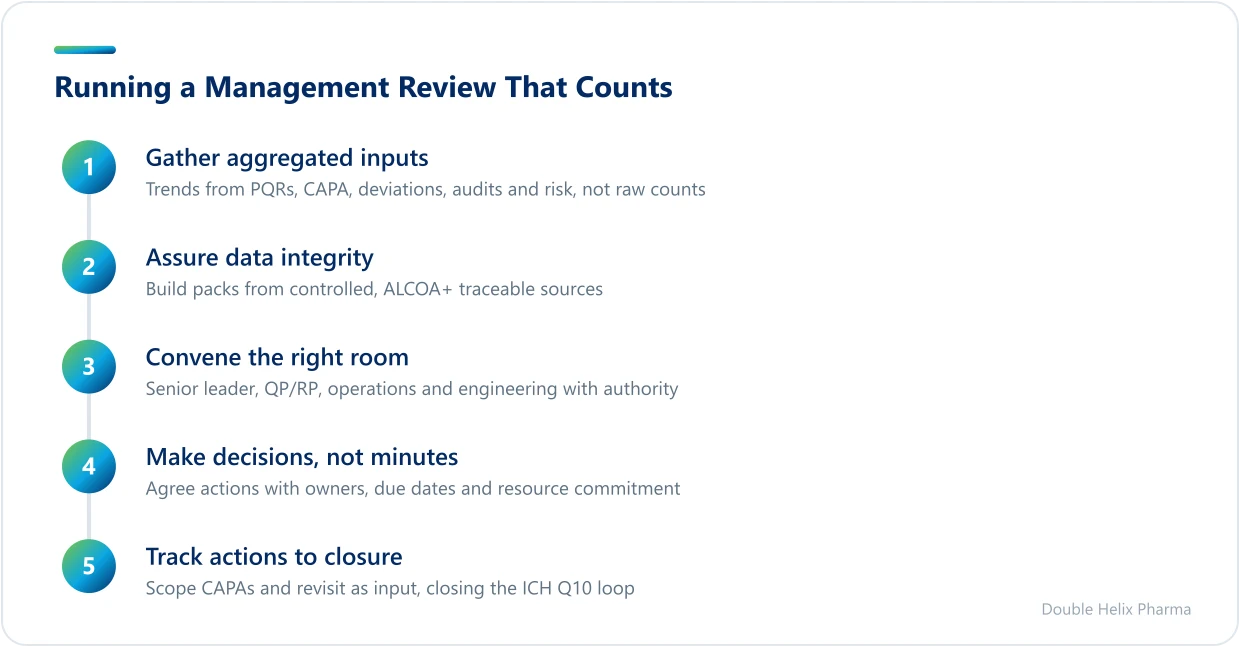
The discipline that separates strong sites from weak ones is aggregation. Forty individual deviations tell you little; the observation that a third of them trace to a single ageing utility, reviewed against ICH Q9 risk thinking, tells you where to invest. Raw counts belong in the appendix. The review itself should deal in trends, themes and decisions.
Data integrity of the inputs
If the metrics are wrong, the decisions will be too. Review packs should be built from controlled, traceable sources that respect ALCOA+ principles, with clear ownership of each metric. A common inspection finding is a glossy dashboard whose numbers cannot be reconciled to the underlying records. Treat the data behind the review with the same rigour you would apply to any GMP record.
Cadence, attendance and decision-making authority
Neither EU GMP nor ICH Q10 prescribes a fixed frequency, so you must justify your own. Quarterly review of the full PQS, supported by a lighter monthly quality metrics check, works for many manufacturers and importers; a small importer may run a meaningful review less often, provided escalation routes exist between meetings for urgent issues. Define the cadence in a procedure and apply it consistently.
Attendance is where reviews quietly fail. The meeting must include people with the authority to commit resources, not just the quality department reporting to itself. Expect the senior site leader, the Qualified Person or Responsible Person, operations, engineering and supply chain at the table. The QP's perspective is particularly valuable because the patterns surfaced here often bear directly on certification confidence and product disposition.
A management review that cannot reallocate budget or headcount is a status update, not a review. The test is simple: did a decision in the room change what happens on the floor?
Turning the review into action and oversight
The output of the meeting is not minutes; it is decisions with owners, due dates and a mechanism to verify they land. Each agreed action should be tracked to closure and revisited as a standing input at the next review, closing the loop ICH Q10 intends. Where the review identifies a systemic weakness, the response should be a properly scoped CAPA, not a vague intention to "monitor".
Crucially, the review is your evidence of management oversight. When an inspector asks how senior management assures itself the PQS is effective, the minutes, the trended data and the resulting actions are the answer. A robust, repeatable review process is one of the clearest signals of a mature quality culture, and it underpins much of the work we describe in our QMS implementation service. For practical illustrations of how sites have rebuilt this from a paper exercise into a genuine governance forum, our case studies are a useful starting point.
Common failure modes to design out
- The data dump: hundreds of slides, no synthesis, no themes, no decisions.
- The closed loop that never closes: previous actions carried forward indefinitely without challenge.
- The wrong room: attendees who can describe problems but cannot authorise solutions.
- The retrospective trap: backward-looking metrics with no forward view of emerging risk.
- Quality talking to itself: operations and engineering absent or silent.
Key takeaways
A strong management review pharma process is the engine of continual improvement under ICH Q10 and a core expectation of EU GMP, MHRA and GDP oversight. Feed it aggregated, ALCOA+-sound data; convene people with real authority; and judge it by the decisions it produces rather than the slides it generates. The minutes are your living evidence that senior management owns quality, so make them count.
If your management review has drifted into a reporting exercise, it can be redesigned into a sharp, decision-led forum without adding bureaucracy. Explore our full range of quality and compliance services, or contact our team to discuss strengthening your PQS governance and management review framework.
Regulatory sources
This guidance reflects current UK and EU GMP/GDP requirements. Primary references:
- EU GMP Chapter 1 — Pharmaceutical Quality System
- EudraLex Volume 4 — EU GMP Guidelines
- EMA — GMP/GDP Questions & Answers
Always confirm against the latest published version of each source.
Frequently asked questions
How often should a pharmaceutical management review be held?+
Neither EU GMP nor ICH Q10 prescribes a fixed frequency, so you must define and justify your own cadence in a procedure. Many manufacturers run a full PQS review quarterly, supported by a lighter monthly quality metrics check, while a small importer may review less frequently provided urgent issues can be escalated between meetings. The key is consistency and a documented rationale that an inspector can follow.
What inputs are required for an ICH Q10 management review?+
ICH Q10 expects the review to consider process performance and product quality monitoring, CAPA status and effectiveness, change management, deviations, complaints and out-of-specification results. It should also cover audit and inspection outcomes, quality risk management outputs, regulatory feedback and the status of actions from previous reviews. Crucially, these inputs should be presented as aggregated trends and themes rather than raw counts.
Who should attend the management review meeting?+
The meeting must include senior management with the authority to commit resources, not only the quality department. Typical attendees are the senior site leader, the Qualified Person or Responsible Person, and heads of operations, engineering and supply chain. Without decision-making authority in the room, the review becomes a status update rather than a genuine governance forum that can change what happens on the floor.