Site Readiness (MIA/WDA) · 7 min read
Variations to a Manufacturing or Wholesale Licence
An MHRA licence variation keeps your MIA or WDA current. Learn how to classify changes, build defensible evidence and sequence submissions to avoid findings.
By Balasubramanian Ramaiah · 9 June 2026 · Updated 31 August 2026
Few regulatory obligations are as routinely underestimated as keeping your authorisations current. An MHRA licence variation is the formal mechanism by which the holder of a Manufacturer's/Importer's Authorisation (MIA) or Wholesale Dealer's Authorisation (WDA) notifies the regulator of a change to the licensed particulars. Get the timing, classification or evidence wrong, and you risk operating outside the terms of your licence — a finding that can stop product flow overnight.
Why your licence is a living document
When the MHRA grants an MIA or WDA, the licence captures a defined scope: the named sites, the categories of operation, the dosage forms or product classes, the Qualified Persons (QPs) and Responsible Persons (RPs) or RPi named on it, and the activities permitted at each location. The moment your real-world operation diverges from those particulars, the licence no longer reflects reality — and the gap is yours to close.
This is not a paperwork exercise. Operating beyond your authorised scope is a deficiency under EU GMP and the UK GDP guidelines, and it undermines the chain of accountability that ICH Q10 expects of a functioning pharmaceutical quality system. A licence that drifts out of date is, in effect, an uncontrolled change.
What counts as a change?
Variations are far broader than most teams assume. Common triggers include:
- Adding or removing a site, or changing a registered address.
- Introducing a new dosage form, manufacturing operation, or category of product.
- Appointing or removing a QP, RP or RPi.
- Adding importation of products from a third country, or new wholesale activities.
- Changes to the legal entity, ownership or company name.
- Significant changes to facilities, equipment or quality control arrangements that affect what the site can do.
Standard versus administrative MHRA licence variations
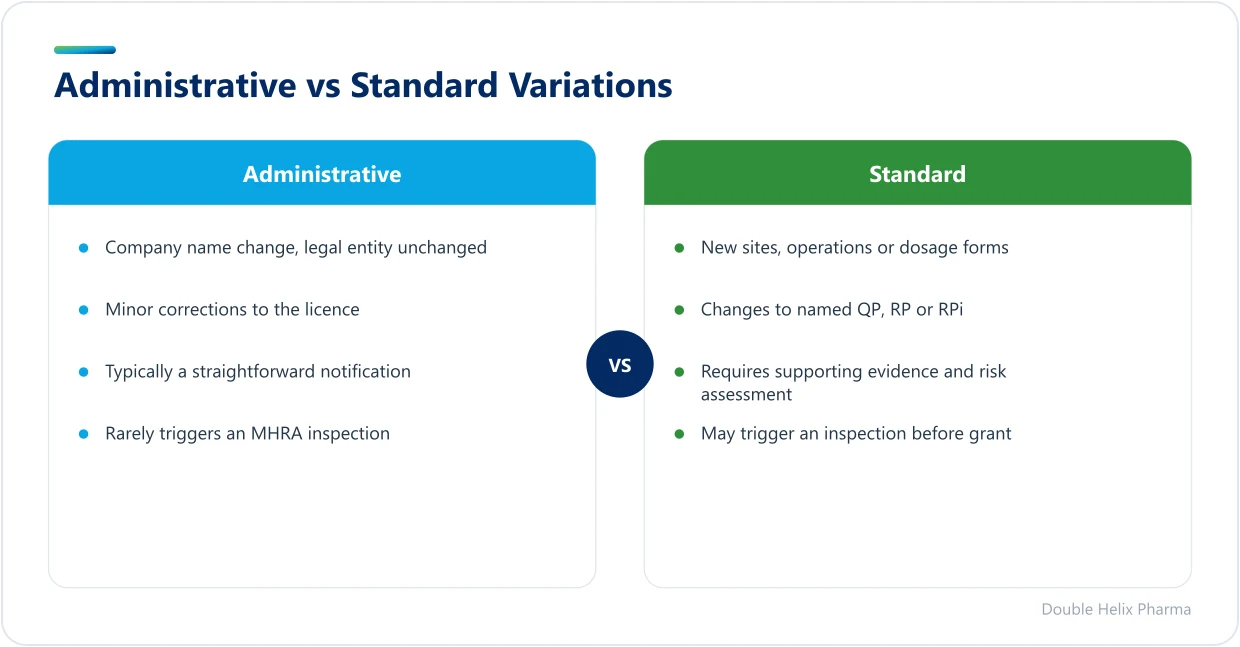
Not every change carries the same weight, and matching the right route to the right change is the first discipline to master. Broadly, variations to an MIA or WDA fall into two practical buckets.
Administrative changes — such as a change of company name where the legal entity is unchanged, or minor corrections — are typically straightforward notifications. Standard variations cover substantive changes to scope: new sites, new operations, additional dosage forms, or changes to named personnel. These require supporting evidence and, depending on the nature and risk of the change, may prompt the MHRA to schedule an inspection before the variation is granted.
A useful test: if the change alters what you are authorised to do, where you do it, or who is accountable for it, treat it as a standard variation and plan accordingly.
Crucially, do not confuse company licence variations with marketing authorisation variations. The latter concern the product dossier and follow an entirely separate classification system. This article addresses changes to the site licence itself — the MIA or WDA — not the product.
Building a variation that survives scrutiny
A variation submitted through the MHRA Process Licensing Portal is only as strong as the evidence behind it. The regulator is assessing whether your quality system genuinely supports the expanded or amended scope — not merely whether a form has been completed.
The evidence the regulator expects
For a meaningful variation, assemble a coherent package that may include:
- An updated Site Master File reflecting the new scope, sites or activities.
- Revised organisational charts and clear delegation of QP/RP responsibilities.
- Validation, qualification or technical transfer data for any new operation, line or dosage form.
- Updated quality agreements, supplier and customer qualification records where the supply chain changes.
- A documented change control record, in line with ICH Q10, showing the rationale and the risk assessment behind the change.
Underpinning all of this should be a formal risk assessment in the spirit of ICH Q9. The MHRA wants to see that you have anticipated the impact of the change on product quality and patient safety, and that your data integrity controls — ALCOA+ — extend cleanly to any new system or process. Where a new sterile operation is involved, expect Annex 1 expectations to be front and centre of the assessment.
Timing, sequencing and the cost of getting it wrong
The single most common failure is sequencing: starting a new activity, or having personnel act in a role, before the variation is granted. You must not manufacture, import or distribute outside your current authorised scope while a variation is pending — doing so is operating without the relevant authorisation.
Plan backwards from the date you need the new capability live. Standard variations take time to assess, and any that trigger an inspection will take longer still. Build that lead time into project plans for site expansions, technology transfers and new product introductions, and never assume same-day approval. For changes to named personnel, ensure continuity of QP or RP cover throughout — a gap in named, available cover is itself a deficiency.
Equally, do not let a portfolio of small, unreported changes accumulate. A backlog of unsubmitted variations is a classic inspection finding and a signal that change control is not functioning. Our case studies repeatedly show that organisations who treat variations as a routine, scheduled activity fare far better at inspection than those who batch them under pressure.
How Double Helix supports MHRA licence variations
Variations sit squarely within site readiness, and they reward the same rigour as a new licence application. As your contract QP or RP, or as an independent reviewer, we help you classify each change correctly, assemble defensible evidence, and sequence submissions so that operations are never out of scope. Where a variation is likely to trigger an inspection, we prepare the site to meet it with confidence.
If you are planning a new site, a new dosage form, a change of named QP/RP, or simply want to close a backlog of pending changes, explore our site readiness service or browse the full range of compliance services we offer. To discuss a specific variation, get in touch with our team and we will help you map the right route and timeline before you submit.
Key takeaways
- An MHRA licence variation keeps your MIA or WDA aligned with what you actually do; a stale licence is an uncontrolled change.
- Classify correctly: administrative notifications differ markedly from standard variations, and site licence changes are separate from marketing authorisation variations.
- Build the evidence — updated Site Master File, QP/RP delegation, validation data and an ICH Q9 risk assessment — to a standard that survives MHRA scrutiny.
- Never operate outside your current scope while a variation is pending, and plan lead time for any change that may trigger an inspection.
Regulatory sources
This guidance reflects current UK and EU GMP/GDP requirements. Primary references:
- MHRA — UK Medicines & Healthcare products Regulatory Agency
- EudraLex Volume 4 — EU GMP Guidelines
- MHRA Inspectorate Blog
Always confirm against the latest published version of each source.
Frequently asked questions
What is the difference between an MHRA licence variation and a marketing authorisation variation?+
A licence variation changes the company authorisation itself — your MIA or WDA — covering things like sites, named QPs or RPs, dosage forms and permitted activities. A marketing authorisation variation, by contrast, changes the product dossier and follows a completely separate classification system. The two are often confused, but they are submitted through different routes and assessed against different criteria.
Can we start a new manufacturing or wholesale activity while the variation is still pending?+
No. You must operate strictly within your current authorised scope until the variation is granted. Beginning a new activity, adding a new site, or having personnel act in a named role before approval means operating without the relevant authorisation, which is a serious deficiency that can halt supply. Always plan project timelines around the approval, not the submission, date.
Will an MHRA licence variation trigger an inspection?+
It can. Substantive standard variations — such as adding a new sterile operation, a new site or a significant new category of product — may prompt the MHRA to inspect before granting the change. Administrative changes such as a simple company name change usually do not. Build inspection readiness and realistic lead time into your plan whenever the change materially expands what the site is authorised to do.