QMS & PQS Implementation · 7 min read
Quality Risk Management with ICH Q9
A senior QP's practical guide to ICH Q9 quality risk management: scaling formality, managing subjectivity and embedding QRM in your EU GMP quality system.
By Balasubramanian Ramaiah · 9 June 2026 · Updated 10 August 2026
Quality risk management is no longer an optional discipline bolted onto your quality system; under ICH Q9 it is the engine that should drive proportionate, defensible decisions across the product lifecycle. For UK and EU manufacturers, importers and CMOs, the principles set out in ICH Q9 (R1) are now woven directly through EU GMP Chapter 1 and the supporting annexes, which means inspectors increasingly expect to see risk thinking evidenced rather than asserted. This article sets out how to apply the framework so that it strengthens your pharmaceutical quality system instead of generating paperwork.
What ICH Q9 actually requires
At its core, ICH Q9 establishes two enduring principles: that the evaluation of risk to quality should be based on scientific knowledge and ultimately link to the protection of the patient, and that the level of effort, formality and documentation of the process should be commensurate with the level of risk. The 2023 revision (R1) added welcome clarity on four areas that inspectors had found inconsistently applied: managing subjectivity, ensuring risk-based decision-making, addressing formality in risk management, and the relationship between risk management and product availability.
The guideline is deliberately tool-agnostic. It describes a process — risk assessment, risk control, risk communication and risk review — and then offers a menu of recognised methods such as FMEA, FMECA, HACCP, HAZOP, fault tree analysis and preliminary hazard analysis. Crucially, it does not mandate any single technique. The skill lies in matching the method to the question, not in defaulting to a risk matrix for every problem.
Embedding ICH Q9 within ICH Q10 and EU GMP
Quality risk management does not stand alone. It is one of the two enablers of the pharmaceutical quality system described in ICH Q10, sitting alongside knowledge management. In practice this means your risk activities should feed the management review, change control, deviation and CAPA processes rather than living in isolated spreadsheets.
The regulatory expectation is explicit. EU GMP Chapter 1 references quality risk management as integral to the PQS, and the principle now threads through specific chapters and annexes — most visibly in Annex 1, where the contamination control strategy must be underpinned by documented risk assessment, and in the validation expectations of Annex 15. For sites supplying the US market, the same risk-based logic supports the process control and investigation requirements of 21 CFR 210 and 211. A coherent quality management system is what ties these threads together so the same risk language is used from the shop floor to the management review.
Where teams most often go wrong
- Scoring theatre: assigning severity, occurrence and detection numbers without a defined rationale, so two assessors reach different totals for the same hazard.
- Risk assessments with no owner: documents that are created for an inspection and never reviewed when the process, supplier or facility changes.
- Confusing hazard with risk: listing every conceivable failure mode rather than focusing on those credibly linked to product quality and patient harm.
- Over-formalising the trivial: running a full FMEA on a low-impact administrative change while a genuinely complex aseptic intervention gets a single line on a form.
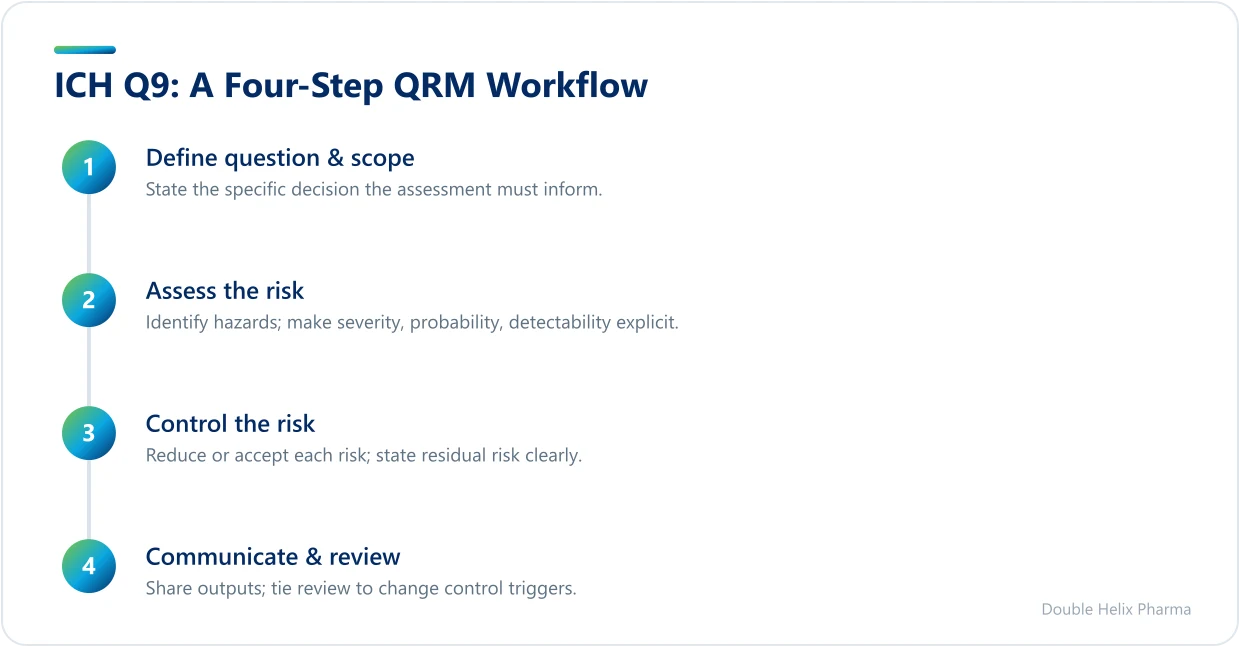
A practical four-step workflow
The R1 revision encourages you to decide, up front, how much formality a given decision warrants. A simple, well-understood, low-risk question may justify a brief documented rationale; a novel sterile process or a complex supplier change demands a structured, cross-functional assessment. Calibrating this consciously is one of the clearest signals of QRM maturity an inspector can see.
- Define the question and scope. State the specific decision the assessment must inform — for example, "is this excipient supplier change acceptable without revalidation?" A vague scope produces a vague output.
- Assess the risk. Identify hazards, analyse them against scientific knowledge and historical data, and evaluate them against pre-agreed criteria. Make the basis for severity, probability and detectability explicit so the scoring is reproducible.
- Control the risk. Decide whether to reduce or accept each risk, define the controls, and confirm that controls do not introduce new hazards. Residual risk should be stated, not implied.
- Communicate and review. Share outputs with affected functions and set a defined trigger and frequency for review. A risk assessment is a living document tied to change control, not a one-off deliverable.
Managing subjectivity and keeping it defensible
Subjectivity cannot be eliminated from risk management, but ICH Q9 (R1) is clear that it must be managed. The most effective controls are practical: use cross-functional teams so a single opinion does not dominate, define your rating scales with concrete descriptors rather than vague adjectives, and base judgements on data — deviation trends, complaint history, environmental monitoring, stability results — wherever it exists.
The goal is not to make risk assessment look objective; it is to make the reasoning transparent, traceable and reproducible by a competent reviewer.
Equally, beware of false precision. A neat number such as a risk priority number of 96 can imply a rigour that the underlying inputs do not support. Document the assumptions and the knowledge gaps openly. Where uncertainty is high, an honest qualitative assessment with a clear rationale is more defensible than a spuriously exact figure. This honesty is exactly what experienced assessors look for, and it is reflected in the way our case studies show remediation projects being scoped and prioritised.
Linking risk to product availability
One of the more significant additions in the R1 revision is the explicit recognition that quality risk management should consider the patient impact of product shortages. A failure that takes a critical medicine out of supply can itself be a patient-safety event. This reframes some classic decisions: an overly conservative rejection or an unnecessarily protracted investigation that interrupts supply of a critical product is not automatically the "safe" choice. ICH Q9 asks you to weigh the risk of the quality defect against the risk to patients of the product being unavailable, and to document that reasoning. It does not lower the quality bar — it simply demands that availability risk be assessed with the same scientific discipline as any other.
Key takeaways
Done well, ICH Q9 turns risk management from a compliance chore into a decision-making tool that earns inspector confidence and protects patients. The essentials are consistent: tie every assessment to patient impact, scale formality to the question, manage subjectivity with cross-functional input and data, and keep your risk documents alive through change control and periodic review.
- Match the QRM tool to the problem — there is no obligation to use a matrix for everything.
- Make scoring rationales explicit so assessments are reproducible and defensible.
- Connect risk outputs to your wider PQS under ICH Q10, not to standalone files.
- Consider product availability as a genuine patient-safety factor.
If your risk assessments are generating paper rather than confident decisions, our team can help you embed a proportionate, inspection-ready QRM framework across your quality and compliance services. Contact Double Helix Pharma to discuss how a pragmatic application of ICH Q9 can strengthen your quality system and stand up to MHRA and EU GMP scrutiny.
Regulatory sources
This guidance reflects current UK and EU GMP/GDP requirements. Primary references:
- EU GMP Chapter 1 — Pharmaceutical Quality System
- EudraLex Volume 4 — EU GMP Guidelines
- EMA — GMP/GDP Questions & Answers
Always confirm against the latest published version of each source.
Frequently asked questions
What is the difference between ICH Q9 and ICH Q10?+
ICH Q9 sets out the principles and process of quality risk management, while ICH Q10 describes the overall pharmaceutical quality system. Quality risk management under Q9 is one of the two key enablers of the Q10 system, alongside knowledge management. In practice, Q9 tells you how to assess and control risk, and Q10 ensures those risk outputs feed change control, CAPA and management review rather than sitting in isolation.
Which risk assessment tool does ICH Q9 require?+
ICH Q9 is deliberately tool-agnostic and mandates no single method. It offers a menu of recognised techniques such as FMEA, FMECA, HACCP, HAZOP and fault tree analysis, and expects you to match the tool to the question being asked. For a simple, well-understood decision a brief documented rationale may suffice, whereas a complex sterile process may justify a full structured assessment.
What did the ICH Q9(R1) revision change?+
The 2023 R1 revision did not change the core principles but added clarity in four areas that had been applied inconsistently: managing subjectivity in risk assessments, ensuring genuinely risk-based decision-making, addressing the appropriate level of formality, and recognising the link between quality risk management and product availability. The headline practical shift is that potential medicine shortages are now treated as a patient-safety factor to be weighed with the same scientific discipline as any quality defect.