Contract QP, RP & RPi · 7 min read
Responsible Person (RP) Duties on a WDA
A senior QP's guide to responsible person duties on a WDA: legal basis, GDP obligations, ICH Q9 risk decisions, contactability and contract RP cover.
By Balasubramanian Ramaiah · 9 June 2026 · Updated 1 July 2026
Every Wholesale Dealer's Authorisation (WDA(H)) issued by the MHRA hinges on one named individual: the Responsible Person. Understanding responsible person duties is not a paperwork exercise — it is the legal and practical mechanism by which a licensed wholesaler demonstrates that medicines reaching the supply chain are sourced, stored, handled and distributed in line with Good Distribution Practice. This article sets out what the role actually demands, where the common failure points lie, and how to keep a WDA in good standing.
The legal basis for the Responsible Person role
Under the Human Medicines Regulations 2012, the holder of a WDA(H) must name at least one Responsible Person (RP) on the licence. The role is reinforced by the EU Guidelines on Good Distribution Practice of Medicinal Products for Human Use (2013/C 343/01), which the MHRA continues to apply post-Brexit, and by the MHRA's Rules and Guidance for Pharmaceutical Distributors (the "Green Guide"). The RP is a condition of the licence — without an acceptable, named and contactable RP, the authorisation cannot be held.
Critically, the RP must be personally satisfied that the obligations of the WDA are met. This is not a duty that can be quietly delegated to a quality team and forgotten. The MHRA assesses the named individual's knowledge, experience and standing during the application and at inspection, and the RP is expected to have the authority to halt distribution where patient safety or compliance is at risk.
Core responsible person duties on a WDA
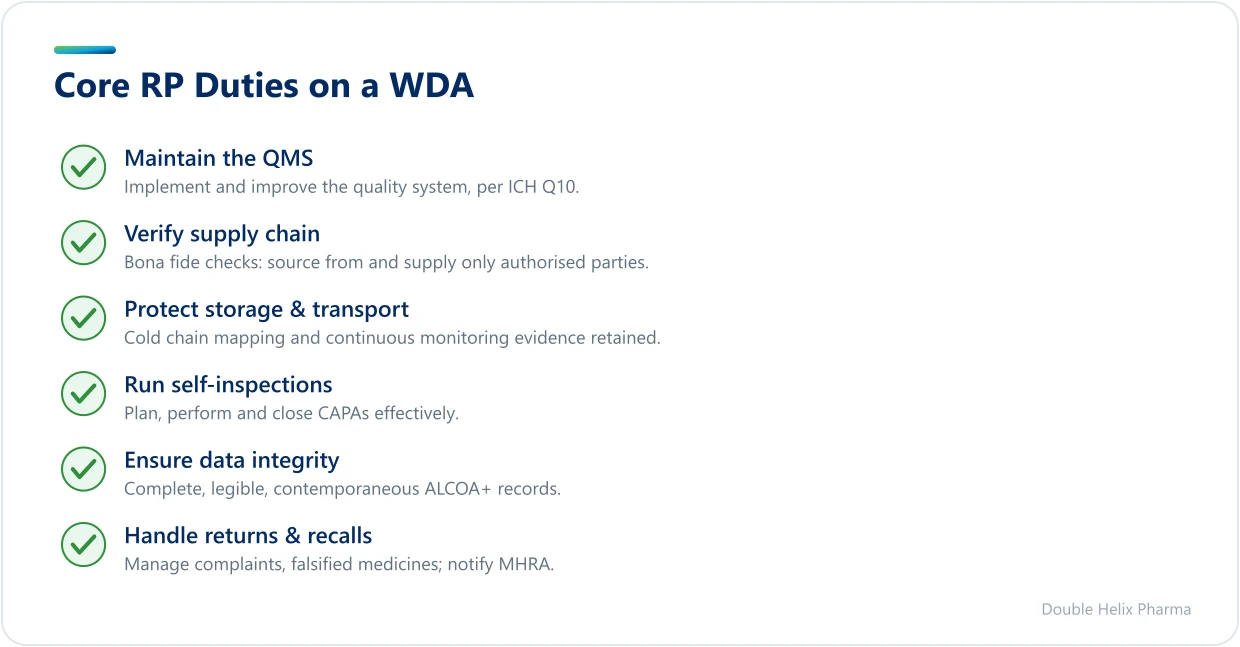
The GDP guidelines and MHRA guidance translate the role into a set of concrete, auditable responsibilities. In practice, a competent RP must ensure that:
- A pharmaceutical quality management system is implemented, maintained and continuously improved, consistent with the principles of ICH Q10.
- Medicines are procured only from, and supplied only to, appropriately authorised parties — with valid WDA, manufacturing authorisation or, where relevant, pharmacy and prescriber credentials verified and recorded.
- Storage and transport conditions, including the cold chain, protect product quality throughout, with mapping and continuous monitoring evidence retained.
- Self-inspections are planned, performed and followed up, and that corrective and preventive actions (CAPA) are closed effectively.
- Records are complete, legible and contemporaneous, satisfying ALCOA+ data integrity expectations.
- Returns, suspected falsified medicines, complaints and recalls are handled promptly and documented, with the MHRA notified where required.
The RP must also ensure that initial and continuing training is delivered to all staff whose work touches GDP activities, and that personal accountability is genuine rather than nominal.
Verifying the supply chain
Bona fide checks on suppliers and customers sit at the heart of the role. The RP is responsible for confirming, before trading, that a counterparty is legally entitled to supply or receive the medicines in question, and for keeping that due diligence current. The Falsified Medicines Directive obligations — including safety-feature verification and decommissioning where applicable — fall squarely within the RP's field of oversight.
Risk management and decision-making authority
A WDA is only as robust as the quality decisions made under pressure. The RP is expected to apply formal quality risk management in the spirit of ICH Q9 — assessing, controlling, communicating and reviewing risk to product quality rather than reacting case by case. Temperature excursions, deviations, and questionable sourcing offers all call for documented, defensible judgement.
The Responsible Person should have the authority and independence to ensure that the obligations of the licence are discharged, including the power to refuse or stop the distribution of a product on quality or safety grounds.
This independence matters most when commercial and compliance interests collide. A senior RP, whether employed or engaged on a contract basis, should be able to say "no" to a profitable but non-compliant transaction and have that decision stand.
Continuity, contactability and the contract RP model
The MHRA expects the RP to be available to the site and contactable when needed. For many wholesalers — particularly newer importers, virtual operations and CMOs adding a distribution arm — maintaining that capability in-house is neither proportionate nor affordable. This is where a contract Responsible Person arrangement becomes attractive.
An experienced contract RP brings inspection-tested judgement, sector breadth and continuity that a single in-house hire can struggle to match. Where the role spans wider regulatory scope, organisations often pair RP cover with a contract QP or RPi (Responsible Person (import)) through a single provider. You can read more about how we structure these engagements on our contract QP, RP and RPi service page, and see how comparable mandates have worked in practice in our case studies.
Avoiding the "name on the licence" trap
A recurring MHRA criticism is the RP who is named but disengaged — unaware of recent deviations, absent from self-inspections, or unable to describe the site's own procedures. Whether your RP is internal or external, the relationship must give them real visibility, real authority and adequate time. A part-time arrangement that exists only on paper will not survive inspection.
Where WDA holders most often fall short
In our audit and readiness work, the same deficiencies surface repeatedly. The most frequent are:
- Weak bona fide verification — trading commenced before counterparty authorisation was confirmed, or due diligence left to lapse.
- Inadequate temperature control evidence — missing mapping studies, unqualified storage areas, or transport conditions assumed rather than demonstrated.
- Self-inspection programmes that are overdue or superficial, with CAPAs left open.
- Data integrity gaps — incomplete records, uncontrolled spreadsheets, and an inability to reconstruct the history of a batch movement.
- An RP without genuine authority to halt distribution when quality is in doubt.
None of these is exotic; each is preventable with a functioning QMS and an engaged RP. A focused gap assessment ahead of an MHRA inspection — across the full breadth of our quality and compliance services — typically pays for itself in avoided findings.
Key takeaways
The Responsible Person is the linchpin of every WDA, and discharging responsible person duties properly means combining a maintained quality system, rigorous supply-chain verification, ICH Q9 risk thinking and the real authority to stop distribution. The role cannot be nominal: the MHRA inspects the person as well as the procedures. Whether you are appointing your first RP, strengthening an existing arrangement, or bridging a gap with experienced contract cover, the priority is the same — demonstrable, defensible control of the medicines you distribute.
If you need a contract Responsible Person, an independent WDA readiness review, or candid advice on a specific finding, get in touch with our team for a confidential discussion.
Regulatory sources
This guidance reflects current UK and EU GMP/GDP requirements. Primary references:
- EU GMP Annex 16 — Certification by a Qualified Person and Batch Release
- EMA — GMP/GDP Questions & Answers
- EudraLex Volume 4 — EU GMP Guidelines
Always confirm against the latest published version of each source.
Frequently asked questions
Who can act as a Responsible Person on a UK WDA?+
The Responsible Person must have appropriate knowledge of, and experience in, wholesale distribution activities and Good Distribution Practice, and be acceptable to the MHRA. They do not have to be a pharmacist, but they must demonstrate the competence, standing and authority to ensure the licence obligations are met. The named individual is assessed by the MHRA during the application and may be questioned directly at inspection.
Can a Responsible Person be a contractor rather than an employee?+
Yes. A contract RP is permitted and is common among importers, virtual wholesalers and smaller operators. The key requirement is that the arrangement gives the RP genuine authority, adequate time, and the visibility needed to discharge the role properly. A purely nominal contract that leaves the RP disengaged will not withstand MHRA scrutiny.
What is the difference between an RP and an RPi?+
The Responsible Person (RP) oversees Good Distribution Practice activities under a WDA generally. The Responsible Person (import), or RPi, is a separate role specific to the UK, covering the importation of certain medicines from listed countries and confirming that appropriate independent certification is in place. A single business may need both, and they can sometimes be held by the same suitably qualified individual.