GDP Transport & Supply Chain · 7 min read
Running a GDP Self-Inspection
A senior QP's practical guide to running a GDP self inspection: scope, independent auditors, ALCOA+ records, CAPA and staying MHRA inspection-ready.
By Balasubramanian Ramaiah · 9 June 2026 · Updated 25 September 2026

A GDP self inspection is the mechanism by which a wholesale dealer or importer checks, on its own initiative, whether its distribution operation still meets Good Distribution Practice in full. It is not a formality bolted on before an MHRA visit; it is the engine of continual improvement that keeps a Wholesale Dealer's Authorisation defensible between inspections. Done honestly, it surfaces the weaknesses you would far rather find yourself than have a regulator find for you.
Why a GDP self inspection is a legal expectation, not housekeeping
Chapter 6 of the EU Guidelines on Good Distribution Practice of medicinal products for human use requires that self-inspections are conducted to monitor implementation of, and compliance with, GDP principles, and that corrective actions are proposed where necessary. The same expectation is embedded in UK GDP, which the MHRA enforces against holders of a WDA(H). In other words, the regulator does not merely permit self-inspection; it requires you to police yourself.
The discipline aligns directly with the quality system thinking of ICH Q10 and the risk-based approach of ICH Q9. A self-inspection programme is one of the clearest ways a Responsible Person demonstrates that the quality system is alive: that deviations are detected, that corrective and preventive action (CAPA) actually closes gaps, and that management is informed. A programme that exists only on paper, with identical "no findings" reports year after year, tells an inspector the opposite of what it intends.
Building a GDP self inspection programme that holds up
A credible programme is planned, not improvised. It should be defined in a procedure, scheduled across a rolling cycle, and proportionate to the risk and complexity of the operation. For most wholesalers an annual cycle covering the whole quality system is the baseline, supplemented by targeted, unannounced or for-cause inspections where intelligence suggests a problem.
Defining scope and frequency
Map your self-inspections to the structure of GDP itself so that nothing falls through the cracks over the cycle. Risk should drive frequency: a temperature-sensitive cold-chain operation, a site newly importing under an RP(i), or an area with a recent excursion or recall warrants more frequent scrutiny than a stable, low-risk activity.
Choosing independent, competent auditors
The non-negotiable principle is objectivity. An auditor should never assess work for which they are personally responsible, because operational familiarity breeds blind spots. Use trained internal staff from another function, peer auditors from a sister site, or an external GDP specialist to bring genuine challenge. Whoever performs it, the auditor must understand both GDP and your specific processes well enough to test them rather than simply tick them.
What a thorough GDP self inspection should cover
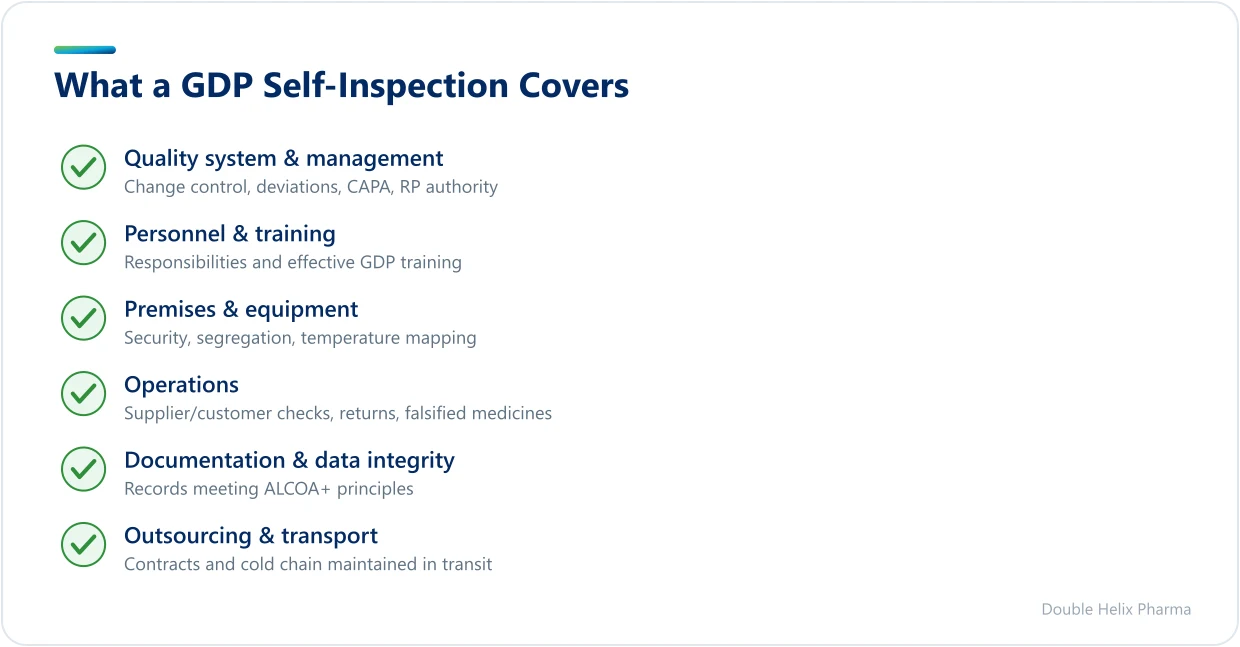
A self-inspection that examines only documentation misses the point. The aim is to confirm that the written system and the lived practice are the same thing. Across the cycle, your inspections should address the full breadth of GDP responsibilities:
- Quality system and management: the quality manual, change control, deviation handling, CAPA effectiveness, risk management and the Responsible Person's authority and availability.
- Personnel and training: defined responsibilities, current job descriptions, and evidence that GDP and role-specific training is delivered and effective.
- Premises and equipment: security, segregation, pest control, and the qualification, calibration and mapping of temperature-controlled areas and monitoring devices.
- Operations: bona fide checks on suppliers and customers, qualification of both, handling of returns, and controls against falsified medicines under the Falsified Medicines Directive framework.
- Documentation and data integrity: records that satisfy ALCOA+ principles — attributable, legible, contemporaneous, original and accurate, plus complete, consistent, enduring and available.
- Complaints, returns, recalls and falsified products: tested procedures, including the ability to execute a recall promptly and reconcile quantities.
- Outsourced activities and transportation: contracts, technical agreements and qualification of third parties such as carriers, with evidence that the cold chain is maintained in transit.
Self-inspection of distribution should never be treated as a lighter exercise than its manufacturing equivalent. The integrity of a product can be destroyed in storage or transit just as easily as on a production line, and our GDP and supply chain services are built around exactly that risk. For broader context on the regulatory framework, the full range of our compliance services sets out how self-inspection connects to audits, licensing and QP/RP support.
Turning findings into genuine improvement
The output of a self-inspection is only as good as what happens next. Findings should be recorded objectively, graded by risk, and channelled into a formal CAPA process with owners and realistic target dates. Critically, the analysis must reach for root cause rather than stopping at the symptom: a temperature excursion is rarely "operator error" and far more often a gap in qualification, packaging or monitoring.
The measure of a self-inspection is not how few findings it raises, but how many real problems it catches before a customer, a patient or a regulator does.
Close the loop with verification. A CAPA is not complete when an action is taken; it is complete when you have evidence the action worked and the issue has not recurred. Trends across successive self-inspections should feed into management review, so that systemic weaknesses — not just isolated faults — are visible to those with the authority to resource a fix. Examples of how this plays out in practice appear in our case studies.
Common pitfalls that undermine the exercise
Three failures recur. The first is the comfortable inspection that confirms what everyone already believes and finds nothing uncomfortable. The second is the report with no teeth, where findings are logged but CAPAs drift and overdue actions accumulate. The third is poor documentation of the self-inspection itself: an inspector who cannot show the plan, the records and the follow-through has, from a regulatory standpoint, not done it at all.
Making your GDP self inspection inspection-ready
A well-run GDP self inspection programme is one of the most cost-effective forms of quality assurance available to a wholesaler or importer: it finds defects while they are cheap to fix and demonstrates to the MHRA that your Responsible Person and quality system are genuinely in control. Treat it as an honest internal audit, resource the resulting CAPAs properly, and feed the trends upward, and an external inspection becomes a confirmation of what you already know rather than a source of surprises.
If you would like an experienced QP or Responsible Person to design your self-inspection programme, train your internal auditors, or perform an independent self-inspection on your behalf, contact our team to discuss how we can help.
Regulatory sources
This guidance reflects current UK and EU GMP/GDP requirements. Primary references:
- EMA — GMP/GDP Questions & Answers
- MHRA Inspectorate Blog
- MHRA — UK Medicines & Healthcare products Regulatory Agency
Always confirm against the latest published version of each source.
Frequently asked questions
How often should a GDP self-inspection be carried out?+
EU and UK GDP expect self-inspections to be conducted on a planned basis covering the whole quality system, and for most wholesalers an annual cycle is the practical baseline. Frequency should be risk-based, so cold-chain operations, newly licensed activities or areas with recent excursions or recalls warrant more frequent attention. The schedule should be defined in a procedure and supplemented by for-cause or unannounced inspections where intelligence suggests a problem.
Who can perform a GDP self-inspection?+
Self-inspections should be carried out by competent, trained persons who are objective about the area under review, and the cardinal rule is that an auditor must not assess work for which they are personally responsible. You can use staff from another function, peer auditors from a sister site, or an external GDP specialist. Whoever performs it must understand both GDP and your specific processes well enough to test them rather than simply confirm them.
What is the difference between a GDP self-inspection and an MHRA inspection?+
A GDP self-inspection is internal: your own organisation examines its distribution operation against GDP and feeds findings into CAPA and management review. An MHRA inspection is external and determines whether your site retains its Wholesale Dealer's Authorisation. A strong self-inspection programme is precisely what makes an MHRA inspection a confirmation of control rather than a source of unwelcome surprises.